

Everyone’s talking about how the job market will be almost unrecognizable by 2025. We keep hearing that technology is going to wipe out jobs or that robots are taking over, and it sounds a bit overwhelming. But this isn’t just hype. The real shock is that studies show 85 percent of the jobs that will exist in 2030 haven’t even been invented yet, so the key skills you need are nothing like the ones your parents relied on.
Table of Contents
- Emerging Trends Shaping Future Job Skills
- Essential Technical And Digital Skills For 2025
- Key Soft Skills For Career Growth
- Building Future Skills: Strategies For All Audiences
Quick Summary
| Takeaway | Explanation |
|---|---|
| Embrace continuous learning and adaptability | Developing a growth mindset is essential as careers evolve. This involves updating skills and remaining open to new technologies and practices. |
| Cultivate both technical and soft skills | Professionals must balance technical competencies with interpersonal abilities for success. Skills like emotional intelligence and communication are crucial. |
| Focus on cybersecurity and data protection | Understanding cybersecurity risks and data protection is essential for all professionals, not just IT specialists. This knowledge enhances organizational security. |
| Develop global and cross-cultural competence | Navigating diverse work environments and understanding cultural dynamics will be key. These skills promote effective teamwork in global markets. |
| Leverage personalized learning pathways | Tailoring skill development to personal strengths and goals maximizes effectiveness. Customized learning plans help fill gaps in knowledge and expertise. |
Emerging Trends Shaping Future Job Skills
The professional world is undergoing a dramatic transformation, driven by technological advancements, global economic shifts, and changing workforce dynamics. Understanding these emerging trends is crucial for professionals seeking to remain competitive and adaptable in the rapidly evolving job market of 2025.
Technology and Skill Convergence
Digital technologies are fundamentally reshaping how we work, creating unprecedented opportunities and challenges. Research from the National Association of Colleges and Employers highlights that employers are increasingly prioritizing career readiness competencies that blend technological proficiency with human-centric skills.
The convergence of technology and human skills means professionals must develop a unique blend of technical knowledge and soft skills. Artificial intelligence, machine learning, and automation are not replacing human workers but transforming their roles. Workers who can effectively collaborate with intelligent systems, interpret complex data, and provide strategic insights will be most valuable.
Adaptability and Continuous Learning
The concept of a static career path is becoming obsolete. Modern professionals must embrace continuous learning and radical adaptability. According to Future of Work research, the most successful individuals will be those who can quickly learn, unlearn, and relearn skills as technological and market landscapes shift.
This requires developing a growth mindset that views challenges as opportunities for development. Professionals need to become agile learners, constantly updating their skill sets, exploring emerging technologies, and remaining curious about industry transformations. Check out our guide on workforce skills for 2025 to understand how to cultivate this adaptive approach.
Global and Cross Cultural Competence
In an increasingly interconnected world, cross cultural competence has become a critical skill. Professionals who can navigate diverse work environments, communicate effectively across cultural boundaries, and understand global business dynamics will have significant competitive advantages.
This trend goes beyond language skills. It encompasses emotional intelligence, cultural sensitivity, and the ability to collaborate in multinational, remote teams. Understanding different perspectives, adapting communication styles, and building inclusive work environments are now essential competencies for future job success.
The job market of 2025 demands more than traditional technical skills. It requires a holistic approach to professional development that integrates technological proficiency, adaptive learning, and global awareness. By recognizing and proactively responding to these emerging trends, professionals can position themselves for meaningful and sustainable career growth.
To help readers scan and compare the major trends driving the need for new skills, the table below summarizes the main emerging trends and their core characteristics described in this section.
| Trend | Core Characteristic |
|---|---|
| Technology & Skill Convergence | Integrating tech proficiency (e.g., AI, data analysis) with human-centric abilities like collaboration & insight |
| Adaptability & Continuous Learning | Moving from static career paths to ongoing learning, agility, and growth mindsets |
| Global & Cross-Cultural Competence | Navigating diverse environments with cultural sensitivity, inclusion, and strong global communication skills |
Essential Technical and Digital Skills for 2025
The digital revolution is transforming the professional landscape, making technical and digital skills critical for success in 2025. Professionals across industries must develop a robust digital skill set that goes beyond basic computer literacy to embrace complex technological competencies.
Foundational Digital Literacy and Advanced Technical Skills
Research from the National Center for Education Statistics emphasizes the critical importance of comprehensive digital skills in the modern workforce. These skills are no longer optional but fundamental to professional effectiveness. Professionals must master a range of technical competencies, from basic digital tools to advanced technological platforms.
Key technical skills include programming languages like Python and JavaScript, cloud computing technologies, data analysis using tools such as SQL and R, and cybersecurity fundamentals. Understanding artificial intelligence and machine learning principles has become equally important. Professionals who can interpret complex digital systems, develop innovative technological solutions, and adapt to rapidly changing digital environments will be highly sought after.
Cybersecurity and Data Protection Expertise
As digital threats become more sophisticated, cybersecurity skills have transformed from specialized technical roles to essential competencies for all professionals. The National Academies of Sciences report highlights the critical need for robust ICT infrastructure and digital skill development, particularly in cybersecurity and systems management.
Professionals must understand principles of data protection, risk management, network security, and ethical digital practices. This includes knowledge of encryption technologies, understanding potential security vulnerabilities, and implementing best practices for digital safety. Learn more about developing essential workforce skills to stay ahead in this critical area.
Emerging Technologies and Adaptive Digital Competence
Beyond current technological skills, professionals must develop an adaptive approach to digital competence. This means cultivating a mindset of continuous learning and flexibility with emerging technologies. Skills in blockchain, Internet of Things (IoT), augmented and virtual reality, and quantum computing are becoming increasingly valuable.
The ability to quickly understand and integrate new technological tools is more important than mastering any single platform. Professionals should focus on developing transferable digital skills that allow them to pivot and learn new technologies rapidly. This includes strong problem-solving abilities, digital creativity, and the capacity to think critically about technological solutions.
As we approach 2025, technical and digital skills will be the cornerstone of professional success. Individuals who invest in comprehensive digital literacy, stay curious about technological advancements, and maintain a flexible learning approach will be best positioned to thrive in an increasingly digital workplace.
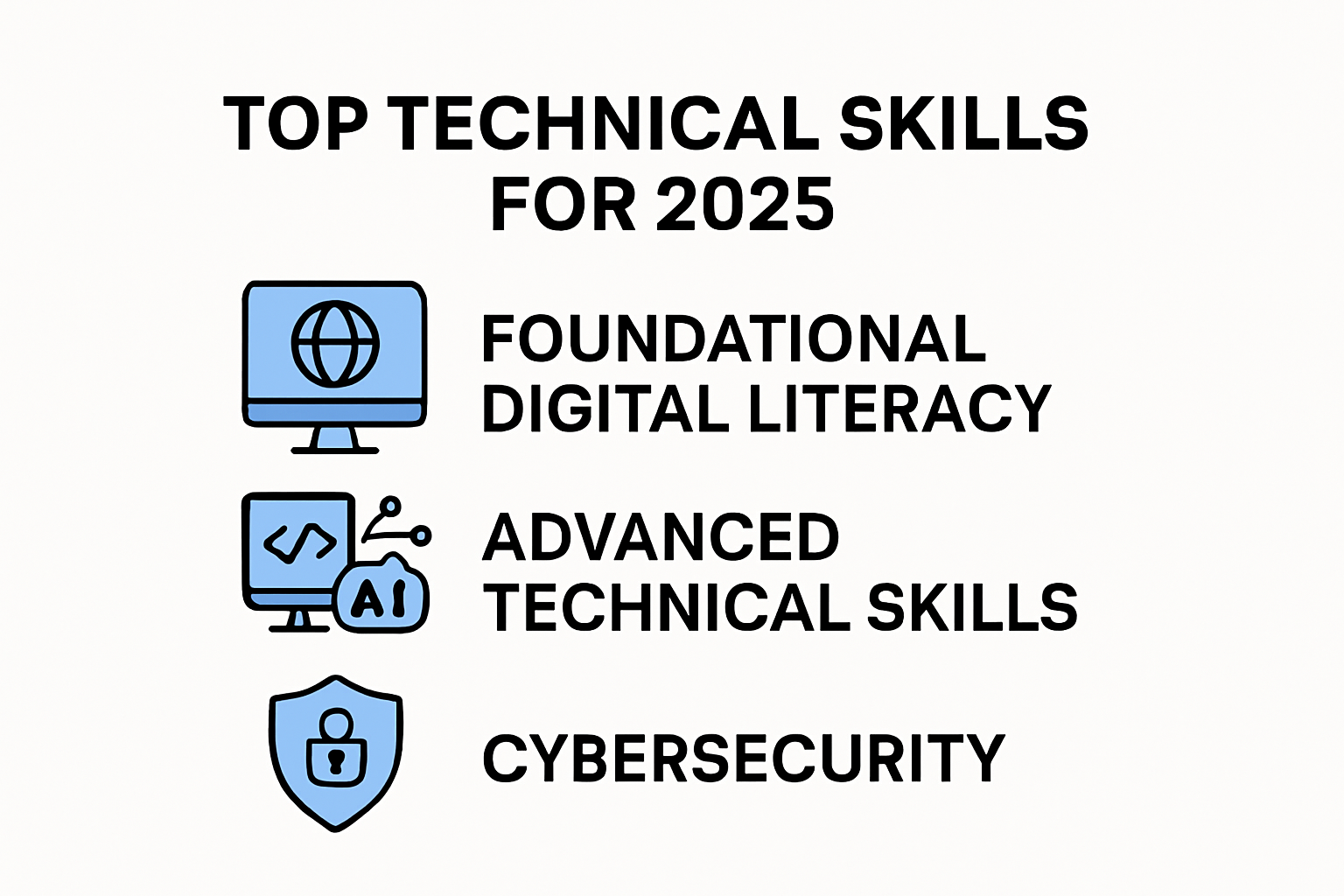
The following table organizes the essential technical and digital skill categories for 2025 along with examples highlighted in the content.
| Skill Category | Examples |
|---|---|
| Programming Languages | Python, JavaScript |
| Cloud Computing | Cloud technologies |
| Data Analysis | SQL, R |
| Cybersecurity | Encryption, risk management, network security |
| AI & Machine Learning | Principles and interpretation |
| Emerging Tech | Blockchain, IoT, AR/VR, quantum computing |
Key Soft Skills for Career Growth
In the dynamic professional landscape of 2025, technical expertise alone is insufficient for career advancement. Soft skills have emerged as critical differentiators that determine an individual’s ability to succeed, collaborate, and lead in complex work environments.
Emotional Intelligence and Interpersonal Dynamics
Research from the National Association of Colleges and Employers consistently highlights emotional intelligence as a fundamental skill for professional success. This goes beyond basic communication, encompassing the ability to understand, manage, and effectively navigate complex human interactions.
Emotional intelligence involves self-awareness, empathy, and adaptive communication. Professionals who can read social cues, manage personal emotions under pressure, and build meaningful workplace relationships will be significantly more valuable. This skill enables effective conflict resolution, team collaboration, and leadership potential. Understanding nuanced communication, recognizing colleagues’ emotional states, and responding constructively are now considered essential professional competencies.
Strategic Communication and Collaboration
Communication has transformed from a linear skill to a multidimensional competency. Modern professionals must excel in diverse communication platforms, from digital collaboration tools to cross-cultural interactions. This requires the ability to articulate complex ideas clearly, listen actively, and adapt communication styles to different audiences and contexts.
Collaboration skills have become equally critical, especially in increasingly remote and distributed work environments. Professionals must demonstrate the capacity to work effectively in diverse teams, bridge communication gaps, and contribute constructively to collective goals. Learn strategies for developing professional collaboration skills to enhance your workplace effectiveness.
Adaptive Problem Solving and Critical Thinking
In an era of rapid technological and economic change, adaptive problem solving has become a crucial soft skill. This involves more than finding solutions it requires the ability to approach challenges creatively, think critically, and develop innovative strategies in unpredictable scenarios.
Critical thinking now demands a holistic approach that integrates analytical reasoning, creative imagination, and strategic foresight. Professionals who can deconstruct complex problems, identify underlying patterns, and generate nuanced solutions will be highly prized. This skill transcends traditional linear problem solving, emphasizing flexibility, continuous learning, and the capacity to reframe challenges as opportunities for growth.
The professional landscape of 2025 demands a holistic skill set that balances technical proficiency with sophisticated interpersonal capabilities. Soft skills are no longer supplementary they are fundamental to career growth, leadership potential, and organizational success. By intentionally developing emotional intelligence, communication prowess, and adaptive problem solving, professionals can position themselves for meaningful and sustainable career advancement.
Building Future Skills: Strategies for All Audiences
Developing future skills is no longer a luxury but a necessity for professionals across all career stages, industries, and backgrounds. The rapidly changing global workforce demands proactive and strategic approaches to skill development that are accessible, flexible, and tailored to individual needs.
Personalized Learning Pathways
Individuals must move beyond traditional one-size-fits-all training models and embrace personalized learning strategies. This requires a deep understanding of personal strengths, potential skill gaps, and career aspirations. Research from McKinsey emphasizes that successful skill development now hinges on creating customized learning experiences that align with individual career trajectories.
Personalized learning pathways involve comprehensive self-assessment, strategic skill targeting, and continuous adaptation. Professionals should conduct regular skills audits, identify emerging competencies relevant to their industry, and design targeted learning plans. This might include online courses, micro-credentials, specialized workshops, or cross-functional project experiences that provide practical skill development opportunities.
Leveraging Technology and Online Learning Platforms
Digital learning platforms have revolutionized skill acquisition, making education more accessible and flexible than ever before. Coursera’s Global Skills Report demonstrates how online learning environments enable professionals to acquire cutting-edge skills from global experts without geographical limitations.
Technology-enabled learning offers multiple advantages: self-paced learning, diverse course offerings, interactive content, and immediate skill application. Professionals can now access high-quality educational resources from top universities and industry leaders, often at a fraction of traditional education costs. Explore our comprehensive guide to workforce development strategies to understand how to maximize these technological learning opportunities.
Collaborative and Organizational Skill Development
Effective skill building extends beyond individual efforts and requires robust organizational and community support. Companies, educational institutions, and professional networks must create collaborative environments that facilitate continuous learning and skill exchange.
This collaborative approach includes mentorship programs, cross-departmental training initiatives, peer learning networks, and structured knowledge-sharing platforms. Organizations that invest in comprehensive skill development strategies not only enhance individual employee capabilities but also build organizational resilience and innovation potential.
Building future skills is a dynamic, multifaceted journey that demands proactive engagement, technological savvy, and a commitment to continuous learning. By embracing personalized learning strategies, leveraging digital platforms, and participating in collaborative skill development ecosystems, professionals can successfully navigate the complex and evolving landscape of work in 2025 and beyond.

Frequently Asked Questions
What are the essential technical skills needed for jobs in 2025?
Professionals will need foundational digital literacy, advanced technical skills such as programming languages like Python and JavaScript, cloud computing knowledge, and competencies in cybersecurity, data analysis, and emerging technologies like AI and IoT.
Why is emotional intelligence important for career growth?
Emotional intelligence is crucial because it enhances interpersonal dynamics, allowing professionals to understand and manage emotions effectively, leading to better teamwork, conflict resolution, and overall workplace relationships.
How can I develop adaptability and continuous learning skills?
To develop adaptability and continuous learning, individuals should embrace a growth mindset, engage in ongoing education through online platforms, and continuously update their skills to keep pace with evolving technologies and market demands.
What strategies can I use to create a personalized learning pathway for my career?
Creating a personalized learning pathway involves assessing your current skills, identifying gaps, and setting clear career goals. Utilize online courses, micro-credentials, and hands-on experiences to tailor your learning to your specific career aspirations.
Unlock Future-Ready Skills and Career Growth with Peuneo
Are you worried about keeping up in a job market where technology and new skills move faster than ever? The article highlighted how continuous learning, digital expertise, and adaptability are now critical for success. Many professionals feel anxious about falling behind or not knowing how to bridge the gap between traditional knowledge and what tomorrow’s employers expect.

At Peuneo, we turn these challenges into real opportunities. Our accredited training and online learning portal cover the key skills listed in the article, including digital literacy, cybersecurity, and adaptive learning strategies. We design programs that fit the latest industry demands and support South Africa’s transformation goals. Visit our online courses page to enroll in targeted programs that help you stay ahead. Take the next step today because your future success depends on what you learn now.