
Career skills for 2025 are changing faster than ever, and what mattered last year might not even be on next year’s checklist. Here’s something wild. By 2025, 50 percent of employees will need reskilling because of technological advancements. Most people assume learning a few new tools will cover it. The truth is, standing out in the future job market means mastering a brand new mix of tech savvy, creative thinking, and emotional smarts that catch companies off guard.
Table of Contents
- Key Essential Workforce Skills For 2025
- Aligning Skills With Organizational Goals
- Developing And Measuring Workforce Skills Effectively
- Future-Proofing Skills In A Changing Job Market
Quick Summary
| Takeaway | Explanation |
|---|---|
| Develop Analytical and Critical Thinking Skills | Cultivate the ability to break down complex problems, recognize patterns, and develop creative solutions, as these skills are crucial for decision-making across industries by 2025. |
| Enhance Technological Literacy and Adaptability | Embrace emerging technologies and maintain proficiency in digital tools, while viewing technological change as an opportunity for growth, essential for success in the future workforce. |
| Focus on Emotional Intelligence and Collaboration | Strengthen interpersonal skills, including self-awareness and empathetic communication, as emotional intelligence will be a key differentiator in high-performing teams by 2025. |
| Implement Strategic Workforce Planning | Engage in comprehensive skill gap analysis and develop targeted upskilling programs to align workforce capabilities with future organizational needs, ensuring competitiveness. |
| Adopt Adaptive Learning and Continuous Skill Development | Foster a growth mindset and create personal learning roadmaps to remain relevant in the evolving job market, as 50% of employees will require reskilling by 2025 due to technological advancements. |
Key Essential Workforce Skills for 2025
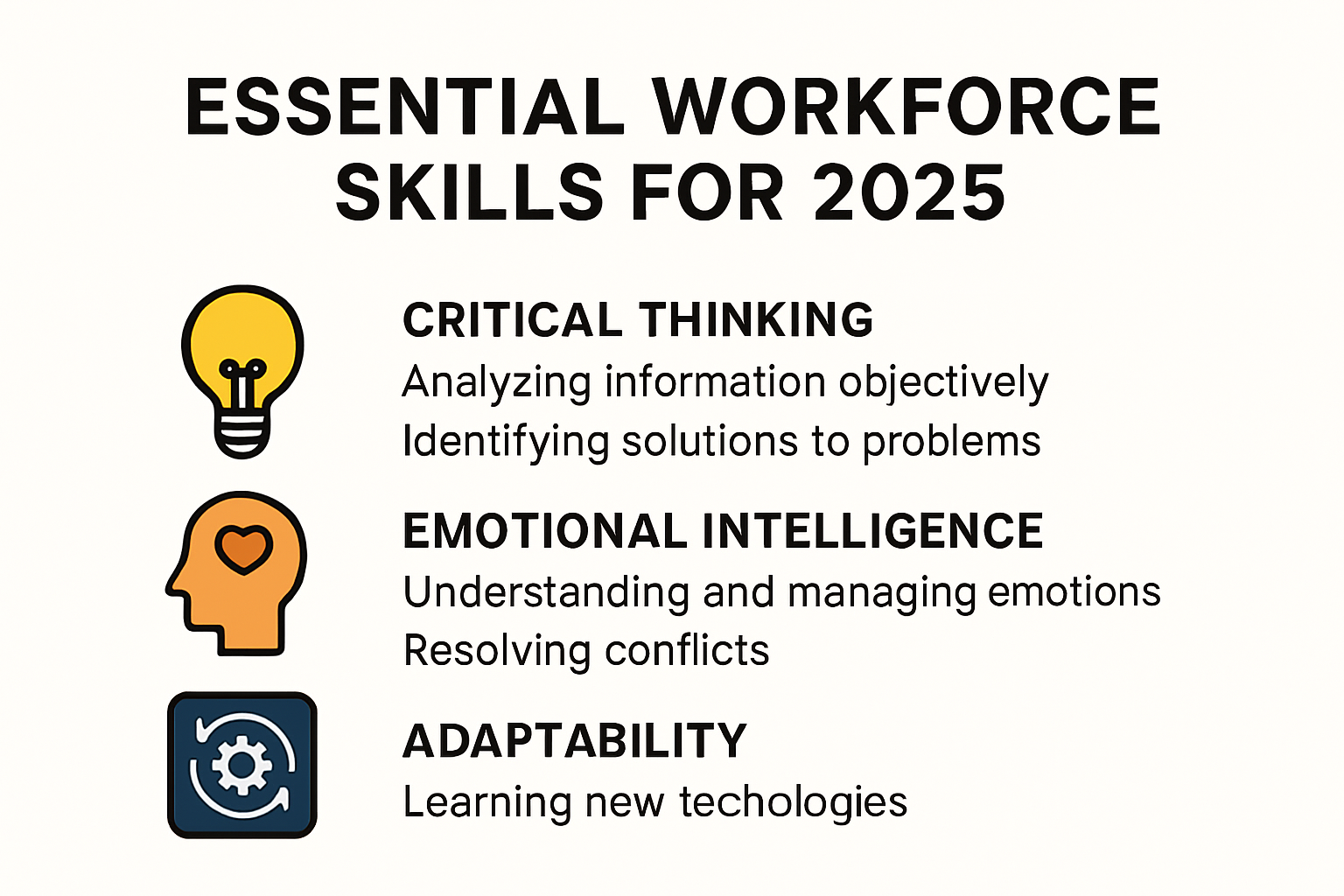
The professional world is transforming rapidly, demanding a new set of skills that go beyond traditional qualifications. By 2025, workers must develop a dynamic skill set that combines technological proficiency, emotional intelligence, and adaptive thinking.
Analytical and Critical Thinking Skills
Analytical and critical thinking have become paramount in the modern workforce. Research from the World Economic Forum highlights that these cognitive skills will be crucial for problem solving and decision making across industries. Professionals who can break down complex problems, evaluate information objectively, and generate innovative solutions will be highly sought after.
This skill involves more than just processing data. It requires the ability to:
- Recognize patterns in seemingly unrelated information
- Challenge assumptions systematically
- Develop creative problem solving approaches
Organizations are increasingly valuing workers who can think beyond traditional boundaries and provide nuanced insights that drive strategic initiatives. Check out our guide on workforce development strategies to understand how to cultivate these skills.

Technological Literacy and Adaptability
Technological literacy is no longer optional but essential. According to the National Association of Colleges & Employers’ Job Outlook 2025 survey, workers must demonstrate proficiency in emerging technologies while remaining adaptable to continuous technological changes.
Key technological competencies include:
- Digital tool proficiency across various platforms
- Understanding of artificial intelligence and machine learning basics
- Capability to quickly learn and integrate new technological systems
The most successful professionals will be those who view technological change not as a threat but as an opportunity for growth and innovation. They will continuously update their skills, remaining curious and open to learning.
Emotional Intelligence and Collaborative Skills
Beyond technical skills, emotional intelligence emerges as a critical workforce competency. Professionals who can navigate complex interpersonal dynamics, communicate effectively, and work collaboratively will distinguish themselves in the 2025 job market.
Emotional intelligence encompasses:
- Self awareness and emotional regulation
- Empathetic communication
- Conflict resolution and team building
The ability to understand and manage personal emotions while effectively interacting with diverse teams will be a significant differentiator in professional success. Organizations are recognizing that technical skills alone are insufficient for creating high performing teams.
By developing these essential workforce skills strategic approach, professionals can position themselves for success in an increasingly complex and dynamic work environment. The key is continuous learning, adaptability, and a proactive approach to personal and professional development.
To help visualize and compare the core essential workforce skills for 2025, the following table summarizes their key focus areas and related competencies.
| Skill Category | Core Focus | Key Competencies |
|---|---|---|
| Analytical & Critical Thinking | Problem Solving & Decision Making | Pattern recognition, challenging assumptions, creative solutions |
| Technological Literacy & Adaptability | Mastery of New Technologies | Digital tool proficiency, AI basics, learning new systems |
| Emotional Intelligence & Collaboration | Relationship Management & Teamwork | Self-awareness, empathetic communication, conflict resolution |
Aligning Skills with Organizational Goals
Successful organizations recognize that strategic skill alignment is no longer optional but a critical survival strategy in a rapidly evolving professional landscape. The ability to match individual capabilities with organizational objectives creates a powerful synergy that drives innovation and competitive advantage.
Strategic Workforce Planning
Workforce planning has transformed from a traditional human resources function to a dynamic strategic process. Research from the OECD’s “Trends Shaping Education 2025” emphasizes that organizations must proactively design skill development frameworks that anticipate future challenges and opportunities.
Effective strategic workforce planning involves:
- Conducting comprehensive skills gap analysis
- Mapping current workforce capabilities against future organizational needs
- Developing targeted upskilling and reskilling programs
Learn more about running effective skills audits to understand how organizations can systematically identify and address skill misalignments.
Technology Integration and Skill Development
Technological advancement demands continuous skill realignment. According to the World Economic Forum’s 2025 report, 85% of employers plan strategic upskilling initiatives to ensure their workforce remains competitive and adaptable.
Key considerations for technology driven skill alignment include:
- Identifying emerging technological trends relevant to the organization
- Creating flexible learning pathways
- Investing in adaptive training technologies
Successful organizations view technological integration not as a disruption but as an opportunity for workforce transformation and enhanced productivity.
Personalized Learning and Development
Modern skill alignment strategies prioritize personalized learning experiences that recognize individual potential while serving organizational objectives. This approach moves beyond traditional one size fits all training models.
Personalized development strategies should focus on:
- Individual skill assessments
- Customized learning trajectories
- Continuous performance feedback mechanisms
Explore our insights on empowering growth through skills development to understand how tailored learning approaches can drive organizational success.
Aligning skills with organizational goals is a dynamic, ongoing process that requires commitment from leadership, continuous learning infrastructure, and a culture of adaptability. Organizations that master this strategic approach will not only survive but thrive in the complex professional ecosystem of 2025 and beyond.
The following table organizes and compares different strategic approaches for aligning workforce skills with organizational objectives.
| Alignment Approach | Key Activities | Outcome/Goal |
|---|---|---|
| Strategic Workforce Planning | Skills gap analysis, capabilities mapping, targeted upskilling | Workforce matches future needs |
| Technology Integration & Skills | Identify trends, flexible learning, invest in training tech | Tech-savvy, adaptable workforce |
| Personalized Learning & Development | Individual assessments, custom learning, continuous feedback | Tailored employee growth and strong alignment |
Developing and Measuring Workforce Skills Effectively
Effective skill development and measurement have become critical strategies for organizations seeking to remain competitive in a rapidly changing professional environment. The approach goes beyond traditional training methods, requiring sophisticated, data driven techniques that align individual growth with organizational objectives.
Comprehensive Skills Assessment Framework
Research from the World Bank highlights that employers increasingly prioritize socio-emotional and higher order cognitive skills over basic technical competencies. This shift demands a nuanced approach to skills assessment that captures the complexity of modern workforce capabilities.
Key components of an effective skills assessment framework include:
- Holistic evaluation techniques
- Multidimensional performance metrics
- Continuous feedback mechanisms
Learn how to conduct targeted skills assessments to understand the intricate process of mapping individual potential against organizational requirements.
Technology Enhanced Learning and Measurement
Technological advancements are transforming how organizations develop and measure workforce skills. According to research published in the National Center for Biotechnology Information, analytical thinking, active learning, and resilience are projected to be the top skills required by 2025.
Emerging technologies enabling skill development and measurement include:
- Artificial intelligence powered learning platforms
- Real time skill tracking systems
- Adaptive learning algorithms
Organizations that leverage these technologies can create personalized learning experiences that dynamically adjust to individual and organizational needs. The key is not just acquiring technology but implementing it strategically to enhance workforce capabilities.
Certification and Skill Validation
Modern skill development extends beyond traditional educational models. Research from ArXiv demonstrates that combining university degrees with targeted industry certifications can dramatically improve employability, with some non technical degrees experiencing up to a 9,296% improvement in alignment with specialized roles.
Effective skill validation strategies should focus on:
- Industry recognized certification programs
- Practical skill demonstration
- Continuous professional development tracking
Explore our comprehensive workforce development strategies to understand how organizations can create robust skill development ecosystems.
Developing and measuring workforce skills is no longer a static process but a dynamic, continuous journey. Organizations must adopt flexible, technology enhanced approaches that recognize the unique potential of each individual while maintaining alignment with strategic organizational goals. The most successful entities will be those that view skill development as an ongoing investment in human potential.
Future-Proofing Skills in a Changing Job Market
The professional landscape is undergoing unprecedented transformation, driven by technological advancements, global economic shifts, and evolving workforce dynamics. Future proofing skills has become a critical strategy for professionals seeking to maintain relevance and competitiveness in an increasingly unpredictable job market.
Adaptive Learning and Continuous Skill Development
Research from the National Center for Biotechnology Information reveals a striking projection: by 2025, 50% of all employees will require reskilling due to technological advancements. This statistic underscores the critical importance of developing an adaptive learning mindset that embraces continuous skill evolution.
Key strategies for adaptive learning include:
- Developing a growth mindset
- Creating personal learning roadmaps
- Embracing cross disciplinary skill acquisition
Explore our comprehensive career development strategies to understand how professionals can systematically approach skill development in a rapidly changing environment.
Technological Resilience and AI Integration
The integration of artificial intelligence is fundamentally reshaping the workforce. According to research from ArXiv, coordinated action from government, industry, and educational institutions is necessary to help workers adapt to accelerating technological change.
Essential components of technological resilience include:
- Understanding AI and automation fundamentals
- Developing skills that complement technological systems
- Maintaining human centric problem solving capabilities
Professionals must view technological change not as a threat but as an opportunity for innovation and personal growth. The most successful individuals will be those who can seamlessly collaborate with technological systems while bringing unique human insights.
Strategic Career Positioning
The World Economic Forum’s Future of Jobs Report highlights that skills gaps will be the most significant barrier to business transformation in the next five years. This emphasizes the need for strategic career positioning that anticipates and prepares for emerging industry trends.
Strategic career positioning involves:
- Monitoring industry transformation trends
- Identifying emerging skill requirements
- Building a versatile professional portfolio
Discover the top skills for career advancement to understand how to strategically develop your professional capabilities.
Future proofing skills is not about predicting exact job roles but about cultivating adaptability, continuous learning, and a proactive approach to professional development. Professionals who embrace this approach will not only survive but thrive in the dynamic job market of 2025 and beyond. The key is to remain curious, flexible, and committed to ongoing personal and professional growth.
Frequently Asked Questions
What are the essential workforce skills needed for success in 2025?
The essential workforce skills for 2025 include analytical and critical thinking skills, technological literacy and adaptability, and emotional intelligence along with collaborative skills. These abilities are crucial for navigating the evolving job market.
Why is technological literacy important for future jobs?
Technological literacy is essential as it enables employees to stay proficient with emerging technologies and adapt to continuous changes in the workplace. This adaptability is increasingly viewed as a key asset among employers.
How can professionals future-proof their skills?
Professionals can future-proof their skills by adopting a growth mindset, engaging in continuous learning, and developing a personalized learning roadmap to stay relevant in the changing job market.
What role does emotional intelligence play in the workplace?
Emotional intelligence is vital as it enhances interpersonal skills, fosters effective communication, and promotes teamwork. It is increasingly recognized as a key differentiator among high-performing teams.
Ready to Master the Essential Workforce Skills for 2025?
Are you feeling the pressure of rapid workplace changes and the urgent need for reskilling? If you recognize that technological literacy, analytical thinking, and emotional intelligence are no longer optional, you are not alone. The article you have just read highlights how 50 percent of employees will need to upskill and adapt to new demands in the very near future. Letting your team fall behind is not an option when success depends on continuous skill development and measurable growth.

Peuneo is here to help you take action right now. Unlock access to accredited training, expert workforce consulting, and tailored learning programs that bridge the gap between where you are and where you need to be. Start future-proofing your career or empower your organization to thrive. Take the next step by exploring Peuneo’s online learning platform and business solutions. Don’t miss your chance to stay ahead—visit Peuneo’s main site and start building the skills that matter for 2025.
Recommended
- Essential Skills for Managers in 2025: Guide for Leaders and Teams – Peuneo
- Top Workforce Development Strategies for 2025: A Practical Guide – Peuneo
- Career Development Strategies: Ultimate 2025 Growth Guide – Peuneo
- Top 20 Skills for Career Advancement in 2025 – Peuneo
- How to Develop Soft Skills for Career Growth in 2025 – Peuneo
- What Is a Skills Gap? Understanding the Workplace Disconnect – Peuneo