

Career success often comes down to more than just skills or experience. Surprisingly, professionals who consistently invest in self-development can see substantial increases in earning potential and enjoy faster career progression. Most people focus only on technical expertise, but it turns out the real driver is something much more personal—your commitment to ongoing growth shapes not just your resume, but your confidence, network, and long-term satisfaction.
Table of Contents
- Benefits Of Self-Development For Career Growth
- How Self-Development Drives Organizational Success
- Key Strategies To Foster Self-Development
- Overcoming Common Barriers To Self-Improvement
Quick Summary
| Takeaway | Explanation |
|---|---|
| Invest in Continuous Skills Development | Regularly updating your skills enhances career growth and satisfaction. Seek targeted learning opportunities to stay competitive in your field. |
| Embrace Lifelong Learning as a Mindset | Self-development is an ongoing journey that fosters confidence and resilience. A growth mindset attracts mentorship and leadership opportunities. |
| Create a Personal Development Plan | Structure your development with clear goals. Self-assess current skills to identify gaps and set specific objectives. |
| Build a Supportive Network | Cultivate relationships with mentors and peers to receive guidance and motivation. Networking enriches your learning and development experience. |
| Identify and Overcome Mental Barriers | Recognize psychological challenges like fear of failure. Use strategies to break down goals into manageable steps and sustain motivation. |
Benefits of Self-Development for Career Growth
Self-development represents a strategic approach to professional growth that goes far beyond traditional career advancement. By proactively investing in personal and professional skills, individuals create powerful opportunities for career transformation and long-term success.
Expanding Professional Capabilities
Professional development is not just about acquiring new skills but fundamentally reshaping your career trajectory. Discover strategies for career advancement that can help you stay competitive in today’s dynamic workplace. According to Harvard University’s Division of Continuing Education, continuous skill enhancement directly correlates with increased job satisfaction and expanded career opportunities.
The process of self-development involves identifying skill gaps, seeking targeted learning experiences, and consistently challenging personal limitations. This approach allows professionals to develop a more robust and adaptable skill set that meets evolving industry demands. By understanding emerging trends and technologies, individuals can position themselves as valuable assets within their organizations.
Career Advancement and Economic Benefits
Self-development creates significant economic advantages for professionals. Research from the University of Virginia’s Darden School of Business highlights that strategic skill development can lead to substantial increases in earning potential. Professionals who consistently invest in their personal growth often experience faster career progression and more diverse job opportunities.
Key economic benefits of self-development include:
To help you compare the key economic benefits of self-development, the following table summarizes the advantages professionals can expect as described in the article.
| Economic Benefit | Description |
|---|---|
| Increased Marketability | Enhanced skills make you more attractive to potential employers |
| Higher Earning Potential | Specialized skills typically command higher compensation |
| Career Flexibility | Diverse skill sets enable easier transitions between roles and industries |
- Increased Marketability: Enhanced skills make you more attractive to potential employers
- Higher Earning Potential: Specialized skills typically command higher compensation
- Career Flexibility: Diverse skill sets enable easier transitions between roles and industries
Psychological and Professional Confidence
Beyond tangible career benefits, self-development profoundly impacts an individual’s psychological landscape. As professionals acquire new competencies, they simultaneously build confidence and resilience. Duke University’s Learning and Organization Development emphasizes that continuous learning creates a positive feedback loop of personal and professional growth.
Professionals who embrace self-development demonstrate a growth mindset that attracts mentorship, leadership opportunities, and respect from colleagues. This proactive approach signals to employers that you are committed to excellence and adaptable in an ever-changing professional environment.
Ultimately, self-development is not a one-time event but a lifelong journey of personal and professional transformation. By consistently investing in your skills, knowledge, and capabilities, you create a powerful foundation for sustained career success and personal fulfillment.
How Self-Development Drives Organizational Success
Self-development is not just an individual pursuit but a critical catalyst for organizational transformation and sustained success. When employees actively engage in personal growth, they create a dynamic ecosystem of continuous improvement that directly impacts an organization’s competitive advantage.
Creating a Culture of Continuous Learning
Explore strategies for organizational growth that leverage individual development. According to the U.S. Office of Personnel Management, aligning employee training with organizational objectives is fundamental to enhancing overall performance. This strategic approach transforms individual skill development into a powerful organizational asset.
Organizations that prioritize self-development create an environment where learning becomes a core cultural value. Employees are encouraged to seek knowledge, challenge existing processes, and contribute innovative solutions. This approach reduces skill stagnation and ensures that the workforce remains adaptable in rapidly changing business landscapes.
Enhancing Organizational Resilience
Research from the National Academies Press demonstrates that developmental assessment centers combined with targeted skill training significantly improve managerial performance. By investing in individual growth, organizations build a robust talent pipeline capable of navigating complex business challenges.
Key benefits of promoting self-development within organizations include:
- Talent Retention: Employees feel valued and are more likely to remain committed
- Innovation Acceleration: Diverse skill sets drive creative problem solving
- Competitive Advantage: A continuously learning workforce stays ahead of industry trends
Transforming Individual Potential into Organizational Strength
The SRI Education report emphasizes that personal success skills like self-directed learning are crucial for building sustainable careers. When organizations support these individual growth journeys, they create a symbiotic relationship where personal development directly translates into organizational capabilities.
Leadership plays a critical role in this transformation. By creating structures that reward learning, providing resources for skill development, and recognizing individual growth, organizations can turn self-development from an individual activity into a strategic organizational tool.
Ultimately, self-development is not just about acquiring new skills but about fostering a mindset of continuous improvement. Organizations that embrace this philosophy position themselves as dynamic, adaptive entities capable of thriving in an increasingly complex and competitive global business environment.
Key Strategies to Foster Self-Development
Self-development requires intentional planning and strategic approaches that transform personal growth from a passive concept into an active, dynamic process. By implementing targeted strategies, professionals can systematically enhance their skills, knowledge, and overall career potential.
Creating a Personalized Development Framework
Learn how to design a comprehensive development plan that aligns with your professional aspirations. According to research from the National Institutes of Health, evidence-based self-development techniques are critical for sustained professional growth.
A robust personal development framework involves several key components. First, conduct a comprehensive self-assessment to identify current skills, potential gaps, and areas for improvement. This introspective process helps professionals create targeted learning objectives that are both challenging and achievable. By establishing clear, measurable goals, individuals can track their progress and maintain motivation throughout their development journey.
Leveraging Diverse Learning Modalities
Modern self-development goes beyond traditional learning methods. Professionals must embrace a multifaceted approach that incorporates various learning channels and experiences. This might include online courses, professional workshops, mentorship programs, industry conferences, and cross-functional project experiences.
Key strategies for diverse learning include:
- Micro-Learning: Engage in short, focused learning modules that fit into busy schedules
- Cross-Disciplinary Exposure: Explore skills and knowledge outside your immediate professional domain
- Reflective Practice: Regularly document and analyze your learning experiences
Building a Supportive Development Ecosystem
Successful self-development rarely occurs in isolation. Creating a supportive network of mentors, peers, and professional connections is crucial for sustained growth. This ecosystem provides critical feedback, diverse perspectives, and ongoing motivation.
Networking strategies should focus on quality interactions rather than mere quantity. Seek out mentors who can provide nuanced guidance, participate in professional communities, and engage in meaningful dialogue with colleagues who challenge and inspire your thinking.

Technology can also play a significant role in self-development. Utilize digital platforms, learning management systems, and professional networking sites to access resources, track progress, and connect with global learning communities.
Ultimately, self-development is a personal commitment to continuous improvement. By adopting a strategic, holistic approach that combines structured learning, diverse experiences, and a supportive network, professionals can transform their potential into tangible career success. The journey of self-development is not about perfection but about consistent, intentional growth.
Overcoming Common Barriers to Self-Improvement
Self-improvement is a challenging journey fraught with psychological and practical obstacles that can derail even the most motivated individuals. Understanding and strategically addressing these barriers is crucial for sustained personal and professional growth.
Identifying Mental Roadblocks
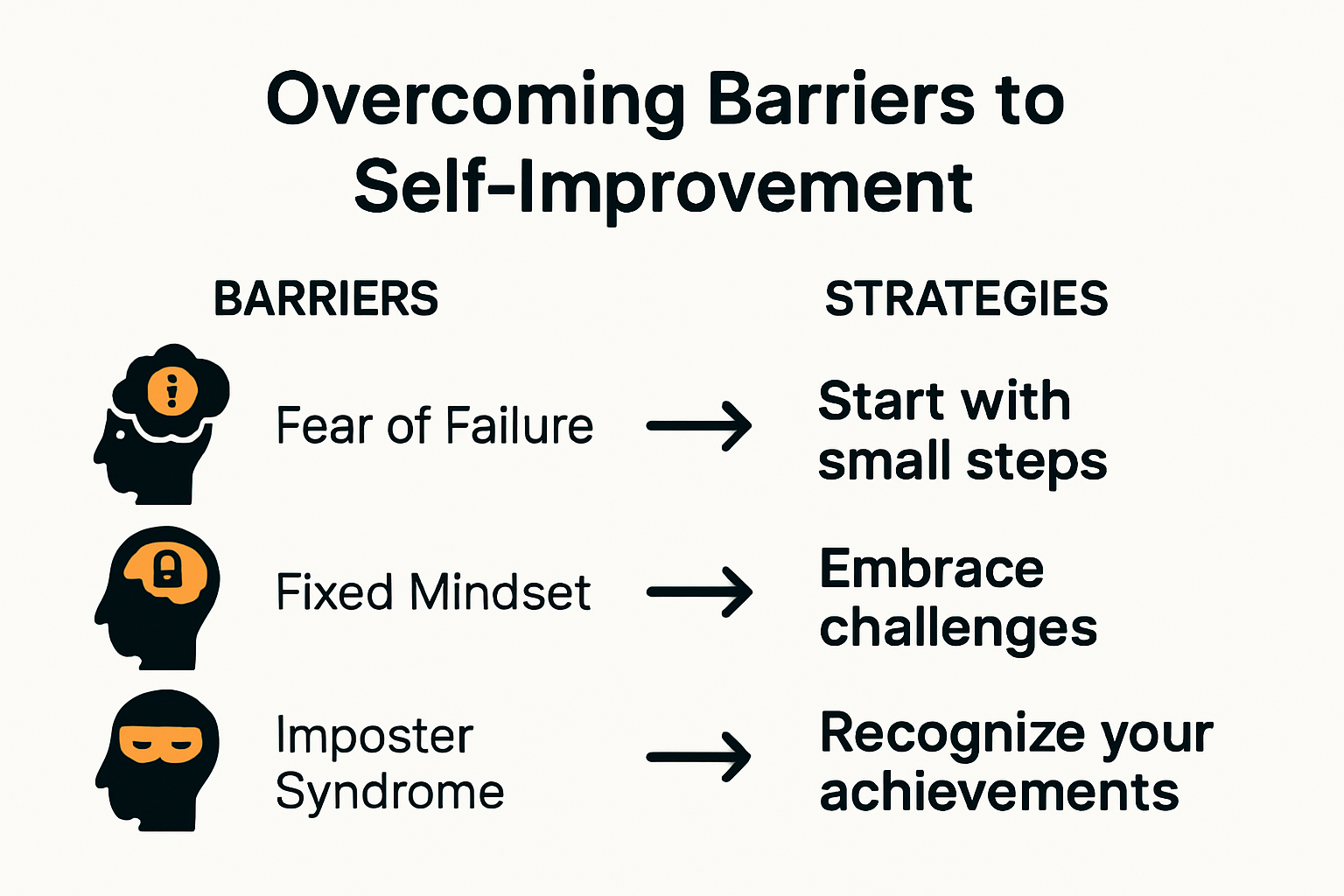
Learn effective strategies for managing personal change that can transform internal resistance. The primary barriers to self-improvement often stem from deep-rooted psychological patterns such as fear of failure, imposter syndrome, and fixed mindset thinking.
Mental barriers typically manifest through self-limiting beliefs that convince individuals they are incapable of growth or change. These internal narratives create psychological resistance that prevents meaningful progress. Recognizing these thought patterns is the first critical step in overcoming them. Professionals must develop metacognitive skills that allow them to observe and challenge their own thought processes, separating objective reality from subjective perception.
Practical Strategies for Overcoming Resistance
Effective self-improvement requires a multifaceted approach that addresses both psychological and practical challenges. Breaking down large goals into smaller, manageable steps can help mitigate feelings of overwhelm and create momentum. Implementing structured accountability mechanisms and creating clear, measurable objectives provides a framework for consistent progress.
Key practical strategies include:
For a quick reference, the following table organizes major practical strategies for overcoming resistance to self-improvement as described above.
| Strategy | Purpose |
|---|---|
| Incremental Goal Setting | Create bite-sized objectives that build confidence |
| Performance Tracking | Use measurable metrics to monitor progress |
| Adaptive Learning | Embrace failure as a developmental opportunity |
- Incremental Goal Setting: Create bite-sized objectives that build confidence
- Performance Tracking: Use measurable metrics to monitor progress
- Adaptive Learning: Embrace failure as a developmental opportunity
Building Resilience and Sustainable Motivation
Sustained self-improvement demands more than initial enthusiasm. Developing psychological resilience involves cultivating a growth mindset that views challenges as opportunities for learning and development. This approach transforms potential obstacles into constructive experiences that contribute to personal evolution.
Motivational sustainability requires creating supportive environments and establishing robust personal support systems. This might involve seeking mentorship, participating in peer learning groups, or engaging with professional development communities that provide ongoing encouragement and constructive feedback.
Technology and digital platforms can also play a significant role in overcoming self-improvement barriers. Utilizing productivity apps, online learning platforms, and virtual coaching resources can provide structured guidance and continuous learning opportunities.
Ultimately, overcoming barriers to self-improvement is a dynamic, ongoing process. It requires consistent self-reflection, willingness to embrace discomfort, and a commitment to personal growth. By developing sophisticated strategies that address both psychological and practical challenges, individuals can transform potential limitations into powerful opportunities for transformation and success.
Frequently Asked Questions
What are the benefits of self-development for career growth?
Self-development leads to increased marketability, higher earning potential, and greater career flexibility by enhancing your skills and adapting to industry demands.
How can self-development impact organizational success?
When employees engage in self-development, it fosters a culture of continuous learning, enhances organizational resilience, and transforms individual potential into collective organizational strength.
What strategies can I use to foster self-development?
Creating a personalized development framework, leveraging diverse learning modalities, and building a supportive network are key strategies to promote self-development.
How can I overcome barriers to self-improvement?
Identifying mental roadblocks, breaking down large goals into manageable tasks, and developing psychological resilience can help overcome obstacles to self-improvement.
Empower Your Potential with Proven Self-Development Solutions
Are you ready to bridge the gap between personal growth and real career success? The article highlighted how ongoing self-development can help you overcome skill gaps, boost your confidence, and gain a competitive edge in your profession. Many professionals know that investing in themselves is key, but struggle to find structured programs and support that align with their goals and the fast pace of modern careers. If you have ever felt stuck, uncertain about your next step, or unsure where to find accredited and results-driven skill-building options, you are not alone.

Peuneo is here to guide your journey with accredited training, expert consulting, and a powerful online learning portal designed specifically for professionals like you. Whether you want to create a personalized development plan, stay compliant with industry standards, or join business leaders in transforming your potential, now is the time to act. Start advancing your career and building your future today by exploring the Peuneo website. Enroll in specialized programs or connect with our team for customized solutions that support your path to success.