

Change management often gets tagged as a buzzword in business circles. Yet over 70 percent of major change initiatives actually fail to reach their intended goals. That sounds bleak, right? The real surprise is that success depends less on complex strategies and more on a few honest principles almost anyone can learn to apply.
Table of Contents
- Core Principles Of Change Management
- Implementing Principles In Real-World Scenarios
- Overcoming Resistance And Driving Engagement
- Measuring Success And Continuous Improvement
Quick Summary
| Takeaway | Explanation |
|---|---|
| Create a Clear Vision | Articulating a compelling vision motivates employees and aligns their roles with transformation goals. |
| Engage Stakeholders Early | Involving stakeholders from the initial planning stages fosters commitment and reduces resistance to change. |
| Implement with Flexibility | Use structured plans that allow for real-time adjustments and incorporate continuous evaluation to drive success. |
| Address Resistance Proactively | Understanding and addressing employee concerns through transparent communication can convert resistance into momentum. |
| Measure Success Continuously | Establish comprehensive metrics and employ advanced analytics to assess and refine change management initiatives effectively. |
Core Principles of Change Management
Change management represents a strategic approach that transforms organizational dynamics by guiding teams through complex transitions. Understanding the core principles is crucial for leaders seeking to implement successful change initiatives that drive sustainable performance and growth.
Creating a Compelling Vision for Transformation
At the heart of effective change management lies the ability to articulate a clear and compelling vision. Learn more about organizational transformation strategies that can help leaders develop meaningful change narratives. According to research from the National Center for Biotechnology Information, establishing a well-defined vision provides critical direction and motivation for employees during periods of organizational transition.
A powerful vision does more than outline objectives. It communicates the purpose behind the change, connects individual roles to broader organizational goals, and helps employees understand their unique contribution to the transformation process. Leaders must craft narratives that resonate emotionally and intellectually, addressing both the rational and psychological aspects of organizational change.
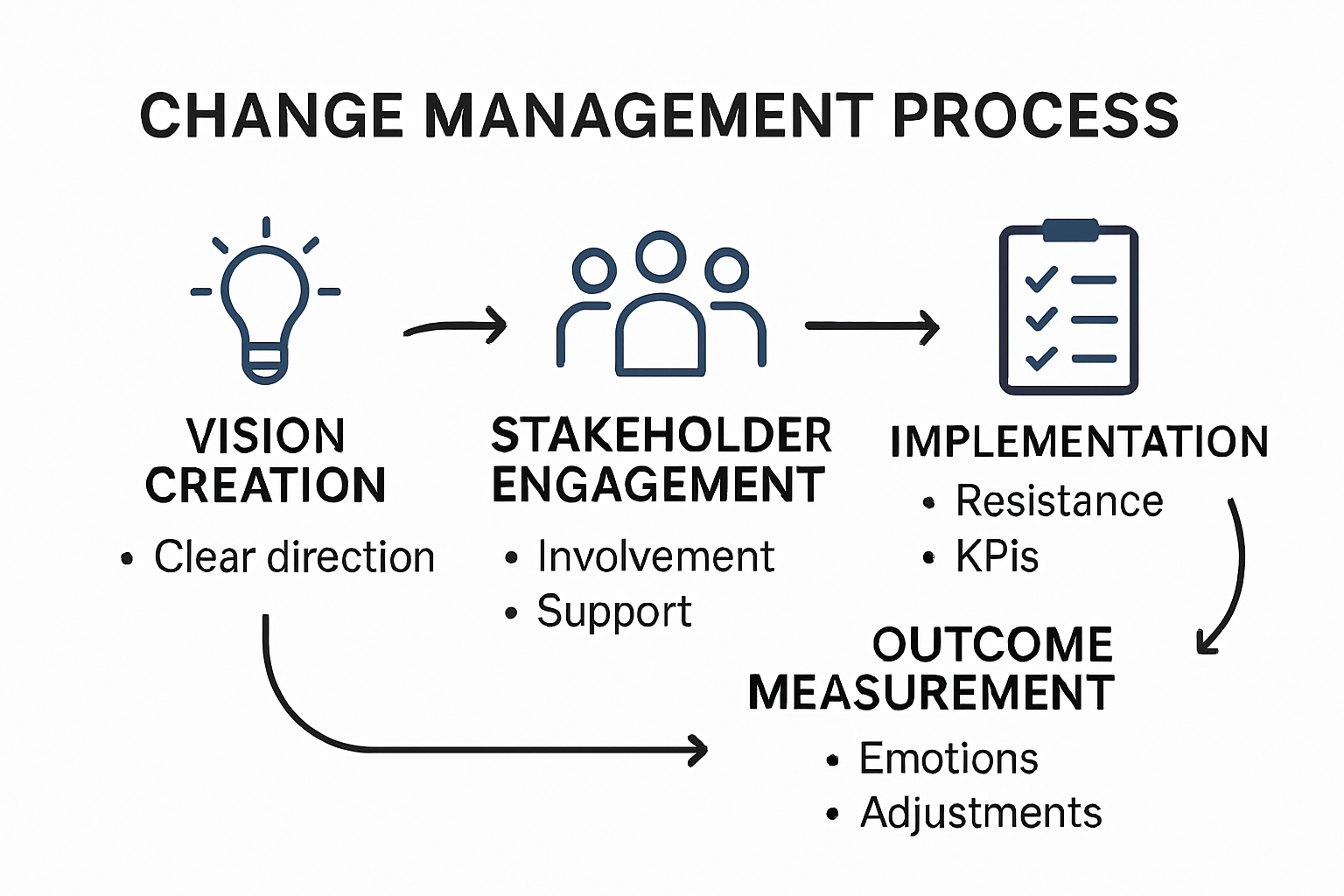
Stakeholder Engagement and Communication
Successful change management hinges on comprehensive stakeholder engagement and transparent communication. This principle recognizes that change is fundamentally a human process requiring active participation and commitment from all organizational levels.
Effective communication strategies involve:
- Early Involvement: Engaging stakeholders from the initial planning stages
- Transparent Dialogue: Creating open channels for feedback and discussion
- Consistent Messaging: Maintaining clear and consistent communication throughout the change process
By prioritizing stakeholder perspectives and maintaining regular communication, organizations can mitigate resistance, build trust, and create a collaborative environment conducive to successful transformation.
Structured Implementation and Continuous Evaluation
Change management is not a linear process but a dynamic journey requiring structured implementation and ongoing assessment. Organizations must develop robust frameworks that allow for flexibility while maintaining strategic focus.
Key components of a structured implementation approach include:
To help clarify the implementation process for successful change management, here’s a summary table outlining key components involved in structured implementation and continuous evaluation.
| Component | Description |
|---|---|
| Change Management Plans | Develop comprehensive plans to guide the transition |
| Barrier Identification | Anticipate and address obstacles proactively |
| Milestones & Performance Indicators | Set measurable markers to track progress |
| Real-time Feedback Mechanisms | Establish systems for ongoing input and adaptive responses |
- Developing comprehensive change management plans
- Identifying potential barriers and proactively designing mitigation strategies
- Creating measurable milestones and performance indicators
- Establishing mechanisms for real-time feedback and adaptive response
Continuous evaluation enables organizations to track progress, make data-driven adjustments, and ensure that change initiatives remain aligned with overarching strategic objectives. This iterative approach transforms change from a one-time event into a sustainable organizational capability.
Implementing Principles in Real-World Scenarios
Transitioning from theoretical change management principles to practical application requires strategic planning, adaptability, and a nuanced understanding of organizational dynamics. Real-world implementation demands more than conceptual knowledge technical execution skills that can navigate complex workplace environments.
Bridging Theory and Practice
Explore practical project management techniques that support effective change implementation. According to research from the National Institutes of Health, successful real-world change management hinges on creating visible leadership commitment and establishing dedicated project teams.
Organizations must develop robust implementation frameworks that translate abstract change management principles into concrete actions. This involves breaking down comprehensive strategies into measurable, actionable steps that employees can understand and execute. Practical implementation requires identifying specific organizational goals, mapping current processes, and designing targeted interventions that align with existing workplace cultures.
Overcoming Resistance and Building Momentum
Practical change management demands proactive strategies for addressing potential resistance. Employees often perceive organizational changes as threats to their established routines and professional security. Effective implementation requires a multifaceted approach that combines empathy, communication, and strategic engagement.
Key strategies for managing resistance include:
The following table summarizes key strategies for overcoming resistance by addressing both the psychological and practical aspects discussed in the article.
| Strategy | Purpose |
|---|---|
| Transparent Communication | Address employee concerns and clarify the reason for change |
| Personal Impact Mapping | Help individuals see professional benefits of the change |
| Incremental Implementation | Ease transitions by phasing in changes gradually |
| Skill Development | Provide resources and training for successful adaptation |
| Active Listening | Understand underlying concerns for personalized management |
| Recognition & Rewards | Reinforce positive adaptive behaviors |
- Transparent Communication: Clearly explaining the rationale behind changes
- Personal Impact Mapping: Helping individuals understand how changes benefit their professional development
- Incremental Implementation: Introducing changes gradually to reduce psychological barriers
- Skill Development: Providing training and resources to support transition
By anticipating and addressing potential resistance points, organizations can transform potential obstacles into opportunities for collaborative growth and organizational development.
Continuous Learning and Adaptive Implementation
Successful change management is not a linear process but a dynamic, iterative journey. Organizations must create flexible frameworks that allow for continuous learning, real-time adjustments, and responsive strategy modifications.
Effective adaptive implementation involves:
- Regular performance assessments
- Gathering comprehensive feedback from all organizational levels
- Creating mechanisms for rapid strategic pivoting
- Maintaining open communication channels
- Celebrating incremental successes
This approach ensures that change management remains responsive to emerging challenges and opportunities. By treating implementation as an ongoing process of learning and refinement, organizations can develop resilient change management capabilities that drive sustainable transformation.
Overcoming Resistance and Driving Engagement
Resistance to change is a natural human response that can significantly impede organizational transformation efforts. Understanding and strategically addressing this resistance is crucial for successful change management and maintaining employee engagement throughout complex transitions.
Understanding the Psychology of Resistance
Explore comprehensive change management strategies that help organizations navigate employee concerns. According to research from Michigan State University, resistance often stems from fear of the unknown, perceived loss of control, and concerns about personal job security.
Psychological barriers to change can manifest in various ways. Employees might exhibit passive resistance through reduced productivity, active resistance through open criticism, or subtle resistance by delaying implementation. Leaders must recognize these nuanced responses as legitimate expressions of organizational anxiety rather than simple obstruction.
Strategic Approaches to Engagement
Effective engagement requires a multifaceted approach that addresses both emotional and rational concerns. The Public Administration Institute emphasizes that transparent communication is fundamental in reducing organizational friction.
Key strategies for driving engagement include:
- Comprehensive Communication: Providing clear, consistent messaging about change objectives
- Participative Decision Making: Involving employees in planning and implementation processes
- Personal Impact Mapping: Clearly articulating individual and collective benefits of proposed changes
- Skill Development: Offering training and resources to support transition competencies
By creating a supportive environment that validates employee experiences and perspectives, organizations can transform potential resistance into collaborative momentum.
Implementing Targeted Resistance Management
According to Prosci’s change management research, successful resistance management requires a nuanced, personalized approach. Organizations must develop sophisticated strategies that go beyond generic communication tactics.
Effective resistance management involves:
- Active listening to understand underlying concerns
- Providing clear choices and potential consequences
- Creating safe spaces for honest dialogue
- Recognizing and rewarding adaptive behaviors
- Developing individualized support mechanisms
This approach transforms resistance from a potential roadblock into an opportunity for organizational learning and growth. By treating resistance as valuable feedback rather than an obstacle, leaders can create more resilient and responsive change management processes that genuinely engage employees at all organizational levels.
Measuring Success and Continuous Improvement
Measuring the effectiveness of change management initiatives is critical for understanding organizational transformation and driving sustainable improvement. Without robust measurement strategies, organizations risk implementing changes blindly, with no clear indication of their impact or effectiveness.
Establishing Comprehensive Performance Metrics
Learn about effective performance assessment techniques that can help organizations track change management success. According to research from the National Institutes of Health, establishing clear key performance indicators (KPIs) is fundamental to evaluating organizational change efforts.
Comprehensive performance measurement goes beyond simple numerical tracking. It requires a holistic approach that captures both quantitative and qualitative aspects of organizational transformation. This involves developing metrics that assess various dimensions of change, including operational efficiency, employee engagement, cultural adaptation, and strategic alignment.
Effective metric development should include:
- Baseline Performance Measurements: Establishing clear starting points for comparison
- Objective Performance Indicators: Quantifiable metrics that track specific organizational outcomes
- Subjective Assessment Tools: Surveys and feedback mechanisms that capture employee perceptions
- Longitudinal Tracking: Monitoring changes over extended periods to understand long-term impacts
Data-Driven Continuous Improvement
Continuous improvement represents the core philosophy of successful change management. The U.S. Government Accountability Office emphasizes the importance of creating adaptive frameworks that allow for ongoing assessment and strategic refinement.
Key components of a data-driven continuous improvement approach include:
- Regular performance reviews
- Systematic feedback collection
- Agile response mechanisms
- Iterative strategy adjustments
- Transparent reporting processes
This approach transforms measurement from a static reporting exercise into a dynamic tool for organizational learning and adaptation. By creating systems that continuously capture, analyze, and respond to performance data, organizations can develop more resilient and responsive change management capabilities.
Advanced Analytics and Predictive Modeling
Advanced analytical techniques are revolutionizing how organizations approach change management measurement. Modern approaches move beyond retrospective analysis to predictive and prescriptive modeling that anticipates potential challenges and opportunities.
Predictive change management analytics involve:
- Machine learning algorithms
- Sentiment analysis tools
- Advanced data visualization techniques
- Predictive performance modeling
- Complex organizational network analysis
These sophisticated approaches enable organizations to develop more nuanced understanding of change dynamics. By leveraging advanced analytics, leaders can identify potential resistance points, predict implementation challenges, and design more targeted intervention strategies.
Ultimately, measuring success in change management is about creating a culture of continuous learning and adaptation. It requires a commitment to transparency, data-driven decision-making, and a willingness to view measurement not as a punitive process, but as a collaborative journey of organizational growth and improvement.

Frequently Asked Questions
What are the core principles of change management?
The core principles of change management include creating a compelling vision, engaging stakeholders early, implementing with flexibility, addressing resistance proactively, and continuously measuring success.
How can organizations effectively engage stakeholders during change?
Organizations can effectively engage stakeholders by involving them from the initial planning stages, maintaining transparent communication throughout the process, and encouraging consistent feedback to foster commitment and reduce resistance.
What strategies can be employed to overcome resistance to change?
Strategies to overcome resistance include transparent communication about the reasons for change, personal impact mapping to illustrate benefits, incremental implementation of changes, and providing skill development training to ease transitions.
Why is measuring success important in change management?
Measuring success in change management is essential because it enables organizations to evaluate the effectiveness of initiatives, understand employee engagement, and identify areas for continuous improvement to drive sustainable transformation.
Ready to Transform Change Management Into Real Results?
Many organizations struggle to see true progress because change efforts stall or face resistance. As highlighted in this article, failing to communicate a clear vision and not supporting people through transitions are the biggest reasons most change management programs do not last. You want to inspire commitment, not fear. Real transformation is possible when you address the psychology of resistance, develop strong leadership skills, and measure results every step of the way.

At Peuneo, we help South African companies just like yours put effective change management into action. Our accredited training programs and consulting services are designed to turn your vision into reality, whether through targeted skills development, expert-led project guidance, or interactive online courses. Do not let your next project fail when you can start building a culture of adaptability and measurable performance improvement today. Visit the Peuneo online portal to explore solutions and take your next step toward lasting success.