

Managers are stepping into a whole new world in 2025 where running teams takes far more than just giving orders. While many believe the secret lies in hard skills or flashy tech, research shows that organizations that prioritize continuous learning see higher innovation rates and better employee retention. The surprising reality is that the real edge comes from leaders who combine emotional intelligence, out-of-the-box problem solving, and a fresh approach to technology with a deep human touch.
Table of Contents
- Core Qualities Every Good Manager Needs
- Essential Leadership Skills For Modern Managers
- How Effective Managers Drive Team Success
- Improving Management Through Continuous Learning
Quick Summary
| Takeaway | Explanation |
|---|---|
| Emotional intelligence is essential for managers. | Managers should cultivate empathy and communication skills to foster effective workplace relationships and team dynamics. |
| Adaptive problem-solving enhances strategic thinking. | Encourage flexible thinking to address challenges creatively and navigate complex organizational environments effectively. |
| Cultural intelligence is vital for leadership. | Developing cultural awareness allows managers to engage meaningfully with diverse teams and respect varied perspectives. |
| Create a culture of psychological safety. | Foster an environment where team members feel safe to express ideas and take risks without fear of retribution. |
| Continuous learning is necessary for effective management. | Embrace ongoing skill development and adaptive learning strategies to remain relevant in a rapidly evolving professional landscape. |
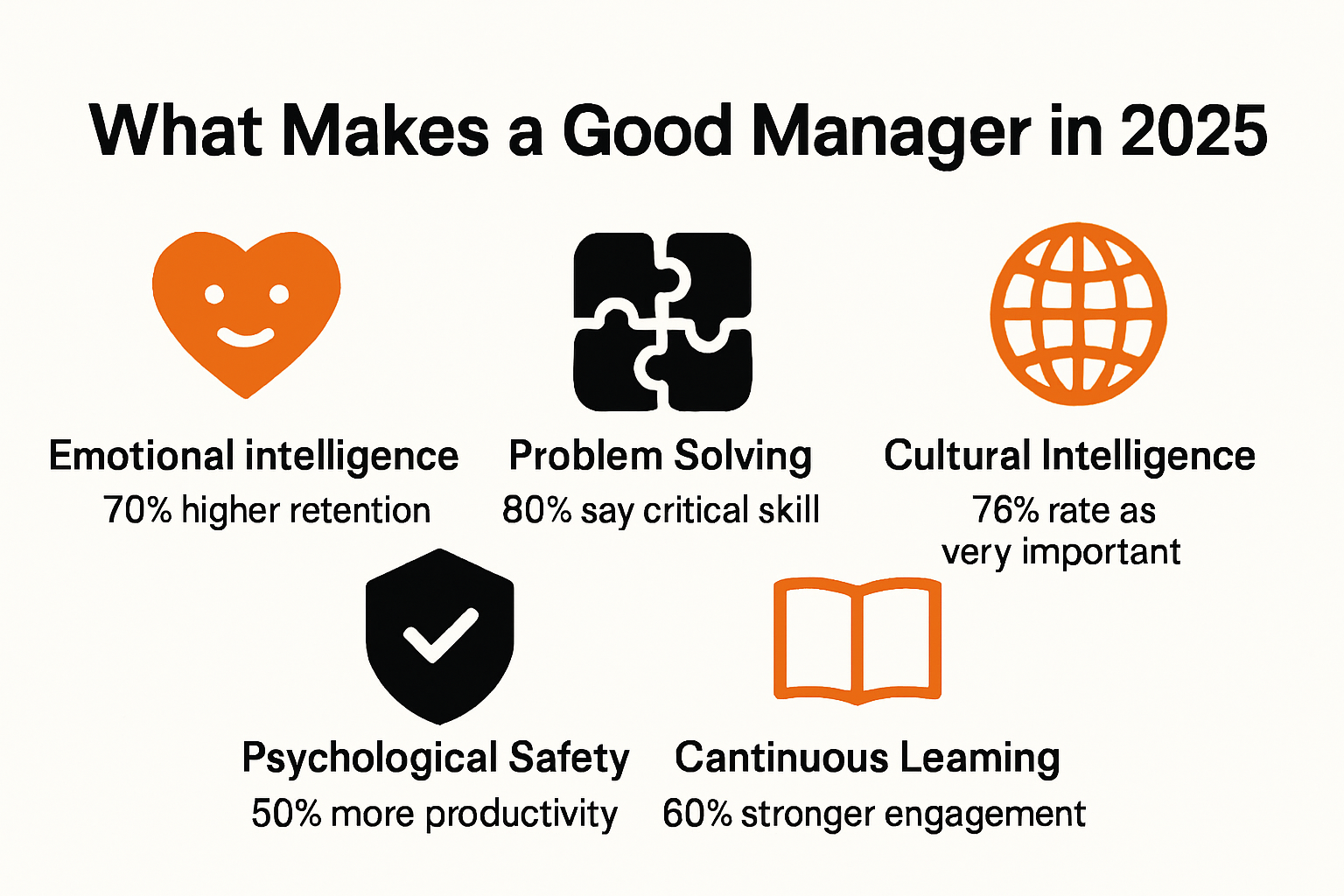
Core Qualities Every Good Manager Needs
The landscape of management is rapidly evolving, demanding a new breed of leaders who can navigate complex organizational challenges with precision and empathy. Successful managers in 2025 will need a multifaceted skill set that goes far beyond traditional command and control approaches.
Emotional Intelligence and Human Connection
In an era of increasing workplace complexity, emotional intelligence emerges as a critical cornerstone of effective management. Explore our guide on leadership development to understand how emotional intelligence transforms management practices. According to the American Psychological Association, managers must cultivate deep empathy and robust communication skills that transcend mere transactional interactions.
Effective managers recognize that understanding human dynamics is as crucial as understanding business metrics. This means developing the ability to read unspoken team dynamics, recognize individual team member motivations, and create an environment of psychological safety. The best managers know how to balance professional expectations with genuine human connection, allowing team members to feel valued beyond their immediate work output.
Adaptive Problem Solving and Strategic Thinking
The modern manager must be a strategic architect, capable of reimagining solutions in real time. This requires a combination of analytical thinking and creative problem solving. Managers can no longer rely on rigid frameworks but must develop flexible mental models that allow rapid adaptation to changing circumstances.
Strategic thinking involves seeing beyond immediate challenges and understanding interconnected systems. A good manager anticipates potential obstacles, develops multiple contingency plans, and remains calm under pressure. This approach requires continuous learning, intellectual curiosity, and the willingness to challenge existing paradigms.
Technological Literacy and Human Centered Leadership
As technological transformation accelerates, managers must become conversant with emerging tools and platforms while maintaining a deeply human approach to leadership. Understanding technological trends is no longer optional but essential. However, the most successful managers will be those who can seamlessly integrate technological capabilities with nuanced human understanding.
This means being able to leverage digital tools for communication and collaboration while preserving the irreplaceable elements of human interaction. Managers must become skilled at using technology to enhance team productivity without losing the personal touch that drives genuine engagement and motivation.
The essence of great management in 2025 lies not in perfection, but in the continuous commitment to growth, understanding, and human centered leadership. By developing these core qualities, managers can create resilient, innovative, and deeply connected teams that are prepared to tackle the complex challenges of our rapidly changing world.
To clarify the core qualities modern managers need, the following table summarizes each main quality and the key attributes associated with it.
| Core Quality | Key Attributes |
|---|---|
| Emotional Intelligence & Human Connection | Empathy, communication, understanding team dynamics, psychological safety |
| Adaptive Problem Solving & Strategic Thinking | Analytical skills, creative thinking, flexibility, contingency planning |
| Technological Literacy & Human Centered Leadership | Comfort with digital tools, human-centric approach, digital collaboration |
Essential Leadership Skills for Modern Managers
The role of a manager in 2025 demands a sophisticated blend of skills that transcend traditional leadership paradigms. Modern managers must become adaptive, strategic, and technologically savvy professionals who can navigate complex organizational ecosystems with precision and empathy.
Cultural Intelligence and Global Perspective
In an increasingly interconnected world, cultural intelligence has become a critical leadership competency. Learn about advanced leadership development strategies to understand the nuanced requirements of global leadership. According to research on Leader Cultural Intelligence and Organizational Performance, managers with high cultural intelligence demonstrate remarkable abilities to bridge diverse workplace environments.
Cultural intelligence involves more than understanding different cultural norms. It requires a deep capacity to adapt communication styles, recognize implicit workplace behaviors, and create inclusive environments that respect and leverage diverse perspectives. Successful managers will need to develop keen observational skills, emotional flexibility, and a genuine curiosity about different human experiences.
Ambidextrous Leadership and Strategic Flexibility
The concept of ambidextrous leadership emerges as a critical skill set for managers navigating complex organizational landscapes. As highlighted by organizational research, ambidextrous leaders must simultaneously manage current operational efficiency while driving innovative strategic initiatives. This requires a rare combination of analytical thinking and creative problem solving.
The National Research Council’s report on Developing Transferable Knowledge and Skills underscores the importance of cognitive flexibility. Modern managers must develop the ability to switch between exploitative activities (optimizing existing processes) and explorative activities (experimenting with new approaches) without losing organizational momentum.
Technological Mastery and Human-Centered Innovation
Technological literacy is no longer an optional skill but a fundamental requirement for effective management. However, true leadership in 2025 will be characterized by the ability to integrate technological capabilities with profound human understanding. Managers must become adept at using digital tools not as replacements for human interaction, but as enablers of more meaningful, collaborative experiences.
This requires continuous learning, a growth mindset, and the willingness to experiment with emerging technologies while maintaining a deep commitment to human-centered leadership principles. Successful managers will be those who can leverage artificial intelligence, data analytics, and collaboration platforms without losing sight of the fundamental human needs for connection, purpose, and meaningful work.
The leadership journey in 2025 is not about achieving a static set of skills, but about cultivating a dynamic, responsive approach to management that balances technological innovation with genuine human understanding. By developing these essential skills, managers can create resilient, adaptive organizations prepared to thrive in an increasingly complex global environment.
How Effective Managers Drive Team Success
Successful team performance is no longer about traditional command structures but about creating an ecosystem of collaboration, trust, and shared purpose. Effective managers in 2025 will be architects of high-performing teams, focusing on holistic strategies that go beyond mere task management.
Psychological Safety and Team Dynamics
Discover advanced team performance strategies that transform workplace interactions. According to research from Forbes, emotional intelligence is a critical determinant of organizational culture and team success. Managers who cultivate psychological safety create environments where team members feel comfortable taking risks, sharing innovative ideas, and expressing vulnerable thoughts without fear of retribution.
Psychological safety means more than preventing negative interactions. It involves actively encouraging diverse perspectives, acknowledging individual contributions, and creating a culture of mutual respect. By demonstrating genuine empathy and understanding, managers can unlock unprecedented levels of team creativity and collaboration.
Strategic Resource Allocation and Barrier Removal
Effective managers recognize their role as enablers rather than controllers. According to insights from the Microsoft Viva research, managers significantly impact team success by helping members prioritize projects and removing potential barriers to their progress.
This strategic approach involves multiple dimensions. Managers must become skilled at identifying team members’ strengths, aligning individual capabilities with organizational goals, and proactively securing resources that enable peak performance. By understanding each team member’s unique potential and potential roadblocks, managers can create personalized support structures that elevate collective performance.
Holistic Performance Management
Performance management in 2025 transcends traditional metrics and annual reviews. It requires a nuanced, continuous approach that balances quantitative achievements with qualitative growth. Managers must develop sophisticated feedback mechanisms that provide real-time insights, constructive guidance, and opportunities for professional development.
This holistic approach means treating team members as whole individuals with complex motivations, aspirations, and potential. Successful managers will integrate technology-enabled performance tracking with deeply human coaching techniques. They will use data analytics to provide objective insights while maintaining a compassionate, personalized approach to team development.
Driving team success is an intricate dance of technological understanding, emotional intelligence, and strategic thinking. By embracing these multifaceted approaches, managers can transform traditional workplace dynamics into vibrant, adaptive ecosystems where individual potential and collective achievement flourish simultaneously.
The table below highlights the main ways effective managers drive team success in modern organizations.
| Managerial Focus | Key Actions |
|---|---|
| Psychological Safety | Encourage diverse perspectives, create mutual respect, support risk-taking |
| Strategic Resource Allocation/Barrier Removal | Align strengths with goals, prioritize projects, provide needed resources |
| Holistic Performance Management | Ongoing feedback, combine data with coaching, support personal growth |
Improving Management Through Continuous Learning
In the rapidly evolving professional landscape of 2025, continuous learning has transformed from a career enhancement option to an absolute necessity for managers. The most successful leaders will be those who embrace a perpetual growth mindset, viewing learning not as a periodic activity but as an integrated, dynamic process of professional development.
Building a Personal Learning Ecosystem
Explore advanced management training strategies that support ongoing skill development. According to the International Data Corporation (IDC), organizations that prioritize continuous learning experience higher innovation rates and better employee retention. This requires managers to proactively design personalized learning paths that blend multiple learning modalities.
Personal learning ecosystems go beyond traditional training programs. They involve curating diverse learning experiences including online courses, peer learning networks, industry conferences, mentorship programs, and self-directed research. Managers must become adept at identifying skill gaps, seeking targeted learning opportunities, and translating new knowledge into practical workplace applications.
Cultivating Organizational Learning Culture
The Association for Talent Development emphasizes that sustainable learning organizations share critical characteristics such as leadership engagement, continuous improvement, and organizational resilience. Effective managers play a pivotal role in fostering this culture by modeling continuous learning behaviors and creating supportive environments that encourage knowledge sharing.
This involves developing transparent communication channels, recognizing and rewarding learning initiatives, and integrating learning opportunities into daily work processes. Managers must transform traditional hierarchical knowledge structures into collaborative, interdependent learning networks where information flows freely and employees feel empowered to contribute and grow.
Technology Enhanced Learning Strategies
According to insights from the Chief Learning Officer, modern learning leaders must possess empathy, adaptability, and sophisticated communication skills to navigate emerging learning technologies. Artificial intelligence, virtual reality, microlearning platforms, and adaptive learning systems are revolutionizing how professionals acquire and apply new skills.
Technology-enhanced learning strategies allow for personalized, on-demand skill development that can be precisely tailored to individual and organizational needs. Managers must become proficient in leveraging these digital tools, understanding their potential limitations, and integrating them seamlessly with human-centered learning approaches.
Continuous learning in 2025 is not about accumulating credentials but about developing adaptive intelligence. By embracing a holistic, technology-enabled, and intrinsically motivated approach to learning, managers can create resilient, innovative organizations prepared to thrive in an increasingly complex global environment.

Frequently Asked Questions
What are the core qualities of a good manager in 2025?
The core qualities include emotional intelligence, adaptive problem solving, and technological literacy. These qualities enable managers to connect with their teams, navigate complex challenges, and effectively leverage technology while maintaining a human-centered approach.
How does emotional intelligence impact management effectiveness?
Emotional intelligence impacts management effectiveness by enhancing communication, fostering trust, and creating psychological safety in teams. Managers who cultivate empathy and understanding can better support their team members and drive collaboration.
Why is continuous learning important for managers in 2025?
Continuous learning is vital for managers in 2025 as it enables them to stay relevant in an ever-changing work environment. It allows them to adapt to new technologies, improve their leadership skills, and foster a culture of innovation and growth within their organizations.
What skills should modern managers develop for success?
Modern managers should develop skills such as cultural intelligence, strategic flexibility, and ambidextrous leadership. These skills help them effectively manage diverse teams, balance operational efficiency with innovation, and navigate the complexities of the global workplace.
Ready to Build the Next Generation of Managers?
Are you struggling to keep up with the rapid changes highlighted in “What Makes a Good Manager in 2025”? If you want your managers to excel in emotional intelligence, adaptive problem-solving, and technological mastery, you need more than buzzwords. You need proven, accredited development programs that address the real challenges of today’s workplace—cultivating empathy, building psychological safety, and mastering essential technologies. Explore our accredited training and consulting solutions designed to close these critical skills gaps for government and corporate teams alike.

Take action now, because staying ahead means proactive learning. Visit Peuneo’s website to discover online courses, expert-led workshops, and personalized consulting services that empower your managers to create high-performing, future-ready teams. Secure your organization’s competitive edge—enroll today and build leadership that thrives in 2025 and beyond.