


Business administration is going through a rapid transformation as companies juggle growth, technology, and people operations all at once. Here is something few expect. Seventy-nine percent of organizations now put human-centered leadership at the heart of their strategy according to Deloitte. Skills like digital know-how and data analysis matter, but the real winning edge is in building trust, adapting fast, and putting people first as workflows get more complex.
Table of Contents
- Core Principles Of Business Administration
- Essential Skills For Modern Administrators
- Best Practices For Effective Management
- Tools And Resources For Business Success
Quick Summary
| Takeaway | Explanation |
|---|---|
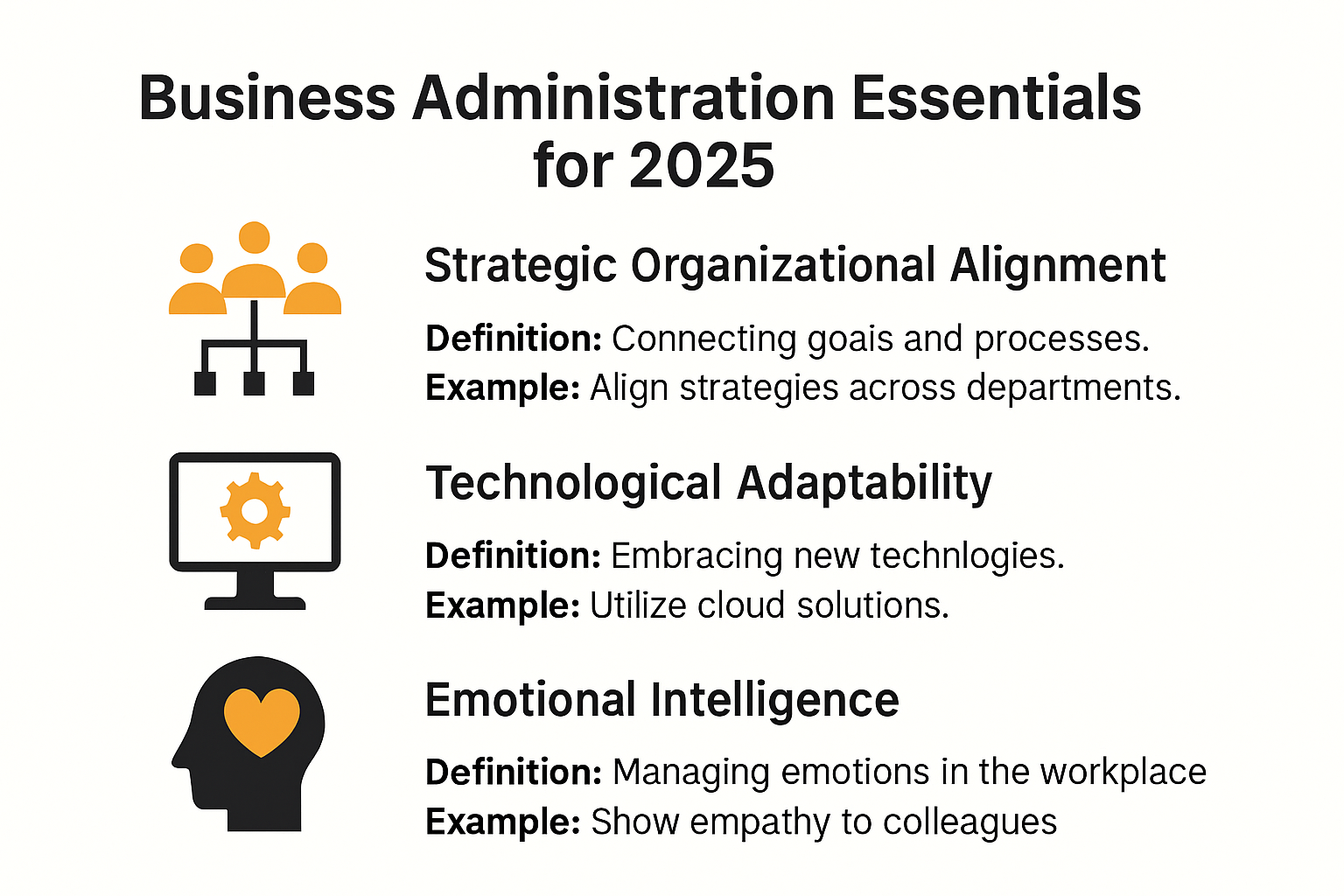
| Strategic Organizational Alignment | Modern administrators must create seamless communication and collaboration across departments to enhance organizational efficiency and drive performance. |
| Technological Adaptability | Proficiency in digital tools and analytics is essential; administrators must evaluate and integrate technology to improve operational workflows. |
| Emotional Intelligence | Advanced interpersonal skills, including empathy and active listening, are crucial for building resilient teams and fostering inclusive environments. |
| Data-Driven Decision Making | Utilizing advanced data analytics enables administrators to transform insights into proactive strategies for organizational challenges. |
| Sustainability and Resilience | Emphasizing long-term sustainability through innovative practices is vital for adapting to the complexities of the global business landscape. |
Core Principles of Business Administration
Business administration forms the strategic backbone of organizational success, defining how companies operate, grow, and adapt in a complex global environment. The core principles driving business administration in 2025 represent a sophisticated blend of strategic thinking, technological integration, and human-centric management approaches.
Strategic Organizational Alignment
At the heart of effective business administration lies the ability to create seamless organizational alignment. This principle goes beyond traditional hierarchical structures, focusing on creating flexible, interconnected systems where departments communicate and collaborate efficiently. According to research from Northwest Career College, successful organizations integrate all departments including human resources, finance, and marketing to ensure cohesive operational performance.
The modern business administrator must develop a holistic view of organizational dynamics. This means understanding how individual roles and departmental functions contribute to broader strategic objectives. By creating transparent communication channels and establishing clear performance metrics, administrators can drive organizational efficiency and accountability.
Adaptive Leadership and Resource Management
Leadership in business administration has transformed from a top-down approach to a more dynamic, responsive model. Experts from DECA highlight that successful business management professionals must demonstrate key competencies including:
- Resourcefulness: Ability to solve complex problems with limited resources
- Collaboration: Creating cross-functional teams and fostering cooperative environments
- Decisiveness: Making informed decisions quickly in rapidly changing contexts
- Interpersonal Skills: Building strong relationships across different organizational levels
Resource management now extends beyond traditional financial and human capital considerations. Modern administrators must also manage technological resources, data assets, and intellectual capital. This requires a quantitative mindset that balances analytical insights with strategic vision.
Technological Integration and Ethical Practices
Technology and ethics have become inseparable components of business administration. IDC’s research on CEO priorities indicates that business leaders are prioritizing AI-driven transformation, automation, and ethical business practices. Administrators must now balance technological innovation with responsible implementation.
This principle involves understanding emerging technologies, assessing their potential impact on organizational workflows, and implementing them in ways that enhance rather than replace human capabilities. Ethical considerations include data privacy, transparent decision making, and ensuring that technological advancements support rather than marginalize workforce development.
By embracing these core principles, business administrators can create resilient, adaptive organizations capable of navigating the complex challenges of the modern business landscape. The future of business administration lies not in rigid methodologies, but in flexible, human-centered approaches that leverage technology while maintaining a commitment to organizational values and employee growth.
Essential Skills for Modern Administrators
The rapidly evolving business landscape demands a new breed of administrators who can navigate complex organizational challenges with agility, technological proficiency, and emotional intelligence. Modern administrators must cultivate a multifaceted skill set that goes beyond traditional management techniques.
Technological Adaptability and Digital Competence
In 2025, technological proficiency is no longer optional for business administrators. Administrators must develop a robust understanding of digital tools, data analytics, and emerging technologies that drive organizational efficiency. Our guide for managers in 2025 emphasizes the critical importance of staying current with technological trends and understanding how to integrate digital solutions strategically.
This skill set includes proficiency in cloud computing platforms, data visualization tools, artificial intelligence applications, and advanced project management software. Administrators must not only understand these technologies but also evaluate their potential impact on organizational workflows, employee productivity, and strategic objectives. The ability to bridge the gap between technological innovation and practical implementation distinguishes exceptional administrators.

Emotional Intelligence and Cross Functional Leadership
According to research from Verifyed, emotional intelligence has become a cornerstone of effective administration, particularly in hybrid and remote work environments. Modern administrators must demonstrate advanced interpersonal skills that include:
- Self-awareness: Understanding personal emotional triggers and leadership style
- Empathy: Recognizing and responding to team members’ emotional states
- Active Listening: Creating communication channels that foster genuine understanding
- Cross Cultural Competence: Navigating diverse team dynamics with sensitivity
These skills help administrators mitigate workplace stress, build resilient teams, and create inclusive work environments. Emotional intelligence transforms administrators from mere managers to transformative leaders who can inspire, motivate, and guide teams through complex organizational changes.
Strategic Problem Solving and Analytical Thinking
The modern administrator must possess advanced analytical capabilities that enable rapid, informed decision making. This involves developing a comprehensive approach to problem solving that integrates quantitative data analysis, creative thinking, and strategic foresight.
Key components of strategic problem solving include:
- Advanced data interpretation skills
- Ability to develop predictive models
- Understanding of risk assessment methodologies
- Capacity to synthesize information from multiple sources
Administrators must transform raw data into actionable insights, identifying potential challenges before they emerge and developing proactive strategies to address them. This skill requires a combination of technical knowledge, critical thinking, and the ability to see complex systems holistically.
By cultivating these essential skills, modern administrators can position themselves as indispensable organizational leaders who drive innovation, manage complexity, and create sustainable business value. The future of business administration lies not in rigid control, but in adaptive, intelligent, and empathetic leadership that embraces technological change while maintaining a deep commitment to human potential.
Best Practices for Effective Management
Effective management in 2025 demands a holistic approach that balances technological innovation, human-centered leadership, and strategic adaptability. Organizations must evolve beyond traditional management models to create resilient, responsive, and purpose-driven workplace environments.
Human-Centered Leadership and Trust Building
Our team building guide for 2025 emphasizes the critical importance of creating organizational cultures rooted in trust and genuine human connection. According to Deloitte’s Global Human Capital Trends, 79% of organizations now prioritize human-centered leadership as a fundamental management best practice.
This approach requires managers to move beyond traditional hierarchical structures and develop more collaborative, transparent leadership strategies. Key elements include:
- Psychological Safety: Creating environments where team members feel comfortable sharing ideas
- Transparent Communication: Providing clear, consistent information about organizational goals and challenges
- Individual Development: Investing in personalized growth opportunities for each team member
- Empowerment: Delegating meaningful responsibilities and trusting employees’ capabilities
By focusing on these principles, managers can build high-performance teams that are motivated, engaged, and aligned with organizational objectives.
Technological Integration and Data-Driven Decision Making
Research from IESE Insight highlights that integrating technological capabilities with strategic management is no longer optional but essential. Modern managers must develop sophisticated approaches to digital transformation that go beyond mere technological adoption.
Effective technological integration involves:
- Advanced data analytics capabilities
- Understanding of artificial intelligence applications
- Strategic assessment of emerging digital tools
- Continuous learning and technological adaptability
Managers must transform raw data into actionable insights, using technological tools to predict market trends, optimize operational efficiency, and make informed strategic decisions. This requires a blend of technical understanding and strategic vision.
Sustainability and Organizational Resilience
As global business environments become increasingly complex, managers must develop practices that prioritize long-term sustainability and organizational resilience. According to research from Must EDU, this involves creating adaptive strategies that can respond quickly to unexpected challenges.
Key sustainability best practices include:
- Implementing circular economic principles
- Developing flexible organizational structures
- Creating robust risk management frameworks
- Integrating environmental and social governance considerations
Effective managers in 2025 must think beyond quarterly performance metrics, developing holistic approaches that balance economic performance with social responsibility and environmental stewardship.
The future of management lies in creating agile, empathetic, and technologically sophisticated organizational cultures. By embracing these best practices, leaders can develop workplaces that are not just productive, but also meaningful, adaptive, and prepared for the complex challenges of the modern business landscape.
Tools and Resources for Business Success
In the rapidly evolving business landscape of 2025, organizations must leverage sophisticated digital tools and resources that enhance operational efficiency, drive strategic decision making, and create competitive advantages. The right technological ecosystem can transform business potential, enabling administrators to navigate complex challenges with precision and agility.
Integrated Business Management Platforms
Our skills development guide emphasizes the critical role of technological integration in modern business environments. According to research from Kestrel Pro, integrated business suites like Zoho One have become essential for comprehensive organizational management.
These platforms offer unified solutions that combine multiple business functions, including:
- Customer relationship management
- Human resources administration
- Financial tracking
- Project management
- Advanced analytics and reporting
By consolidating diverse operational needs into a single platform, businesses can eliminate software fragmentation, reduce operational costs, and gain holistic insights into organizational performance. The AI-powered capabilities of these platforms enable predictive analytics, automated workflow optimization, and real-time strategic decision support.
Financial Management and Compliance Tools
Research from Emory Wheel highlights the continued importance of robust financial management tools in maintaining organizational financial health. Modern businesses require sophisticated solutions that go beyond traditional accounting practices.
Key financial management tools include:
- QuickBooks: Advanced accounting and bookkeeping
- FreshBooks: Invoice management and expense tracking
- Xero: Cloud-based financial reporting and analysis
These tools provide more than simple numerical tracking. They offer comprehensive financial insights, compliance monitoring, tax preparation support, and predictive financial modeling. Administrators can generate detailed financial reports, track cash flow in real time, and make data-driven financial decisions with unprecedented accuracy.
Collaboration and Communication Technologies
Effective business success in 2025 depends on seamless communication and collaboration technologies that transcend traditional workplace boundaries. Modern tools must support hybrid work environments, facilitate global team interactions, and ensure secure, efficient information exchange.
Essential collaboration technologies include:
- Advanced video conferencing platforms
- Real-time document collaboration systems
- Virtual whiteboarding and brainstorming tools
- Secure messaging and project management applications
These technologies enable organizations to maintain productivity, foster innovation, and create inclusive work environments regardless of physical location. By investing in sophisticated communication tools, businesses can break down geographical barriers and create dynamic, responsive organizational cultures.
The future of business success lies not just in adopting technologies, but in strategically integrating tools that enhance human potential, streamline operations, and create adaptive, intelligent organizational ecosystems. Administrators who understand and leverage these technological resources will be best positioned to lead their organizations through the complex challenges of the modern business landscape.
Frequently Asked Questions
What are the core principles of business administration in 2025?
The core principles of business administration in 2025 include strategic organizational alignment, adaptive leadership and resource management, as well as technological integration with a focus on ethical practices.
Why is emotional intelligence important for business administrators?
Emotional intelligence is crucial for business administrators as it enhances interpersonal skills, fosters a collaborative work environment, and helps in managing diverse teams, particularly in hybrid and remote setups.
What technological skills are essential for modern business administrators?
Modern business administrators should have technological adaptability, digital competence, and the ability to effectively use advanced data analytics and emerging technologies to improve operational workflows.
How can organizations achieve human-centered leadership?
Organizations can achieve human-centered leadership by focusing on trust-building, transparent communication, empowering team members, and fostering psychological safety within the workplace.
Future-Proof Your Business Administration Skills with Accredited Solutions
Are you struggling to keep pace with the demands of human-centered leadership, advanced data analytics, and technological integration highlighted in this article? Many forward-thinking professionals and companies face challenges like bridging skills gaps, fostering cross-functional alignment, and ensuring compliance as work environments grow more complex. The pressure to adapt has never been greater—and you deserve a guide you can trust.

Empower your growth today. Visit Peuneo’s online platform to access accredited training and consulting services tailored specifically for South African businesses. Whether you need to enhance emotional intelligence, master digital transformation, or build resilient, high-performing teams, our range of online courses and business solutions will help you meet the real-world challenges of business administration in 2025. Take your next step now—advance your career and organizational success with guidance from local experts at Peuneo.