


Team building can do more than just lift morale in the office. Research shows that targeted team-building can increase workplace productivity by up to 25 percent. Surprised? Most people think team events are just icebreakers and trust falls. The real advantage is how these strategies unlock hidden collaboration and innovation that regular meetings never touch.
Table of Contents
- How Team Building Drives Success
- Key Benefits For Different Organizations
- Effective Team Building Strategies For 2025
- Measuring The Impact Of Team Building
Quick Summary
| Takeaway | Explanation |
|---|---|
| Team Building Increases Productivity | Strategic team building can enhance workplace productivity by up to 25% through improved interpersonal dynamics and collaboration. |
| Trust is Essential for High Performance | Building trust among team members fosters a culture of risk-taking, innovation, and collective goal achievement, leading to better performance outcomes. |
| Tailored Approaches for Different Sectors | Effective team building strategies must be customized for corporate, government, and nonprofit sectors to address their unique challenges and objectives. |
| Data-Driven Impact Measurement | Organizations should implement robust, data-driven assessment strategies, using both quantitative and qualitative metrics, to measure the effectiveness of team-building initiatives. |
| Embrace Technology and Personalization | Adopting technology-driven methods, such as AI and immersive experiences, alongside personalized interventions enhances team development and engagement. |
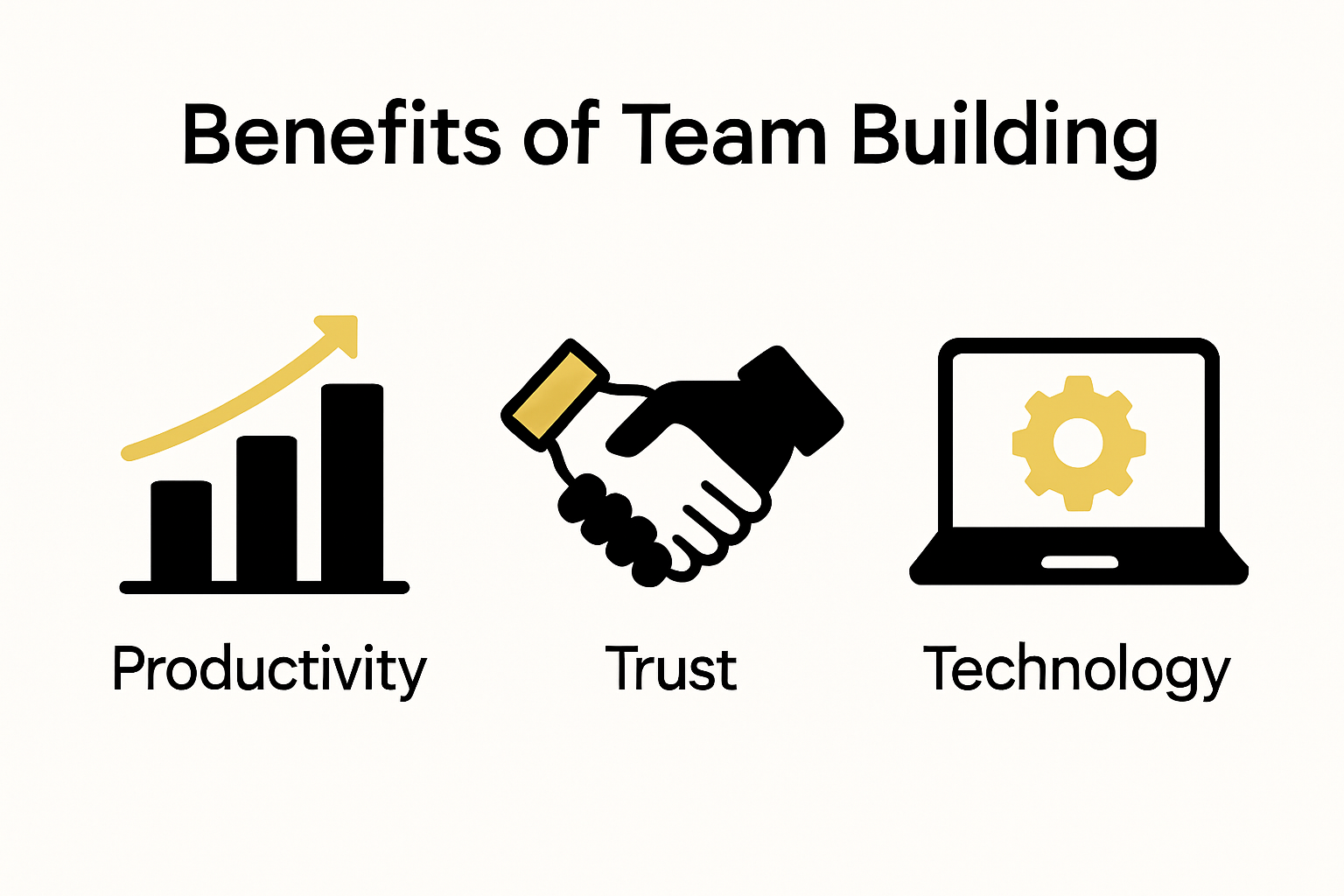
How Team Building Drives Success
Team building transforms ordinary workplace interactions into strategic pathways for organizational success. Understanding how effective team development drives performance provides critical insights for modern businesses seeking competitive advantages.
Creating Collaborative Performance Ecosystems
Successful team building goes beyond simple social activities. It systematically develops communication frameworks that enable teams to operate with unprecedented synergy. Research from Indeed reveals that strategic team building activities can increase workplace productivity by up to 25% through enhanced interpersonal dynamics.
When organizations invest in deliberate team development, they create environments where individual strengths are recognized and collective potential is maximized. This approach transforms workplace interactions from transactional exchanges to collaborative performance ecosystems. Team members learn to anticipate each other’s needs, communicate more effectively, and solve complex challenges with coordinated efforts.

Trust as a Performance Catalyst
Trust represents the fundamental currency of high-performing teams. A meta-analysis by academic researchers demonstrated that targeted team building interventions significantly improve both objective team performance and supervisory evaluations. By creating structured opportunities for genuine interaction, organizations can systematically build interpersonal trust.
The trust-building process involves multiple strategic elements. Transparent communication, shared vulnerability, and collaborative problem-solving become mechanisms through which team members develop deeper mutual understanding. When team members trust each other, they become more willing to take calculated risks, share innovative ideas, and support collective goals over individual achievements.
Measuring Team Building Impact
Measuring the tangible impact of team building requires sophisticated assessment strategies. Progressive organizations now view team development not as a discretionary expense but as a critical investment in human capital. Our comprehensive guide on team building techniques provides deeper insights into measuring and maximizing these strategic interventions.
Key performance indicators for successful team building include improved communication metrics, reduced conflict resolution time, increased project completion rates, and enhanced employee engagement scores. By treating team building as a data-driven process, organizations can continuously refine their approach and demonstrate clear return on investment.
The importance of team building extends far beyond momentary morale boosts. It represents a strategic approach to unlocking collective potential, transforming workplace dynamics, and creating resilient, adaptable organizational cultures prepared for complex future challenges.
Key Benefits for Different Organizations
Team building strategies are not one-size-fits-all. Different organizational types require tailored approaches that address their unique challenges, team dynamics, and strategic objectives. Understanding how team building benefits various sectors helps leaders design more effective development programs.
Corporate Sector Performance Enhancement
In corporate environments, team building serves as a critical mechanism for driving organizational performance. Research involving 200,000 employees revealed that team camaraderie is the primary motivator for employees going beyond their standard job responsibilities. Companies that invest in strategic team development see significant improvements in collaboration, innovation, and overall productivity.
Modern corporations face complex challenges that demand seamless interdepartmental communication. Team building activities help break down traditional silos, creating cross-functional understanding and enabling more agile problem-solving approaches. By fostering environments where employees from different departments can interact authentically, organizations create pathways for knowledge sharing and innovative thinking.
Government and Public Sector Adaptability
Government agencies and public sector organizations require unique team-building strategies that emphasize accountability, communication, and mission-driven collaboration. A comprehensive study on organizational development indicates that structured team-building interventions can significantly improve role clarity and interdepartmental cooperation.
Public sector teams often manage complex, high-stakes projects with significant societal implications. Team building in these environments focuses on developing resilient communication frameworks, enhancing emotional intelligence, and creating shared commitment to organizational objectives. By investing in targeted development programs, government agencies can improve service delivery, reduce bureaucratic friction, and create more responsive administrative systems.
Nonprofit and Social Impact Organizations
Nonprofit organizations operate in dynamic environments that demand exceptional teamwork and adaptability. These teams typically work with limited resources while addressing complex social challenges. Team building becomes a crucial mechanism for maintaining motivation, alignment, and collective impact.
For social impact organizations, team development goes beyond traditional corporate models. It involves creating deep emotional connections, shared value systems, and collaborative problem-solving capabilities. Effective team-building approaches help these organizations maintain high levels of engagement, manage potential burnout, and sustain long-term commitment to challenging missions.
The diversity of organizational contexts demonstrates that team building is not a luxury but a strategic necessity. Whether in corporate, government, or nonprofit settings, well-designed team development programs unlock human potential, create robust communication frameworks, and drive meaningful performance improvements. Organizations that recognize and invest in thoughtful, context-specific team-building strategies position themselves for sustainable success in an increasingly complex professional landscape.
To help readers compare the unique focus and benefits of team building across corporate, government, and nonprofit organizations, here is a summary table:
| Organization Type | Team Building Focus | Unique Benefits |
|---|---|---|
| Corporate | Cross-functional collaboration, innovation, productivity | Breaks down silos, boosts innovation, enhances overall performance |
| Government/Public Sector | Accountability, communication, mission-driven collaboration | Improves role clarity, service delivery, and reduces bureaucratic friction |
| Nonprofit/Social Impact | Emotional connections, shared values, adaptability | Maintains motivation, supports alignment, sustains long-term commitment and engagement |
Effective Team Building Strategies for 2025
As workplace dynamics continue to evolve, organizations must adopt innovative team-building strategies that align with technological advancements and changing workforce expectations. The landscape of team development is rapidly transforming, requiring leaders to embrace cutting-edge approaches that enhance collaboration, engagement, and performance.
Technology-Driven Team Development
Technology is revolutionizing how teams interact and develop. Research utilizing Virtual Reality environments demonstrates that immersive technologies can break traditional communication barriers and promote deeper team inclusion. By creating simulated experiences that challenge team members to collaborate in novel ways, organizations can develop more adaptive and resilient workforce capabilities.
Artificial Intelligence is emerging as a powerful tool in team building. AI-driven coaching systems now provide real-time guidance and personalized interventions, helping teams identify communication gaps, optimize performance, and develop more effective collaboration strategies. These intelligent systems analyze team interactions, offering insights that were previously impossible to capture through traditional assessment methods.
Holistic Approach to Team Engagement
Modern team-building strategies move beyond isolated activities to create comprehensive engagement ecosystems. Our comprehensive guide on team building techniques highlights the importance of integrating multiple development approaches that address psychological, professional, and technological dimensions of teamwork.
Successful strategies now incorporate elements such as emotional intelligence training, cross-functional skill development, and adaptive communication workshops. Organizations are recognizing that effective team building is not about single events but creating continuous learning environments that foster trust, innovation, and collective growth.
Personalized and Data-Driven Interventions
The future of team building lies in personalization and data-driven insights. Advanced organizations are leveraging sophisticated analytics to create tailored development programs that address specific team dynamics. Automated feedback tools can now analyze team interactions, providing nuanced insights into communication patterns, potential conflict areas, and opportunities for improvement.
These personalized interventions allow organizations to move beyond generic team-building approaches. By understanding the unique characteristics of each team, leaders can design targeted strategies that align with specific organizational goals, team compositions, and performance objectives.
As we move into 2025, successful team building will require a sophisticated blend of technological innovation, human-centric design, and strategic thinking. Organizations that embrace these advanced approaches will create more adaptable, engaged, and high-performing teams capable of navigating increasingly complex professional challenges.
Measuring the Impact of Team Building
Effective team building requires more than intuitive approaches. Organizations must develop robust, data-driven methodologies to quantify the tangible and intangible benefits of team development initiatives. Understanding how to measure these impacts provides critical insights into organizational performance and strategic human capital investment.
To clarify the different types of metrics and methods for measuring team building, here is a summary table:
| Measurement Type | Example Metrics/Methods | Purpose/Insight |
|---|---|---|
| Quantitative | Productivity rates, project completion times, error rates | Track numerical improvements in performance |
| Qualitative | Team feedback, 360-degree evaluations, narrative surveys | Understand team dynamics, trust, engagement |
| Longitudinal Tracking | Ongoing data collection, performance comparisons | Assess sustained impact over time |
Quantitative Performance Metrics
Research on software development teams demonstrates that teamwork quality explains an astounding 81% of variance in team performance. This highlights the critical importance of developing precise measurement frameworks that go beyond superficial assessments.
Key quantitative metrics include productivity rates, project completion times, error reduction percentages, and cross-functional collaboration efficiency. Advanced organizations utilize sophisticated tracking systems that capture nuanced performance indicators. These metrics help transform team building from a perceived soft skill into a measurable strategic intervention.
Some specific quantitative indicators organizations should track include:
- Average project completion speed
- Interdepartmental communication effectiveness
- Innovation generation rates
- Collective problem-solving efficiency
Qualitative Assessment Techniques
A comprehensive study in Arusha, Tanzania revealed a strong positive correlation between leadership-focused team-building initiatives and organizational growth. Qualitative assessments provide deeper insights into team dynamics that numerical data cannot capture.
Qualitative measurement techniques include:
- Structured team feedback surveys
-360-degree performance evaluations - Narrative-based interaction assessments
- Emotional intelligence and team cohesion surveys
These methods capture intricate aspects of team interactions, trust levels, and collaborative potential that quantitative metrics might overlook. Our comprehensive guide on team building techniques offers additional insights into designing effective assessment frameworks.
Longitudinal Performance Tracking
Meta-analysis research in team cohesion demonstrates that task cohesion exhibits significant effect sizes in performance improvement. Longitudinal tracking becomes crucial in understanding the sustained impact of team-building interventions.
Effective longitudinal measurement involves:
- Consistent data collection over extended periods
- Comparative analysis across different team configurations
- Tracking individual and collective performance trajectories
- Identifying long-term behavioral and performance shifts
Organizations must view team building as an ongoing, adaptive process rather than a one-time event. By implementing comprehensive, multi-dimensional measurement strategies, leaders can transform team development from a discretionary activity into a precise, strategic organizational tool.
The future of team building lies in sophisticated, data-driven approaches that blend quantitative rigor with nuanced qualitative understanding. Successful organizations will be those that can effectively measure, interpret, and continuously improve their team development strategies.
Frequently Asked Questions
What are the key benefits of team building in 2025?
Team building enhances workplace productivity by up to 25%, fosters trust among team members, and encourages collaboration and innovation tailored to each organizational sector.
How does trust impact team performance?
Trust acts as a performance catalyst, leading to improved communication, risk-taking, and collective goal achievement, which ultimately results in better team outcomes.
What effective team building strategies should be adopted in 2025?
Organizations should focus on technology-driven methods, holistic engagement approaches, and personalized, data-driven interventions to improve team development and collaboration.
How can the impact of team building be measured?
The impact of team building can be measured using quantitative metrics like productivity rates, qualitative assessments such as team feedback, and longitudinal tracking to identify sustained improvements over time.
Unlock Peak Team Performance with Expert Development Now
Is your organization trapped by poor collaboration or lack of trust? The article showed that true team building is no longer just about morale—real transformation means fostering trust, measurable growth, and creating dynamic ecosystems for performance. Whether you lead a fast-paced corporate group, a government office, or a mission-driven nonprofit, you are likely searching for solutions that boost productivity while ensuring your teams are ready for the challenges ahead. The hidden problem is often a missing link between theory and measurable action.

You can bridge that gap today with help from leaders in accredited training and development. At Peuneo, you will find comprehensive skills development programs and professional consulting services designed to convert your team-building goals into tangible results. Our expertise helps you measure the real impact of your training, strengthen trust, and create lasting, positive change in your organization. Ready to turn powerful insights into action? Visit Peuneo’s online platform and explore our accredited training solutions or connect with an expert for customized consulting. Transform your team and elevate your results now.
Recommended
- 2025 Effective Team Building Techniques to Boost Team Morale – Peuneo
- 2025 Effective Team Building Techniques to Boost Team Morale – Peuneo
- Top Ways to Motivate Teams: Strategies for 2025 Success – Peuneo
- Best Team Building Activities for the Workplace 2025 – Peuneo
- How to Improve Team Performance: Expert Strategies for 2025 – Peuneo
- How to Lead a Team Effectively in 2025: Essential Strategies for Every Leader – Peuneo