
Effective team building can revolutionize your workplace. Research shows that companies with strategic team-building initiatives see a 25% increase in team performance. But here’s the kicker: most people think team building is just about trust falls and icebreakers. The real game-changer? It’s the lasting culture of collaboration and engagement that these activities create. By prioritizing team building, you can foster an environment that boosts morale, enhances productivity, and increases employee satisfaction.
Table of Contents
- Benefits Of Effective Team Building
- Strategies For Effective Collaboration
- Interactive Exercises For Teams
- Implementing Techniques For Lasting Change
Quick Summary
| Takeaway | Explanation |
|---|---|
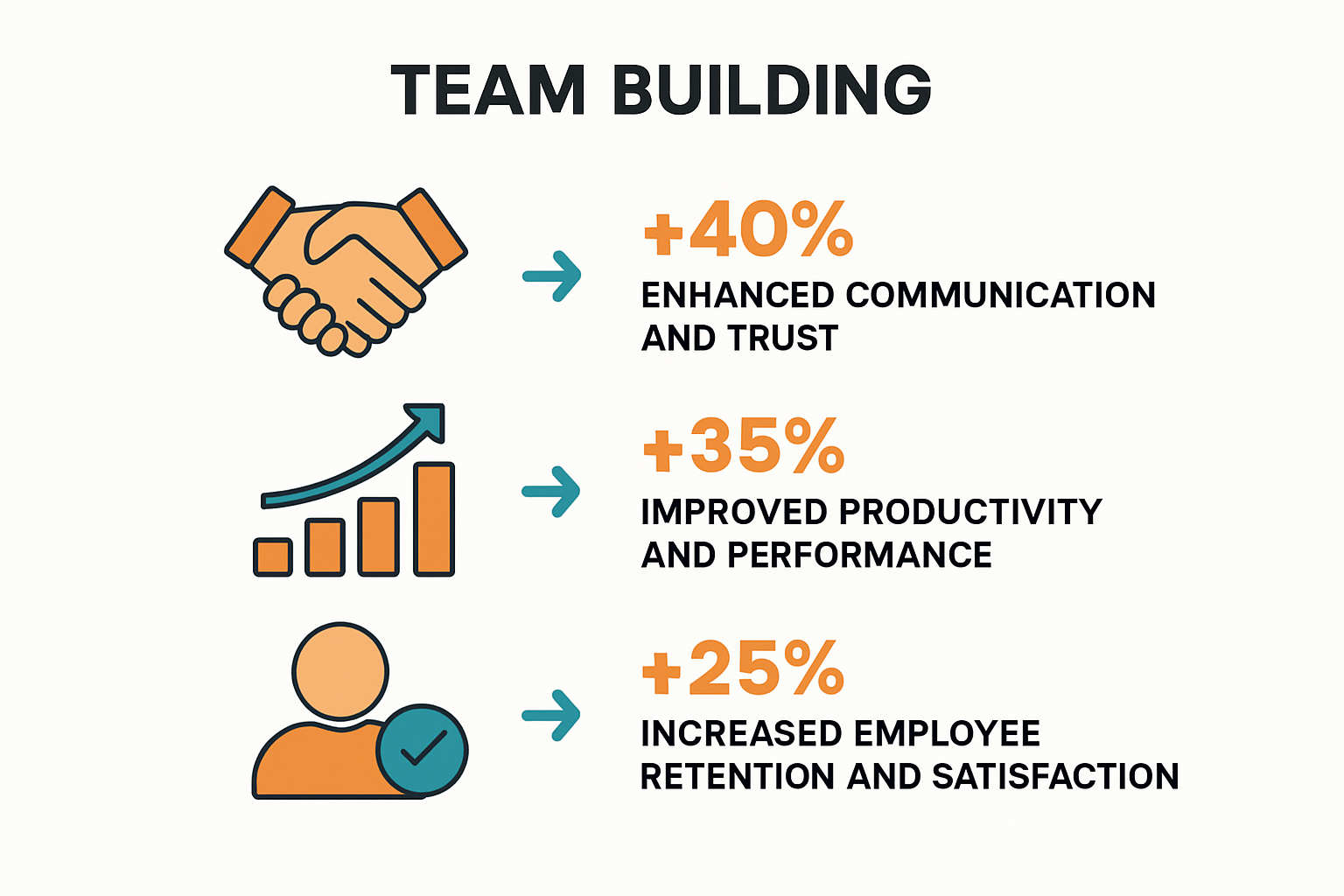
| Enhanced Communication and Trust | Team building activities improve communication and build trust, fostering an environment where team members can freely express ideas and collaborate effectively. |
| Improved Productivity and Performance | Organizations that prioritize team building see up to a 25% increase in team performance due to clarified roles, reduced conflicts, and enhanced cooperation toward shared goals. |
| Increased Employee Retention and Satisfaction | Regular team-building activities result in employee retention rates 36% higher than those without such initiatives, as they foster bonds that make employees feel valued and connected. |
| Implement Structured Collaboration Frameworks | Using frameworks like the GRPI model guides teams in setting clear goals, roles, and processes, ensuring better collaboration and accountability. |
| Build a Culture of Continuous Feedback and Recognition | Establishing a culture where feedback is normalized and achievements are recognized reinforces collaborative efforts and motivates continued engagement among team members. |
Benefits of Effective Team Building
Effective team building is more than just a fun activity or corporate event—it’s a strategic investment that yields significant returns for organizations of all sizes. When implemented thoughtfully, team building creates powerful transformations that impact every aspect of your business operations. Let’s explore the concrete benefits that make team building techniques worth prioritizing.
Enhanced Communication and Trust
One of the most immediate benefits of effective team building is the improvement in communication patterns among team members. When people participate in collaborative activities outside their normal work routines, they develop communication pathways that transfer back to workplace interactions. These activities create safe spaces for team members to express ideas, provide feedback, and resolve misunderstandings without the pressure of formal meetings.
Trust forms the foundation of high-performing teams, and team building accelerates its development. Through shared experiences—whether challenging outdoor adventures or creative problem-solving exercises—team members learn to rely on each other’s strengths and support each other through difficulties. This translates directly to the workplace, where team members become more comfortable delegating tasks, sharing responsibilities, and collaborating on complex projects.
The trust established through team building also creates psychological safety—an environment where team members feel secure taking risks and being vulnerable with one another. This psychological safety is crucial for innovation, as it encourages people to share unconventional ideas without fear of ridicule or rejection.
Improved Productivity and Performance
Organizations that invest in team building see tangible returns in productivity and performance. According to research, companies that prioritize team building report a 25% increase in team performance, as cohesive teams work more efficiently toward shared goals. This significant performance boost stems from several factors.
First, team building clarifies roles and responsibilities, reducing confusion and workflow bottlenecks. When team members understand how their contributions fit into the larger picture, they work with greater purpose and efficiency. Second, effective team building techniques help identify and leverage individual strengths, ensuring that tasks are assigned to those best equipped to handle them.
Team building also reduces workplace conflicts that drain productivity. When team members develop personal connections and mutual respect, they’re more likely to approach disagreements constructively rather than defensively. The result is faster conflict resolution and less time wasted on interpersonal friction.
Increased Employee Retention and Satisfaction
In today’s competitive job market, retention is a critical concern for organizations. Businesses that engage in regular team-building activities see employee retention rates 36% higher than those that don’t. This impressive statistic reflects how team bonding fosters a sense of belonging and loyalty that keeps employees committed to their organizations.
Team building creates meaningful connections among colleagues, transforming a job into a community. These social bonds make coming to work more enjoyable and provide emotional support during challenging periods. The camaraderie developed through team building makes employees think twice before leaving for another position, even when offered higher compensation elsewhere.
Employee isolation can reduce productivity by up to 21%, but fostering connections through team building helps counteract this isolation and boosts both productivity and job satisfaction. When employees feel connected to their colleagues, they experience higher workplace engagement and motivation to contribute to team success.
Team building also creates opportunities for recognition and appreciation. Activities often reveal talents and qualities in colleagues that might go unnoticed in regular work settings. This recognition boosts morale and reinforces each person’s value to the team.
The benefits of effective team building extend far beyond temporary morale boosts. They create lasting improvements in communication, trust, productivity, innovation, and employee satisfaction that directly impact an organization’s bottom line. By investing in structured, purposeful team building techniques, organizations build stronger foundations for success in an increasingly collaborative business environment.
Strategies for Effective Collaboration
Collaboration is the engine that powers successful teams, yet many organizations struggle to build truly collaborative environments. Effective collaboration doesn’t happen by accident—it requires intentional strategies and ongoing effort. When team members work together seamlessly, they can accomplish far more than they could individually. Let’s explore practical strategies to foster collaboration that drives results.
Implement Structured Collaboration Frameworks
One of the most effective ways to improve team collaboration is to adopt a proven framework that provides structure to collaborative efforts. The GRPI model (Goals, Roles, Processes, Interpersonal Relationships) offers a research-backed approach for improving collaboration. This four-component model creates a roadmap for teams to follow when working together on projects or solving problems.
Start with clearly defined goals that everyone understands and commits to. When team members share a unified vision of what success looks like, they naturally align their efforts toward common objectives. Next, establish clear roles and responsibilities so everyone knows exactly what’s expected of them and how their work contributes to the larger goal. This clarity eliminates confusion and prevents both duplicated efforts and overlooked tasks.
Develop streamlined processes that outline how work flows through your team. Document these workflows and make them accessible to everyone. These processes should include decision-making protocols, communication channels, and methods for sharing information. Finally, invest time in building interpersonal relationships among team members. Strong relationships create the psychological safety needed for honest communication and constructive feedback.
Regular check-ins are essential for maintaining accountability and keeping collaboration on track. Schedule brief, focused meetings where team members can report progress, identify obstacles, and request support. These check-ins reinforce ownership and commitment, which are key drivers of collaborative team performance.
Create Collaborative Physical and Digital Spaces
The environment in which your team works significantly impacts collaboration quality. Physical workspaces should be designed to facilitate both impromptu interactions and focused collaborative sessions. Consider creating different zones for different types of collaboration—quiet areas for small group discussions, larger conference spaces for team meetings, and informal gathering spots for spontaneous brainstorming.
In today’s hybrid work environment, digital collaboration spaces are equally important. Invest in tools that make remote collaboration as seamless as in-person interaction. Project management platforms, cloud-based document sharing, real-time editing tools, and communication software all play vital roles in connecting team members regardless of location.
Many organizations are now leveraging immersive technologies like virtual reality (VR) and augmented reality (AR) for team collaboration. These technologies have been shown to enhance strategic thinking, communication, and collaboration skills, making training and collaborative experiences more engaging and effective in modern workplaces. Virtual reality can create shared spaces where remote team members can gather, interact with 3D models, and collaborate as if they were physically present together.
Whatever tools you choose, prioritize those with intuitive interfaces that don’t create technical barriers to participation. The best collaboration tools fade into the background, allowing team members to focus on the work rather than the technology.
Build a Culture of Trust and Balanced Contribution
Effective collaboration requires a foundation of trust. Team members must feel safe expressing opinions, asking questions, and taking calculated risks without fear of negative consequences. Building this trust starts with leadership modeling vulnerability and openness to feedback.
Cultivating trust and ensuring role clarity are foundational strategies for seamless team collaboration. Leaders can foster trust by being transparent about decision-making processes, acknowledging their own limitations, and demonstrating faith in team members’ abilities. Trust grows when words and actions align consistently over time.
Encourage balanced participation in collaborative activities. In many teams, a few vocal members dominate discussions while quieter members rarely contribute. Create structures that invite input from everyone—for example, use round-robin techniques where each person shares thoughts on a topic before open discussion begins. Assign facilitation roles that rotate among team members to ensure everyone develops collaborative leadership skills.
Recognize and appreciate different collaboration styles. Some team members process information quickly and think aloud, while others prefer to reflect before speaking. Some communicate most effectively in writing, while others excel in verbal exchanges. Create multiple channels for contribution that accommodate these different styles.
Effective collaboration doesn’t happen overnight. It requires consistent application of these strategies over time. However, the investment pays enormous dividends in increased innovation, higher quality outputs, and stronger team cohesion. With structured frameworks, supportive environments, and a culture of trust, your team can achieve collaborative excellence that drives sustainable success.
Interactive Exercises for Teams
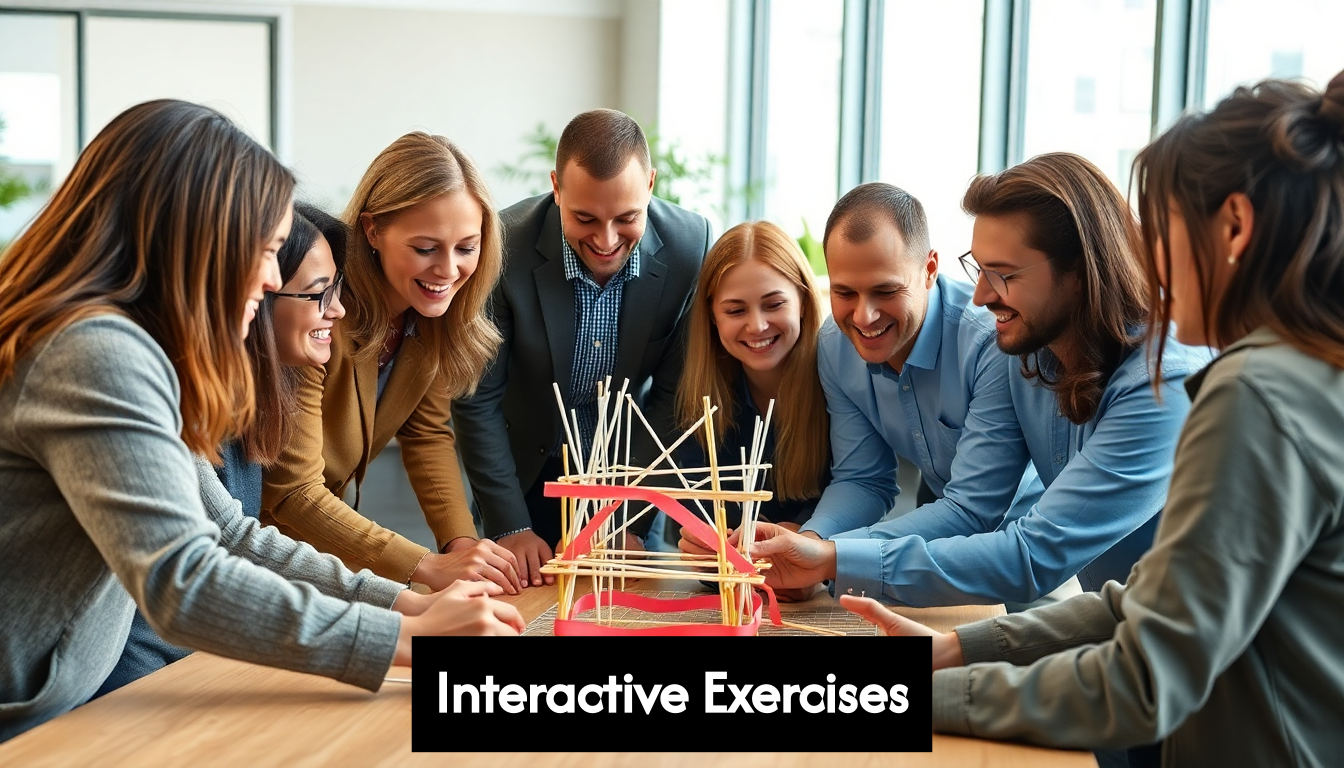
Interactive exercises provide hands-on experiences that transform abstract team building concepts into tangible skills. These activities create memorable shared experiences that strengthen bonds between team members while developing specific competencies. Let’s explore some of the most effective interactive exercises that can help your team reach new levels of cohesion and performance.
Physical Problem-Solving Activities
Physical problem-solving activities engage team members in challenges that require coordination, communication, and creative thinking. According to team building research, exercises like the “Blind Square Rope Game” and “Crocodile River” have been shown to effectively improve communication, trust, and collaboration among team members.
In the Blind Square Rope Game, participants are blindfolded and given a rope, then asked to form a perfect square while maintaining contact with the rope. This exercise forces team members to communicate clearly and develop trust as they work toward a common goal without visual cues. The activity reveals natural leaders, communication patterns, and how the team handles frustration—valuable insights that can be applied to workplace challenges.
The Crocodile River exercise challenges teams to cross an imaginary river full of crocodiles using limited resources (typically planks or platforms). The rules are simple: if anyone touches the ground, the team must restart. This activity encourages strategic thinking, resource management, and mutual support. It’s particularly effective for highlighting how teams approach planning versus execution and how they adapt when initial strategies fail.
Physical problem-solving activities are especially valuable because they level the playing field. In these contexts, job titles and hierarchy matter less than creativity, communication, and collaboration—creating opportunities for team members who might be less vocal in traditional workplace settings to demonstrate leadership and valuable skills.
Collaborative Creative Challenges
Collaborative creative challenges tap into team members’ imagination while building practical skills in communication, decision-making, and resource allocation. Activities like “The Egg Drop” and “Lego Challenge” are proven to foster creativity, out-of-box thinking, and improved teamwork in workplace settings.
In The Egg Drop, teams receive identical supplies (straws, tape, paper, etc.) and compete to build a structure that will protect a raw egg when dropped from height. This classic exercise combines engineering principles with team dynamics. The activity reveals how teams distribute roles, make decisions under time pressure, and balance creativity with practicality. During the debrief, teams can discuss how their approach to this challenge mirrors their approach to workplace projects.
The Lego Challenge divides participants into “builders” and “instructors.” Instructors view a pre-built Lego model and must verbally guide builders to recreate it without showing them the original. This exercise powerfully demonstrates the importance of clear communication, listening skills, and providing feedback. It also highlights assumptions that can lead to misunderstandings—a valuable lesson for workplace communication.
Collaborative creative challenges work well because they’re enjoyable while still delivering meaningful insights. The playful context reduces defensiveness, allowing team members to receive feedback more openly and recognize patterns in their collaborative approach that might otherwise go unnoticed.
Virtual and Hybrid Team Experiences
With increasingly distributed workforces, virtual team-building exercises have become essential. Research indicates that interactive team activities like “Virtual Escape Room” and “Human Knot” promote critical thinking, problem-solving, and communication skills while building team camaraderie and morale.
Virtual Escape Rooms have emerged as powerful team-building tools for remote teams. These digital adventures require participants to solve puzzles collaboratively to “escape” within a time limit. The format requires clear communication, diverse thinking styles, and effective task delegation—all transferable skills for workplace collaboration. The shared excitement of solving puzzles creates bonds even among team members who have never met in person.
For hybrid teams (some in-office, some remote), modified versions of traditional exercises work well. For example, the Human Knot—where participants stand in a circle, grab hands with non-adjacent teammates, and then try to untangle without breaking the chain—can be adapted by having remote participants direct in-person teammates through the challenge. This creates interdependence between remote and in-office staff, breaking down the isolation that remote workers often experience.
Digital whiteboard collaboration tools enhance many virtual exercises by providing shared visual spaces. Teams can use these for activities like “Collaborative Story,” where each team member adds elements to a developing narrative or diagram. These tools level the playing field between extroverts and introverts by allowing multiple simultaneous contributions.
The most effective interactive team exercises share common elements: they’re engaging, they create opportunities for different strengths to shine, and they include thoughtful debriefs that connect the activity to workplace applications. By incorporating these exercises into your team development strategy, you’ll build stronger connections while developing specific skills that enhance everyday collaboration.
Implementing Techniques for Lasting Change
Effective team building isn’t a one-time event but an ongoing commitment to growth and development. While team-building activities can generate enthusiasm and insights in the moment, the real challenge lies in translating these temporary gains into lasting organizational change. Let’s explore practical techniques for embedding team-building principles into your organization’s DNA and ensuring that the benefits endure long after specific activities conclude.
Create Structured Frameworks and Team Rituals
For team building to create lasting change, it must become part of your organization’s regular rhythm rather than an occasional special event. Creating a structured framework with team rituals reinforces employee autonomy and facilitates large-scale project management, which is essential for implementing lasting change in team dynamics.
Start by identifying specific team rituals that can be incorporated into your regular workflow. These might include weekly appreciation sessions where team members recognize each other’s contributions, monthly skill-sharing workshops where colleagues teach each other valuable skills, or quarterly team retrospectives that review progress and set new collaborative goals. The key is consistency—these rituals should occur regularly enough to become habitual but not so frequently that they become burdensome.
Take time to document the frameworks and processes that emerge from successful team-building activities. For example, if a problem-solving exercise reveals an effective decision-making approach, formalize that approach into a step-by-step process that teams can follow in their daily work. This documentation creates institutional memory that persists even as team membership changes over time.
Link team-building objectives directly to performance metrics and business outcomes. When team members understand how improved collaboration connects to concrete results, they’re more likely to maintain collaborative behaviors. For example, if team building focuses on improving cross-departmental communication, track how this improvement affects project completion times or customer satisfaction scores.
Build a Culture of Continuous Feedback and Recognition
Lasting change requires continuous reinforcement through feedback and recognition. Building trust through a culture of transparency, based on exchanges of feedback and intentional collaboration, fosters solid relationships and lasting team collaboration, directly impacting team morale over time.
Implement a structured feedback system that normalizes both giving and receiving constructive input. This might include regular 360-degree feedback sessions, peer coaching arrangements, or designated time in team meetings for feedback exchanges. The goal is to make feedback a normal, expected part of work rather than an unusual or threatening event.
Recognize and celebrate behaviors that align with team-building principles. Public acknowledgment of collaborative achievements reinforces their importance and motivates continued effort. Consider creating specific recognition categories tied to team values—for example, awards for exceptional cross-team collaboration, creative problem-solving, or supporting colleagues through challenges.
Invest in developing feedback skills across your organization. Many people lack confidence in giving clear, constructive feedback or receive feedback defensively. Providing training in these skills ensures that feedback exchanges actually strengthen rather than damage team relationships.
Reinforce Through Formal and Informal Learning
Team building in 2025 may periodically take the form of formal workshops, motivational keynotes, training sessions, or destination events to reinforce organizational changes and maintain momentum. These structured learning experiences provide opportunities to deepen team-building skills and address evolving challenges.
Design a progressive learning path that builds team capabilities over time. Rather than offering disconnected training events, create a curriculum that systematically develops skills from foundational to advanced. For example, start with basic communication workshops, then progress to conflict resolution, and finally to collaborative innovation techniques.
Complement formal training with informal learning opportunities. Establish mentoring partnerships that pair team members with different strengths and backgrounds. Create a resource library of articles, videos, and case studies related to effective collaboration. Encourage team members to share insights from their own reading and experiences during team meetings.
Capture and share success stories that illustrate the impact of improved team dynamics. These narratives make abstract principles concrete and provide models for others to follow. Consider creating a digital repository where teams can document collaborative breakthroughs and the specific techniques that enabled them.
Use a mix of learning formats to accommodate different learning preferences and practical constraints. While in-person workshops offer rich interaction opportunities, digital learning modules provide flexibility, and just-in-time resources offer support at the moment of need.
Implementing lasting change through team building requires patience and persistence. Quick fixes rarely lead to sustained improvement. Instead, focus on gradually building new habits, systems, and cultural norms that support collaboration. When team-building principles become embedded in how work gets done every day, rather than being treated as special occasions, you’ll see the lasting positive change that transforms organizational performance.
Frequently Asked Questions
What are the benefits of effective team building?
Effective team building enhances communication and trust among team members, improves productivity and performance, and increases employee retention and satisfaction.
How can I implement structured collaboration frameworks in my team?
You can implement structured collaboration frameworks by adopting models like GRPI (Goals, Roles, Processes, Interpersonal Relationships), which help clarify objectives and streamline teamwork processes.
What are some interactive exercises for team building?
Interactive exercises include physical problem-solving activities like the Blind Square Rope Game, collaborative creative challenges like the Egg Drop, and virtual experiences like Virtual Escape Rooms that foster teamwork and communication.
How can team building contribute to lasting change in an organization?
Team building can contribute to lasting change by creating structured frameworks and rituals, fostering a culture of continuous feedback and recognition, and reinforcing team dynamics through formal and informal learning opportunities.
Transform Your Team Dynamics Today!
Is your team struggling to communicate effectively or battling high turnover rates? The article on Effective Team Building Techniques highlights critical pain points like low morale, lack of trust, and insufficient collaboration. These obstacles can derail productivity and hinder innovation within your organization. But what if there was a way to turn these challenges into stepping stones for growth?
!
At Peuneo, we understand the importance of fostering a collaborative environment and nurturing employee relationships. Our accredited training programs and consulting services are meticulously designed to address these very issues, equipping your team with the skills they need to enhance communication, build trust, and work cohesively toward shared goals. Don’t let ineffective team dynamics hold you back!
Elevate your organization today! Visit peuneo.co.za to explore our comprehensive suite of training courses and consulting services crafted specifically to boost team morale and performance. Act now to start transforming your team and see the results for yourself!