

Every business talks about productivity and how to get more from their teams, but most skip over the simple power of effective training. Shockingly, companies that invest in employee development see productivity jumps of up to 24 percent according to recent studies. Everyone assumes technology is the main driver of performance and profit, but it turns out that skillful, ongoing training is the secret ingredient turning ordinary workforces into high performing powerhouses.
Table of Contents
- How Employee Training Drives Productivity Gains
- Key Metrics To Measure Training Impact
- Best Practices For Training In Different Sectors
- Overcoming Common Training Challenges
Quick Summary
| Takeaway | Explanation |
|---|---|
| Training enhances employee performance significantly | Systematic training addresses skill gaps, leading to improved operational efficiency and higher output quality. |
| Measure training impact with multiple metrics | Use performance, financial, and behavioral metrics to evaluate the effectiveness and ROI of training initiatives comprehensively. |
| Sector-specific training strategies are crucial | Tailor training approaches to address unique challenges and requirements of different industries for effective skill development. |
| Overcome engagement barriers with personalized content | Engaging training experiences that align with individual goals can increase participants’ motivation and commitment to learning. |
| Create a culture of continuous learning | Leadership support and resource allocation are essential for fostering an environment that values ongoing employee development. |
How Employee Training Drives Productivity Gains
Employee training represents a strategic investment that directly influences organizational productivity and performance. By systematically enhancing worker skills, knowledge, and capabilities, companies can unlock significant gains in operational efficiency and output quality.
Understanding the Performance Connection
Training programs create measurable improvements in employee performance by addressing skill gaps and providing targeted learning opportunities. Research from the Journal of Commerce and Trade investigated training effects in the IT sector and conclusively demonstrated that comprehensive development initiatives positively correlate with enhanced employee performance and productivity.
At its core, effective training empowers workers with several critical advantages. Employees gain deeper technical competencies, develop problem solving skills, and acquire updated knowledge relevant to their specific roles. This multifaceted approach ensures that workers are not just performing tasks, but executing them with greater precision, speed, and understanding.
Quantifying Training Impact
Statistical evidence reinforces the transformative potential of strategic training investments. A study published in GIS Business examining performance at the National Cement Factory in Ethiopia revealed a direct positive correlation between targeted training programs and employee performance metrics.
Companies implementing robust training strategies typically observe significant productivity improvements. Workers become more confident in their abilities, make fewer errors, and can complete complex tasks more efficiently. The learning process enables employees to work smarter, not just harder, by introducing best practices, innovative techniques, and streamlined workflows.
Long Term Organizational Benefits
Beyond immediate performance gains, comprehensive training programs generate sustained organizational advantages. Employees who receive consistent skill development demonstrate higher job satisfaction, increased loyalty, and greater engagement. These intangible benefits translate into reduced turnover rates and a more stable, motivated workforce.
Moreover, organizations that prioritize continuous learning create a culture of growth and adaptability. By understanding the strategic value of training programs, companies position themselves to rapidly respond to technological changes, market shifts, and emerging industry challenges.
The productivity gains from training are not merely theoretical but represent a tangible competitive advantage. By investing in human capital through targeted, high quality learning experiences, organizations can transform their workforce into a dynamic, high performing engine of innovation and efficiency.
Key Metrics to Measure Training Impact
Measuring the impact of training programs requires a comprehensive and strategic approach that goes beyond simple participant feedback. Organizations need robust, quantifiable metrics to truly understand the effectiveness and return on investment of their training initiatives.
Performance and Productivity Metrics
Research from the National Institutes of Health highlights the critical importance of using pre and post training performance assessments to evaluate training effectiveness. These metrics help organizations track tangible improvements in employee output, skill proficiency, and overall productivity.
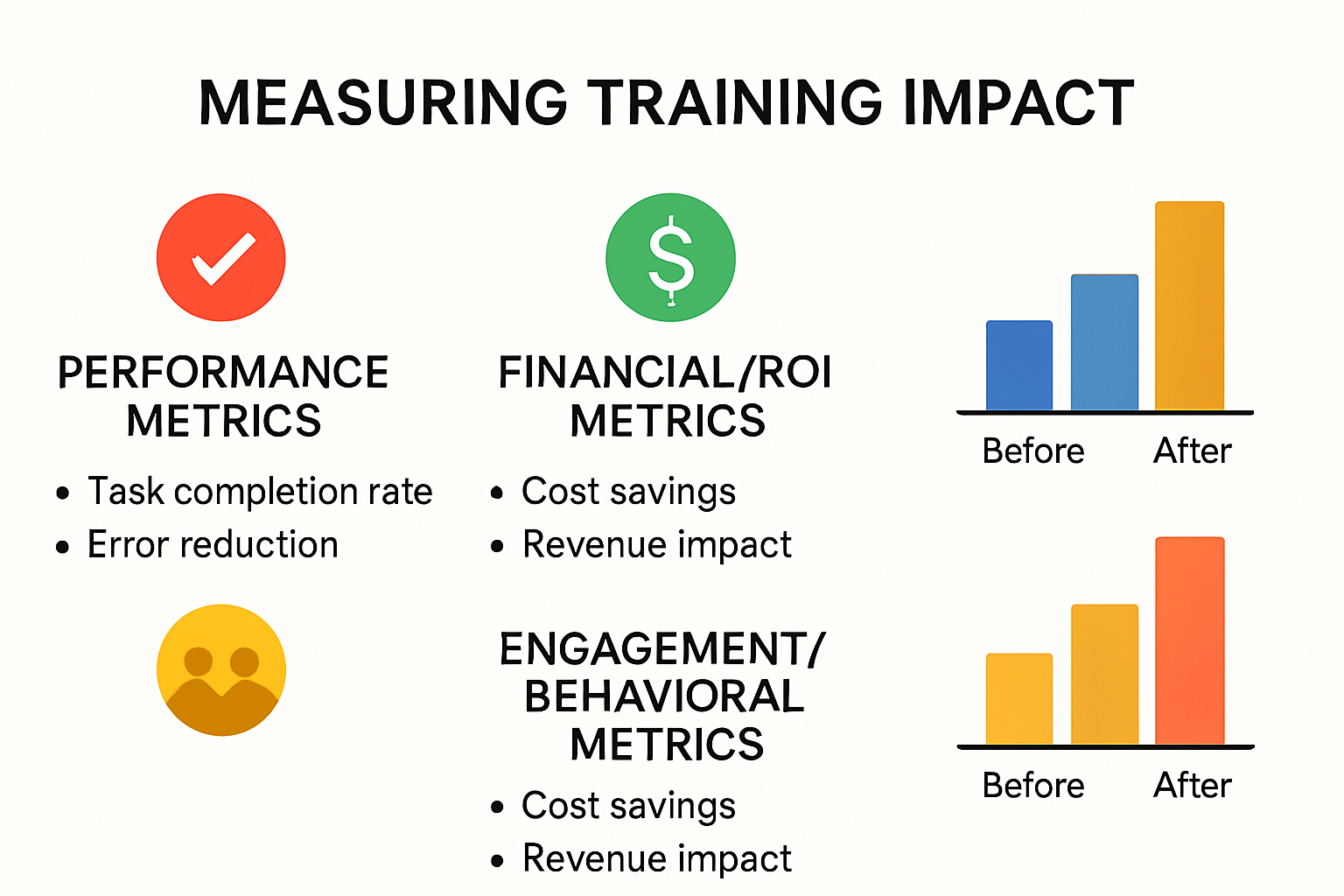
Key performance indicators include quantitative measurements such as task completion rates, error reduction percentages, and time efficiency gains. For instance, tracking the time required to complete specific job functions before and after training provides concrete evidence of skill enhancement. Some organizations implement sophisticated tracking systems that monitor individual and team performance metrics, allowing for granular analysis of training program impacts.
Financial and Return on Investment Metrics
Financial metrics offer a direct way to evaluate the economic value of training investments. Return on investment (ROI) calculations help organizations understand the monetary benefits generated by their training programs. These calculations typically compare the costs of training against the subsequent productivity gains, cost savings, and revenue increases.
Critical financial metrics include:
- Productivity cost savings: Measuring the reduction in time and resources required to complete tasks
- Revenue impact: Tracking performance improvements that directly contribute to increased organizational revenue
- Training cost per employee: Evaluating the efficiency of training expenditures
Behavioral and Engagement Metrics
Beyond quantitative measurements, organizations must also assess qualitative changes in employee behavior and engagement. Learn more about comprehensive training assessment techniques to gain deeper insights into program effectiveness.
Behavioral metrics include employee confidence levels, skill application in real world scenarios, and changes in workplace interactions. Engagement metrics might track indicators such as employee motivation, job satisfaction, and willingness to apply new skills. Surveys, performance reviews, and manager observations provide valuable data points for understanding these less tangible but equally important training outcomes.
A holistic approach to measuring training impact requires organizations to integrate multiple metric types. By combining performance, financial, and behavioral assessments, companies can develop a nuanced understanding of their training programs’ true value. This comprehensive evaluation enables continuous improvement, ensuring that training initiatives remain aligned with organizational goals and drive meaningful workforce development.
The following table consolidates and compares the main types of metrics organizations should use to measure the impact of training programs, offering a quick reference for their key features and methods.
| Metric Category | What It Measures | Examples/Methods |
|---|---|---|
| Performance/Productivity | Skill proficiency & output improvements | Task completion rates, error reduction, time efficiency |
| Financial/ROI | Economic value and cost efficiency | Productivity cost savings, revenue impact, training cost/employee |
| Behavioral/Engagement | Qualitative employee changes | Confidence, skill application, motivation, satisfaction |
Best Practices for Training in Different Sectors
Training strategies are not universal. Each sector requires unique approaches tailored to its specific technological demands, workforce characteristics, and operational challenges. Successful training programs recognize these nuanced differences and develop targeted interventions that address sector specific skill requirements.
Technology and Manufacturing Sector Training
Research from the National Institutes of Health highlights the critical importance of adaptive training methodologies in technology and manufacturing environments. These sectors demand continuous skill upgradation due to rapid technological transformations.
Key best practices include:
- Hands on technical training: Providing practical experience with current machinery and software
- Modular learning programs: Creating flexible training modules that can be quickly updated
- Technology simulation environments: Developing realistic training scenarios that mirror actual workplace conditions
Manufacturing and technology organizations must prioritize training that bridges theoretical knowledge with practical application. This approach ensures workers can immediately implement learned skills, reducing transition periods and improving overall productivity.

Healthcare Sector Training Approaches
Healthcare training requires an exceptional blend of technical proficiency and interpersonal skills. The sector demands training programs that not only teach medical protocols but also emphasize patient communication, emotional intelligence, and rapid decision making.
Effective healthcare training strategies include:
- Scenario based learning: Creating complex medical scenarios for skill assessment
- Interdisciplinary training: Encouraging collaboration across different medical departments
- Continuous professional development: Implementing regular skill refresher courses
Service and Customer Facing Sectors
Service industries require training that focuses on soft skills, customer interaction, and adaptability. Explore proven strategies for comprehensive workforce development to understand the nuanced approaches needed in customer facing roles.
Critical training components for service sectors include:
- Communication skill enhancement: Developing advanced verbal and non verbal communication techniques
- Emotional intelligence training: Teaching methods to manage complex customer interactions
- Cultural sensitivity programs: Preparing employees to work effectively in diverse environments
Each sector presents unique training challenges that demand sophisticated, targeted approaches. Successful organizations recognize that one size does not fit all. By developing sector specific training strategies that align with technological trends, workforce capabilities, and organizational goals, companies can create powerful learning environments that drive continuous improvement and sustainable productivity.
To help readers quickly compare training best practices across various sectors, the following table summarizes the key strategies highlighted for technology & manufacturing, healthcare, and service sectors.
| Sector | Main Training Focus | Key Practices |
|---|---|---|
| Technology & Manufacturing | Technical and adaptive skills | Hands-on technical practice, modular programs, simulation-based |
| Healthcare | Technical & interpersonal skills | Scenario-based learning, interdisciplinary teamwork, ongoing CPD |
| Service (Customer Facing) | Soft skills and adaptability | Communication training, emotional intelligence, cultural sensitivity |
Overcoming Common Training Challenges
Training programs, despite their immense potential, frequently encounter significant obstacles that can diminish their effectiveness and organizational impact. Understanding and proactively addressing these challenges is crucial for developing robust learning initiatives that genuinely enhance workforce capabilities.
Engagement and Motivation Barriers
Research from TriNet highlights the critical issue of employee engagement in training programs. Many organizations struggle to generate genuine interest and commitment from participants, which directly undermines the learning process.
Key strategies to overcome engagement challenges include:
- Personalized learning pathways: Tailoring training content to individual career goals and skill levels
- Interactive learning experiences: Incorporating gamification, real world scenarios, and practical applications
- Clear communication of training benefits: Demonstrating direct connections between training and career advancement
Successful training programs recognize that motivation is not uniform. Employees require compelling reasons to invest their time and energy in learning, beyond mandatory compliance requirements.
Technology and Implementation Challenges
LMS Portals research emphasizes the technological complexities inherent in modern training implementations. Organizations often struggle with platform selection, user adoption, and seamless integration of training technologies.
Effective technology implementation strategies include:
- Pilot program testing: Conducting small scale trials to identify and resolve potential issues
- User friendly platform selection: Prioritizing intuitive interfaces and accessible design
- Comprehensive technical support: Providing robust assistance during technology transitions
Organizational Culture and Structural Limitations
Learn more about creating a sustainable training culture that transcends traditional organizational barriers. Training success depends not just on program design, but on cultivating an environment that genuinely values continuous learning.
Critical cultural considerations include:
- Leadership commitment: Ensuring top management actively supports and participates in training initiatives
- Resource allocation: Dedicating sufficient time, budget, and organizational resources to learning and development
- Continuous feedback mechanisms: Establishing systematic approaches to evaluate and improve training programs
Overcoming training challenges requires a holistic, strategic approach that addresses technological, motivational, and cultural dimensions. Organizations must view training not as a standalone activity, but as an integrated process of workforce development. By anticipating potential obstacles, implementing flexible solutions, and maintaining a commitment to continuous improvement, companies can transform training from a routine requirement into a powerful catalyst for organizational growth and individual employee advancement.
Frequently Asked Questions
How does employee training improve productivity?
Employee training improves productivity by addressing skill gaps, enhancing workers’ competencies, and providing targeted learning opportunities, resulting in higher operational efficiency and output quality.
What metrics should be used to measure the impact of training?
Key metrics include performance and productivity metrics (task completion rates, error reduction), financial metrics (ROI, productivity cost savings), and behavioral metrics (employee confidence, job satisfaction).
Why is sector-specific training important?
Sector-specific training is important because different industries have unique challenges and requirements. Tailored training strategies ensure that employees develop relevant skills that directly apply to their specific roles and environments.
What are common challenges in implementing training programs?
Common challenges include employee engagement and motivation barriers, technological complexities in implementation, and structural limitations within the organizational culture that may hinder training effectiveness.
Unlock Real Productivity Gains With Tailored Training
Do you see your team struggling with outdated skills or low engagement? As highlighted in this article, ineffective training can stall productivity, drain morale, and leave you lagging behind competitors. But building a culture of continuous learning and tracking real progress is more than a theory—it is a proven way to drive measurable performance and achieve lasting results.

Now is your moment to act. At Peuneo, our accredited skills development and consulting solutions are designed for South African businesses ready to turn training into higher output and lasting growth. Explore our comprehensive online learning portal to enroll in sector-specific courses or speak to our team about custom consulting services that transform training challenges into real productivity improvements. Take the next step and start building your high-performing workforce today.