


Employee training is getting a major upgrade in 2025. Companies using artificial intelligence can now personalize learning in ways never seen before, with AI-powered systems making training up to 40 percent more effective. Expecting more screens and longer slide decks? Think again. Virtual reality and data-driven analytics are quietly changing the game, setting a new standard where every minute spent learning delivers measurable business value.
Table of Contents
- Digital Transformation In Employee Training
- Personalized Learning Paths And Adaptive Tools
- Focus On Soft Skills And Leadership Development
- Measuring Impact And ROI In 2025 Training Programs
Quick Summary
| Takeaway | Explanation |
|---|---|
| Embrace AI for Customized Learning | Leverage AI-powered systems to create personalized training modules based on individual employee performance, learning styles, and skill gaps, increasing effectiveness by up to 40%. |
| Utilize Immersive Technologies | Incorporate VR and AR in training to provide realistic, risk-free learning environments that enhance engagement and knowledge retention, achieving up to four times more focus than traditional methods. |
| Focus on Soft Skills Development | Recognize the growing importance of soft skills and leadership capabilities in the workforce, implementing training programs that develop emotional intelligence and effective communication. |
| Measure Impact with Advanced Analytics | Adopt sophisticated metrics and holistic ROI methodologies that include behavioral changes and business outcomes, turning training into a strategic business driver rather than a compliance exercise. |
| Incorporate Microlearning Strategies | Deploy microlearning to provide just-in-time training content that is immediately applicable, resulting in higher engagement and faster skill development, fitting seamlessly into modern workflows. |
Digital Transformation in Employee Training
The rapid evolution of technology is fundamentally reshaping employee training strategies across modern workplaces. Digital transformation represents a comprehensive reimagining of learning and development approaches, moving far beyond traditional classroom-based instruction toward more adaptive, personalized, and technology-enabled training experiences.
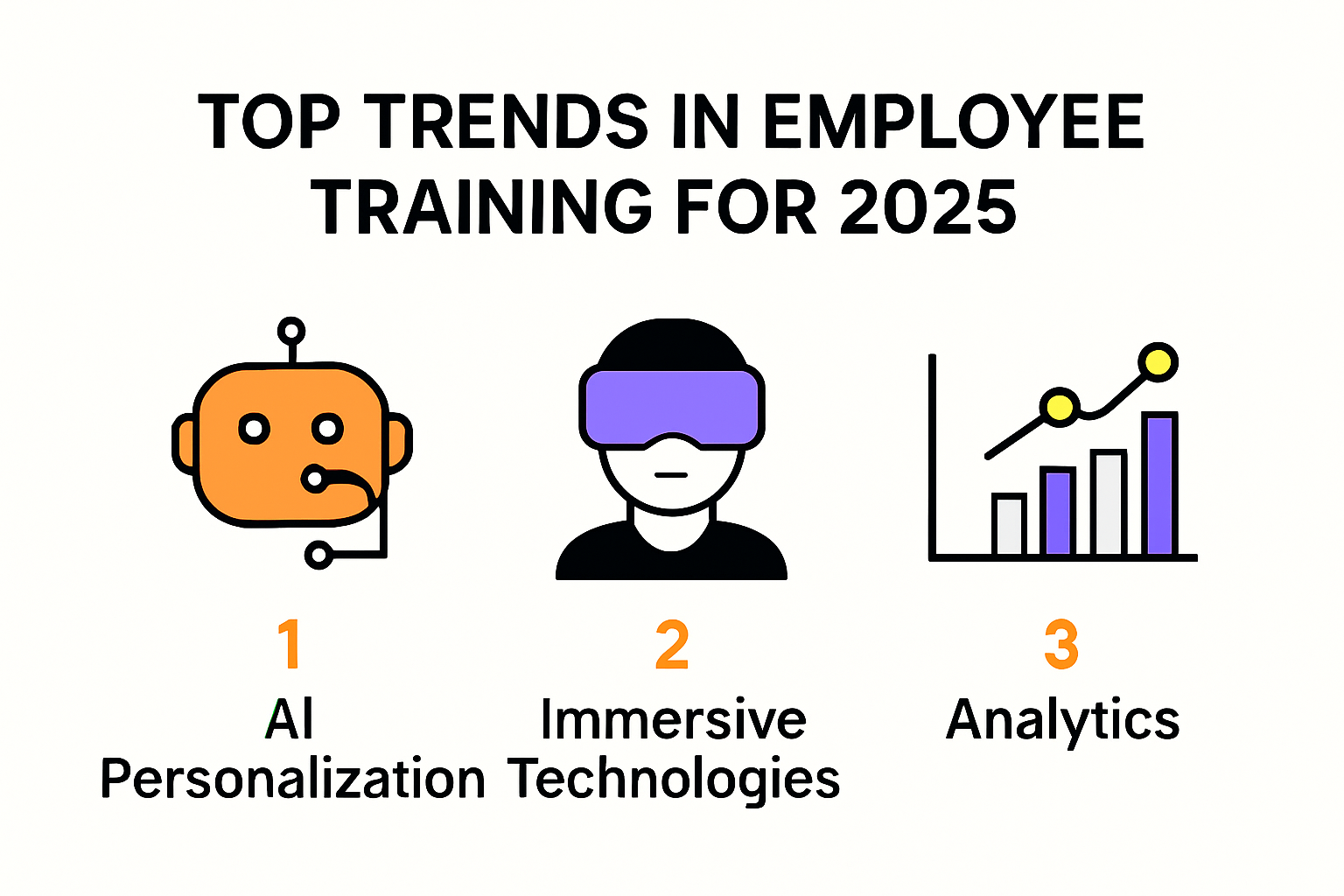
Artificial Intelligence and Personalized Learning Pathways
Artificial intelligence is revolutionizing employee training by creating unprecedented opportunities for customized learning experiences. Explore our technology training strategies to understand this transformation. AI-powered systems can now analyze individual employee performance, learning styles, and skill gaps to generate unique training modules tailored specifically to each worker’s needs. According to research from Gartner, AI-driven personalization can increase learning effectiveness by up to 40% compared to traditional one-size-fits-all training approaches.
These intelligent systems continuously adapt training content based on real-time performance metrics, ensuring that employees receive precisely the knowledge and skills they require for professional growth. Machine learning algorithms track progress, predict potential skill development areas, and recommend targeted learning interventions, creating a dynamic and responsive training ecosystem.
Immersive Technologies and Experiential Learning
Digital transformation is introducing immersive technologies that fundamentally change how employees learn and interact with training content. Virtual reality (VR) and augmented reality (AR) are emerging as powerful tools for creating realistic, risk-free training environments across multiple industries. Research from PwC indicates that VR training can be up to four times more focused than traditional e-learning methods, with significantly higher knowledge retention rates.
For complex technical skills or high-risk scenarios, these technologies provide safe simulation spaces where employees can practice procedures, troubleshoot challenges, and develop muscle memory without real-world consequences. From medical training to industrial equipment operation, immersive technologies are bridging theoretical knowledge and practical application in unprecedented ways.
Data-Driven Learning Analytics
The integration of advanced analytics transforms training from a subjective experience to a measurable, strategic business function. Organizations can now track granular learning metrics, understanding not just completion rates but deep insights into skill acquisition, knowledge transfer, and performance improvement. According to MIT Technology Review, companies implementing data-driven learning strategies report 22% higher employee productivity and more targeted skill development.
These sophisticated analytics platforms provide comprehensive dashboards that reveal learning trends, identify skill gaps across teams, and enable proactive workforce development strategies. By converting training data into actionable intelligence, businesses can align learning initiatives directly with organizational goals, ensuring that employee development becomes a precise, strategic investment rather than a generic compliance exercise.
Digital transformation in employee training represents more than technological adoption—it signifies a fundamental shift toward more intelligent, responsive, and human-centered learning experiences that empower workers to continuously grow and adapt in an ever-changing professional landscape.
Personalized Learning Paths and Adaptive Tools
The future of employee training is moving decisively toward highly individualized learning experiences that recognize each worker as a unique learner with distinct skills, knowledge gaps, and professional development needs. Personalized learning paths represent a transformative approach that goes beyond traditional training models, leveraging advanced technologies to create dynamic, responsive educational experiences.
Intelligent Learning Platforms and Skill Mapping
Modern adaptive learning tools are revolutionizing how organizations approach skill development. Explore our strategic training approaches to understand this personalization. According to research from Deloitte, companies implementing intelligent learning platforms see up to 35% improvement in employee skill acquisition and retention.
These sophisticated platforms utilize advanced algorithms to create comprehensive skill maps for each employee. By analyzing existing competencies, performance metrics, and career trajectory, the systems generate customized learning recommendations that are precisely tailored to individual professional development needs. The technology goes beyond generic training modules, instead creating a nuanced learning journey that adapts in real-time based on the employee’s progress and emerging skill requirements.
AI-Driven Personalization and Adaptive Content
Artificial intelligence is at the forefront of creating truly personalized learning experiences. Research from McKinsey demonstrates that AI-powered adaptive learning tools can reduce training time by up to 50% while simultaneously improving knowledge retention and skill mastery.

These intelligent systems continuously analyze learner interactions, identifying individual learning preferences, pace, and comprehension levels. The AI then dynamically adjusts content difficulty, presentation format, and learning sequence to optimize engagement and knowledge absorption. For instance, an employee struggling with a complex technical concept might receive additional visual explanations, interactive demonstrations, or supplementary practice modules, while a quick learner would be presented with more advanced challenges.
Microlearning and Just-In-Time Training
Personalized learning paths are increasingly incorporating microlearning strategies that deliver targeted, bite-sized learning content precisely when employees need it. According to research from LinkedIn Learning, organizations implementing microlearning see 17% higher employee engagement and significantly faster skill development.
These compact learning modules are designed to be immediately applicable, allowing employees to acquire specific skills or knowledge exactly when required. The approach recognizes that modern professionals need flexible, on-demand learning experiences that fit seamlessly into their workflow. By breaking down complex topics into digestible segments and delivering them through multiple formats—including short videos, interactive modules, quick assessments—microlearning ensures that training remains relevant, accessible, and immediately practical.
Personalized learning paths represent more than a technological innovation. They signify a fundamental shift toward recognizing individual learning needs, respecting diverse learning styles, and creating more human-centered professional development strategies that empower employees to continuously grow and adapt in an increasingly complex professional landscape.
Focus on Soft Skills and Leadership Development
The professional landscape of 2025 demands more than technical expertise. Organizations are increasingly recognizing that soft skills and advanced leadership capabilities are critical differentiators in a rapidly evolving workplace. These interpersonal and adaptive skills have become essential for navigating complex organizational challenges and driving meaningful business outcomes.
The Strategic Importance of Soft Skills
Discover strategies for skill development that transform professional potential. According to research from the World Economic Forum, soft skills like critical thinking, emotional intelligence, and adaptability are projected to become primary drivers of workforce success. Companies are shifting from traditional technical training toward holistic skill development that emphasizes human-centric capabilities.
These skills transcend traditional job boundaries, enabling employees to communicate effectively, solve complex problems, and collaborate across diverse teams. Organizations are implementing comprehensive assessment frameworks that evaluate and nurture these critical competencies. By recognizing soft skills as strategic assets, businesses are creating more resilient, innovative, and agile workforce ecosystems.
Leadership Development in the Digital Era
Research from Gartner highlights that modern leadership development must go beyond conventional management training. Contemporary leaders require a nuanced blend of technological understanding, emotional intelligence, and adaptive thinking. The digital transformation demands leaders who can navigate uncertainty, inspire remote teams, and drive organizational change with empathy and strategic vision.
Advanced leadership programs are incorporating immersive learning experiences that simulate complex organizational scenarios. These training interventions use sophisticated simulations, AI-driven feedback mechanisms, and personalized coaching to develop multifaceted leadership capabilities. By focusing on practical skills like strategic communication, change management, and cross-cultural collaboration, organizations are preparing leaders who can thrive in increasingly dynamic business environments.
Emotional Intelligence and Team Dynamics
Research from Harvard Business Review reveals that emotional intelligence is becoming a critical predictor of professional success. Organizations are developing targeted training programs that help employees and leaders understand and manage emotional responses, build stronger interpersonal relationships, and create more inclusive workplace cultures.
Emotional intelligence training encompasses multiple dimensions, including self-awareness, empathy, social skills, and emotional regulation. These programs teach participants to recognize and navigate complex emotional landscapes, resolve conflicts constructively, and create supportive team environments. By investing in emotional intelligence development, companies are building more resilient, collaborative, and psychologically safe workplaces.
The focus on soft skills and leadership development represents a profound shift in organizational learning strategies. It acknowledges that human potential extends far beyond technical competencies, recognizing the intricate emotional and interpersonal dimensions that drive true professional excellence. As technological advancements continue to reshape work, the ability to adapt, communicate, and lead with empathy will increasingly become the most valuable organizational asset.
Measuring Impact and ROI in 2025 Training Programs
The landscape of employee training has evolved dramatically, making robust measurement strategies more critical than ever. Organizations are moving beyond traditional evaluation methods, recognizing that comprehensive impact assessment is key to demonstrating the true value of learning and development investments.
Advanced Metrics and Analytics Frameworks
Learn how to evaluate training effectiveness with precision and insight. According to research from the Association for Talent Development, organizations are adopting sophisticated multi-dimensional assessment approaches that go far beyond simple completion rates and test scores.
Modern impact measurement integrates complex data points including behavioral changes, performance improvements, and direct business outcomes. Advanced analytics platforms now enable organizations to create sophisticated dashboards that track learning interventions from initial engagement through long-term organizational impact. These frameworks utilize machine learning algorithms to correlate training experiences with quantifiable business metrics, providing unprecedented visibility into the true value of learning investments.
Holistic ROI Calculation Methodologies
Research from McKinsey reveals that comprehensive ROI calculation now encompasses a broader range of value indicators. Traditional financial metrics are being supplemented with qualitative assessments that capture the nuanced impact of training on organizational culture, employee engagement, and strategic capabilities.
The most progressive organizations are developing integrated measurement models that consider multiple dimensions of value creation. These include direct financial returns, productivity improvements, talent retention rates, innovation potential, and cultural transformation metrics. By creating more holistic evaluation frameworks, companies can demonstrate the comprehensive value of their training investments beyond simple monetary calculations.
Predictive Performance Measurement
Research from Gartner highlights the emergence of predictive analytics in training impact assessment. Organizations are now using advanced algorithms to forecast potential performance improvements, identify skill development trajectories, and proactively address potential capability gaps before they impact business performance.
These predictive measurement approaches leverage artificial intelligence to create dynamic performance models. By analyzing historical training data, current workforce capabilities, and emerging industry trends, organizations can develop forward-looking assessment strategies. This approach allows for more strategic learning interventions, enabling companies to anticipate and address skill development needs with unprecedented precision.
Measuring the impact of training programs in 2025 represents a sophisticated blend of data science, strategic thinking, and organizational psychology. As learning and development continue to evolve, the ability to comprehensively demonstrate value becomes a critical competitive advantage. Organizations that master these advanced measurement techniques will be best positioned to transform training from a cost center to a strategic business driver.
To provide a clear overview of the powerful technologies and approaches transforming employee training, the following table summarizes the major trends, tools, and their associated key benefits as described above.
| Trend/Tool | Technologies/Approaches | Key Benefit/Statistic |
|---|---|---|
| AI-Powered Personalization | AI, machine learning, skill mapping, adaptive content | Up to 40% improvement in learning effectiveness |
| Immersive Training | Virtual Reality (VR), Augmented Reality (AR), risk-free simulations | Up to 4x focus and higher retention than traditionals |
| Data-Driven Analytics | Advanced dashboards, granular metrics, machine learning analytics | 22% higher employee productivity |
| Microlearning | Short modules, multi-format delivery, just-in-time access | 17% higher engagement, faster skill development |
| Intelligent Platforms for Skills | Skill mapping, learning platforms, real-time adaptation | 35% improvement in acquisition and retention |
| Predictive Performance Analytics | AI, predictive modeling, proactive capability management | Anticipates gaps before business impact |
To help differentiate among types of measurement strategies discussed, this comparison table outlines each method, what it measures, and its advantages for 2025 training programs.
| Measurement Method | What It Measures | Advantages/Outcomes |
|---|---|---|
| Completion Rates/Test Scores | Training completion, basic knowledge | Simple baseline metrics |
| Behavioral Change Assessments | Changes in employee behavior post-training | Captures real-world application |
| Analytics Dashboards | Skill acquisition, productivity, business results | Enables strategic workforce alignment |
| Holistic ROI Models | Financial, cultural, engagement, retention outcomes | Shows comprehensive impact beyond finances |
| Predictive Analytics | Forecasts skill gaps/performance improvements | Allows proactive, targeted interventions |
Frequently Asked Questions
What are the key trends in employee training for 2025?
Employee training in 2025 is marked by the use of AI for personalized learning, immersive technologies like VR and AR, a focus on soft skills and leadership development, and advanced data-driven analytics for measuring training effectiveness.
How does artificial intelligence enhance employee training?
Artificial intelligence enhances employee training by creating personalized learning pathways, adapting content based on individual performance and learning styles, and increasing training effectiveness by up to 40% compared to traditional methods.
Why are soft skills important in modern employee training?
Soft skills are critical in modern workplaces as they empower employees to communicate effectively, solve complex problems, and collaborate across diverse teams, ultimately driving better business outcomes.
What metrics should organizations use to measure the impact of training programs?
Organizations should use advanced metrics that track behavioral changes, skill acquisition, productivity improvements, and holistic ROI to comprehensively evaluate the impact of training programs.
Take Your Employee Training to the Next Level in 2025
Modern workplaces face the real challenge of making training truly effective. As highlighted in the article, the need for personalized learning, AI-powered training tools, and data-driven results is growing fast. If you feel lost in a sea of outdated methods or are struggling to measure real impact from your training programs, you are not alone. Many organizations are searching for ways to deliver results that matter and keep up with the latest trends.
Explore forward-thinking solutions here

Step into the future of employee development with Peuneo. Discover accredited training, consulting, and a powerful online learning portal designed for measurable growth. Our programs reflect all the key trends from this article. Do not wait until your competitors move ahead. Take action today and give your team the training advantage they deserve.
Recommended
- 2025 Trends in Employee Development: 5 Key Strategies – Peuneo
- Current Trends in Employee Training for 2025 – Peuneo
- Impact of Technology on Training 2025 | Improve Skills – Peuneo
- 2025 Essential Insights: The Importance of Training Programs – Peuneo
- How to Conduct Effective Training: 2025 Actionable Tips – Peuneo
- Top Effective Training Methods 2025: Boost Your Team – Peuneo