


Managers keep hearing about soft skills, but the real surprise is just how much they matter for team success. Soft skills can drive up team productivity by 12 percent according to recent studies. Most people think technical expertise is what makes a great leader, but the truth is emotional intelligence and clear communication are now topping the must-have list for those aiming for management success in 2025. The secret isn’t just mastering your tasks, it’s building trust, adaptability, and high-functioning teams ready for whatever comes next.
Table of Contents
- Key Soft Skills Every Manager Needs
- How Soft Skills Drive Team Performance
- Training Solutions For Building Soft Skills
- Future-Proofing Management With Soft Skills
Quick Summary
| Takeaway | Explanation |
|---|---|
| Emotional Intelligence is Essential | Managers need to develop emotional intelligence to understand their emotions and empathize with their team’s emotional states, enhancing trust and conflict resolution. |
| Effective Communication and Adaptability are Key | Strategic communication and the ability to adapt to changes are crucial for managers to lead effectively in diverse workplace environments. |
| Soft Skills Drive Team Performance | Investing in soft skills can increase team productivity by 12%, transforming groups into high-functioning units through collaboration and clear communication. |
| Targeted Training is Necessary | Organizations must implement comprehensive training programs that address specific soft skill gaps, utilizing methods like workshops, virtual learning, and experiential scenarios. |
| Future-Proofing with Soft Skills | Continuous learning and technology integration, such as virtual reality and AI, will enhance managers’ soft skills and prepare them to navigate the evolving challenges of 2025. |
Key Soft Skills Every Manager Needs
Managers today require a robust set of soft skills to successfully navigate complex workplace environments and lead teams effectively. Beyond technical expertise, these interpersonal capabilities determine a leader’s capacity to inspire, communicate, and drive organizational success.
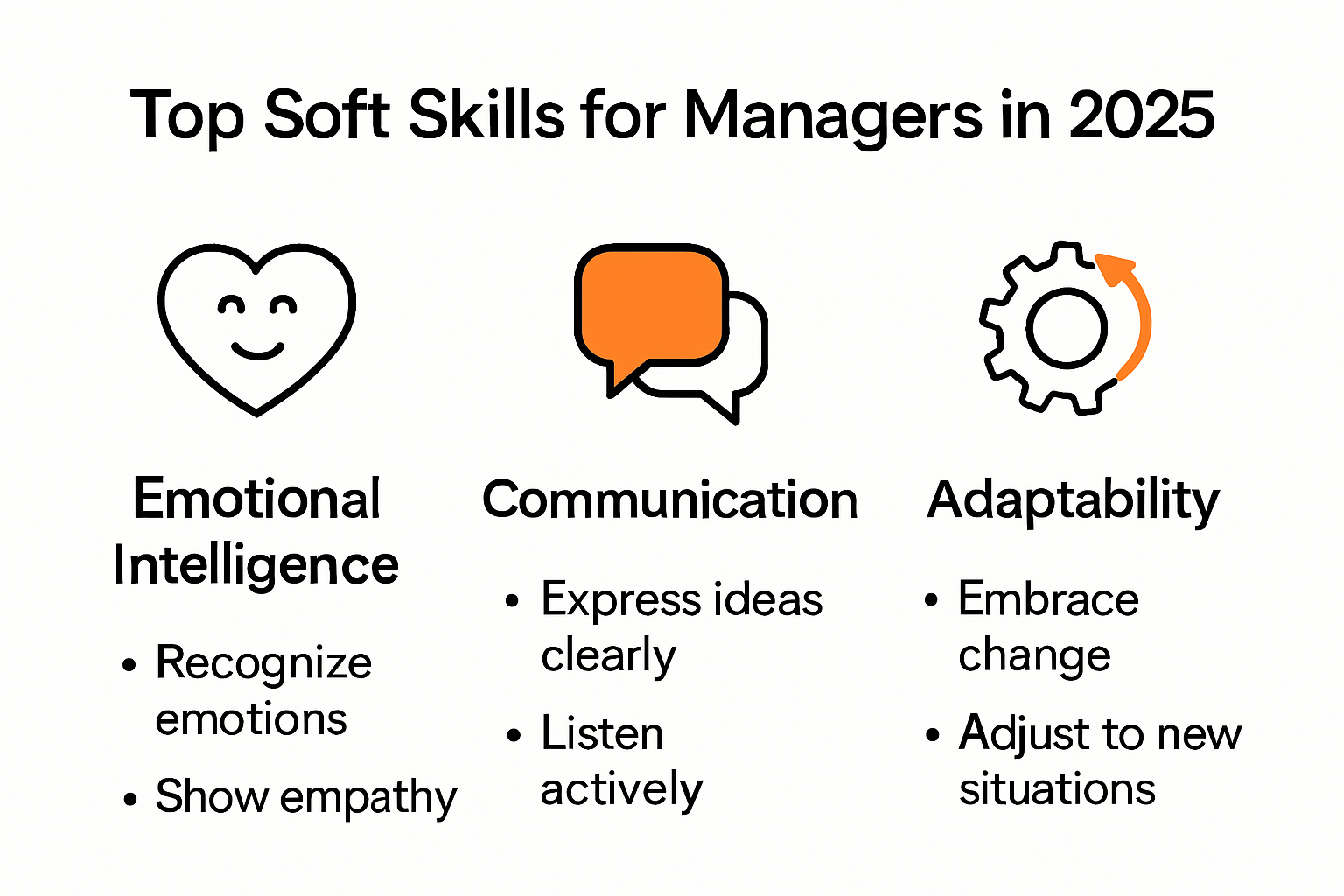
Emotional Intelligence: The Core Leadership Skill
Emotional intelligence stands at the forefront of critical management soft skills. According to research from Compunnel, this skill enables managers to understand and manage their own emotions while empathetically responding to team members’ emotional states. Emotionally intelligent managers can:
- Recognize emotional triggers: Understand personal and team emotional patterns
- Manage workplace conflicts: Resolve disputes with compassion and objectivity
- Build stronger relationships: Create trust and psychological safety within teams
Research indicates that 92% of hiring managers now prioritize soft skills equally or above technical capabilities for leadership roles, highlighting emotional intelligence’s critical importance.
Strategic Communication and Adaptability
Effective communication transcends simple information transmission. Managers must communicate strategically, tailoring messages to diverse audiences and contexts. This involves active listening, clear articulation, and the ability to provide constructive feedback. Modern managers need communication skills that bridge generational, cultural, and technological divides.
Adaptability complements communication as a crucial soft skill. In rapidly evolving business landscapes, managers must quickly pivot strategies, embrace change, and guide teams through uncertainty. The ability to remain flexible and maintain composure during disruptions separates exceptional leaders from average managers.
Critical Thinking and Collaborative Leadership
Critical thinking enables managers to analyze complex situations, make informed decisions, and develop innovative solutions. This skill involves:
- Objective problem solving: Evaluating scenarios from multiple perspectives
- Strategic decision making: Considering long term organizational implications
- Creative problem resolution: Developing unique approaches to challenges
Collaborative leadership further amplifies a manager’s effectiveness. By fostering an environment of inclusive teamwork, managers can unlock team potential through strategic skill development. This involves breaking down silos, encouraging cross functional cooperation, and creating platforms for collective innovation.
As workplace dynamics continue transforming, managers who invest in developing these soft skills will be best positioned to lead successfully in 2025 and beyond. The most effective leaders recognize that technical skills get the job done, but soft skills inspire and elevate team performance.
How Soft Skills Drive Team Performance
Team performance is not merely about individual technical capabilities but hinges critically on the collective soft skills that transform groups of professionals into high functioning units. Soft skills act as the invisible infrastructure that connects, motivates, and propels teams toward exceptional organizational outcomes.
The Productivity Multiplier Effect
Soft skills create a significant performance multiplier within teams. According to research from workplace productivity studies, employees with strong interpersonal capabilities contribute to a 12% increase in overall productivity. This demonstrates that soft skills are not peripheral luxuries but core drivers of workplace effectiveness.
Effective communication stands at the heart of this performance acceleration. When team members can articulate ideas clearly, listen actively, and provide constructive feedback, they reduce misunderstandings and create an environment of collaborative problem solving. These interactions minimize friction and optimize collective energy toward shared objectives.
Building Psychological Safety and Trust

Psychological safety emerges as a critical outcome of well developed soft skills. Teams where members feel respected, heard, and supported are more likely to take calculated risks, share innovative ideas, and support one another through challenges. By cultivating empathy, emotional intelligence, and inclusive communication, managers can develop resilient team dynamics that transcend traditional performance boundaries.
Research indicates that 63% of professionals who received targeted soft skills training reported tangible improvements in their job performance. This statistic underscores the transformative potential of intentional skill development focused on interpersonal capabilities.
Adaptability and Collaborative Problem Solving
In an era of constant technological and organizational change, soft skills become the primary mechanism for team resilience. Adaptable teams characterized by strong collaborative skills can pivot quickly, absorb unexpected challenges, and maintain momentum during disruptions. Critical thinking combined with empathetic communication allows teams to:
- Reframe challenges: View obstacles as opportunities for collective innovation
- Navigate complexity: Break down intricate problems through diverse perspectives
- Maintain team morale: Support each other during high stress scenarios
Managerial soft skills play a pivotal role in modeling and fostering these team dynamics. Leaders who demonstrate flexibility, emotional intelligence, and strategic communication create a cultural blueprint that team members naturally emulate.
The future of organizational success will increasingly depend on teams that can think holistically, communicate transparently, and adapt swiftly. Soft skills are no longer optional enhancements but fundamental competencies that distinguish high performing teams from merely functional groups.
Training Solutions for Building Soft Skills
Developing soft skills requires strategic and comprehensive training approaches that go beyond traditional learning methodologies. As the global soft skills training market continues to expand, organizations must invest in targeted programs that systematically enhance managers’ interpersonal capabilities.
Comprehensive Training Methodologies
Modern soft skills training demands a multifaceted approach. Research on skill development strategies reveals that effective programs integrate multiple learning formats to maximize skill absorption and retention. According to market research from Global Newswire, the soft skills training market is projected to grow from USD 33.4 billion in 2024 to USD 92.6 billion by 2033, underscoring the critical importance of these development initiatives.
Training solutions typically encompass three primary delivery methods:
- Instructor-led workshops: Intensive, interactive sessions that provide immediate feedback
- Virtual learning platforms: Flexible online modules allowing self-paced skill development
- Experiential learning programs: Practical scenarios that simulate real world management challenges
Targeted Skill Development Approaches
Successful soft skills training requires precision in addressing specific competency gaps. Organizations must design programs that focus on critical areas such as emotional intelligence, communication, adaptability, and collaborative leadership. According to workplace performance research, managers benefit most from training interventions that:
- Diagnose individual skill gaps: Conduct comprehensive assessments to identify specific development needs
- Create personalized learning paths: Develop targeted interventions based on individual and organizational requirements
- Implement continuous feedback mechanisms: Provide ongoing support and performance evaluation
Measuring Training Effectiveness
Quantifying the impact of soft skills training is crucial for organizational growth. Advanced assessment techniques now go beyond traditional metrics, incorporating:
- 360-degree feedback systems: Gathering comprehensive performance insights from multiple stakeholders
- Behavioral change tracking: Monitoring tangible improvements in workplace interactions
- Performance correlation analysis: Connecting soft skills development to organizational outcomes
The most progressive organizations recognize that soft skills training is not a one time event but a continuous journey of personal and professional development. As workplace dynamics evolve, managers must commit to ongoing learning and adaptation.
Additional training insights can be found in our comprehensive guide to professional development, which offers deeper exploration of cutting-edge skill enhancement strategies. By investing in targeted, holistic training solutions, organizations can build a resilient leadership workforce prepared to navigate the complex challenges of 2025 and beyond.
Future-Proofing Management with Soft Skills
In the rapidly evolving professional landscape of 2025, managers must strategically develop soft skills to remain competitive and effective. Future-proofing leadership capabilities requires a proactive approach to skill development that anticipates and adapts to emerging workplace challenges.
Emerging Soft Skills Landscape
The workplace of 2025 demands a new breed of managers who can navigate complex, dynamic environments. According to research from workforce development experts, soft skills have become the primary differentiator for successful leaders. An astounding 84% of employees and managers now believe that new professionals must showcase strong interpersonal capabilities during the hiring process.
Key emerging soft skills critical for future-proofing management include:
- Technological adaptability: Seamlessly integrating human intelligence with technological tools
- Cross-cultural communication: Navigating global and diverse workplace environments
- Emotional resilience: Maintaining performance under increasing workplace pressures
Strategic Skill Development Approach
Future-proofing requires a deliberate and comprehensive approach to soft skills development. Managers can systematically enhance their leadership capabilities by implementing a multi-dimensional growth strategy. This involves continuous learning, self-assessment, and targeted skill enhancement.
Critical components of an effective future-proofing strategy include:
- Continuous learning mindset: Embracing ongoing personal and professional development
- Proactive skill gap analysis: Regularly identifying and addressing potential skill weaknesses
- Adaptive learning techniques: Utilizing diverse training methods to enhance skill acquisition
Technology and Soft Skills Integration
Technology will play a crucial role in soft skills development. Emerging tools and platforms are now designed to simulate complex interpersonal scenarios, providing managers with immersive learning experiences. Artificial intelligence and advanced simulation technologies enable professionals to practice and refine critical soft skills in controlled, low-risk environments.
Key technological approaches to soft skills enhancement include:
- Virtual reality training: Creating realistic workplace interaction simulations
- AI-powered feedback systems: Providing personalized skill development insights
- Adaptive learning platforms: Customizing skill development paths based on individual needs
The most successful managers in 2025 will be those who view soft skills not as static attributes but as dynamic capabilities requiring continuous cultivation. By embracing a holistic approach to skill development, leaders can position themselves at the forefront of organizational success.
Explore our comprehensive guide to career advancement skills to gain deeper insights into preparing for the future of work. The ability to adapt, learn, and grow will separate exceptional leaders from the rest in the increasingly complex professional landscape of 2025 and beyond.
Frequently Asked Questions
What are the key soft skills every manager needs for success in 2025?
Key soft skills include emotional intelligence, strategic communication, adaptability, critical thinking, and collaborative leadership. These skills help managers lead effective teams and navigate complex workplace environments.
How do soft skills affect team performance?
Soft skills significantly enhance team performance by fostering better communication, building trust, and increasing productivity. Studies show that strong interpersonal skills can lead to a 12% increase in overall team productivity.
What training solutions are available for developing soft skills in managers?
Training solutions include instructor-led workshops, virtual learning platforms, and experiential learning programs. Organizations should focus on targeted skill development and measurable training effectiveness to enhance manager capabilities.
How can managers future-proof their leadership with soft skills?
Managers can future-proof their leadership by continuously enhancing their soft skills, embracing technological integration in training, and proactively assessing skill gaps. This approach equips them to handle evolving workplace challenges effectively.
Unlock Team Potential With Accredited Soft Skills Training
Struggling to bridge the gap between technical expertise and heartfelt team leadership? As highlighted in our latest article, most managers face real challenges with emotional intelligence, adaptability, and critical thinking. These roadblocks can hold back growth and drag down team performance, creating frustration and uncertainty about how to succeed in 2025.

You can future-proof your leadership and truly energize your workforce with support from Peuneo’s accredited training solutions. Our practical, industry-recognized programs are designed for real managers in South Africa who need immediate results. With interactive online courses and expert consulting, you will gain the confidence to:
- Resolve workplace tension with empathy
- Lead change with high-impact communication
- Build trust and deliver measurable productivity improvements
Do not let your organization fall behind. Visit Peuneo’s online learning portal today to explore our latest training options and set up a call with our consulting team. Upgrade your soft skills before the competition does.