

Recruitment is changing at lightning speed, and companies are fighting for talent in ways few expected. Check this out. Companies with a strong employer brand are seeing a 50 percent reduction in recruitment costs and a 28 percent drop in employee turnover. That sounds like the obvious holy grail in hiring, right? Not quite. Because the real winners in 2025 are those who break the old rules entirely, tossing out credentials in favor of actual skills and letting new AI tools make better predictions than any résumé ever could.
Table of Contents
- Embracing Digital Transformation In Recruitment
- Leveraging Data And AI For Better Hiring
- Inclusive And Skills-Based Talent Acquisition
- Building Employer Brand And Candidate Experience
Quick Summary
| Takeaway | Explanation |
|---|---|
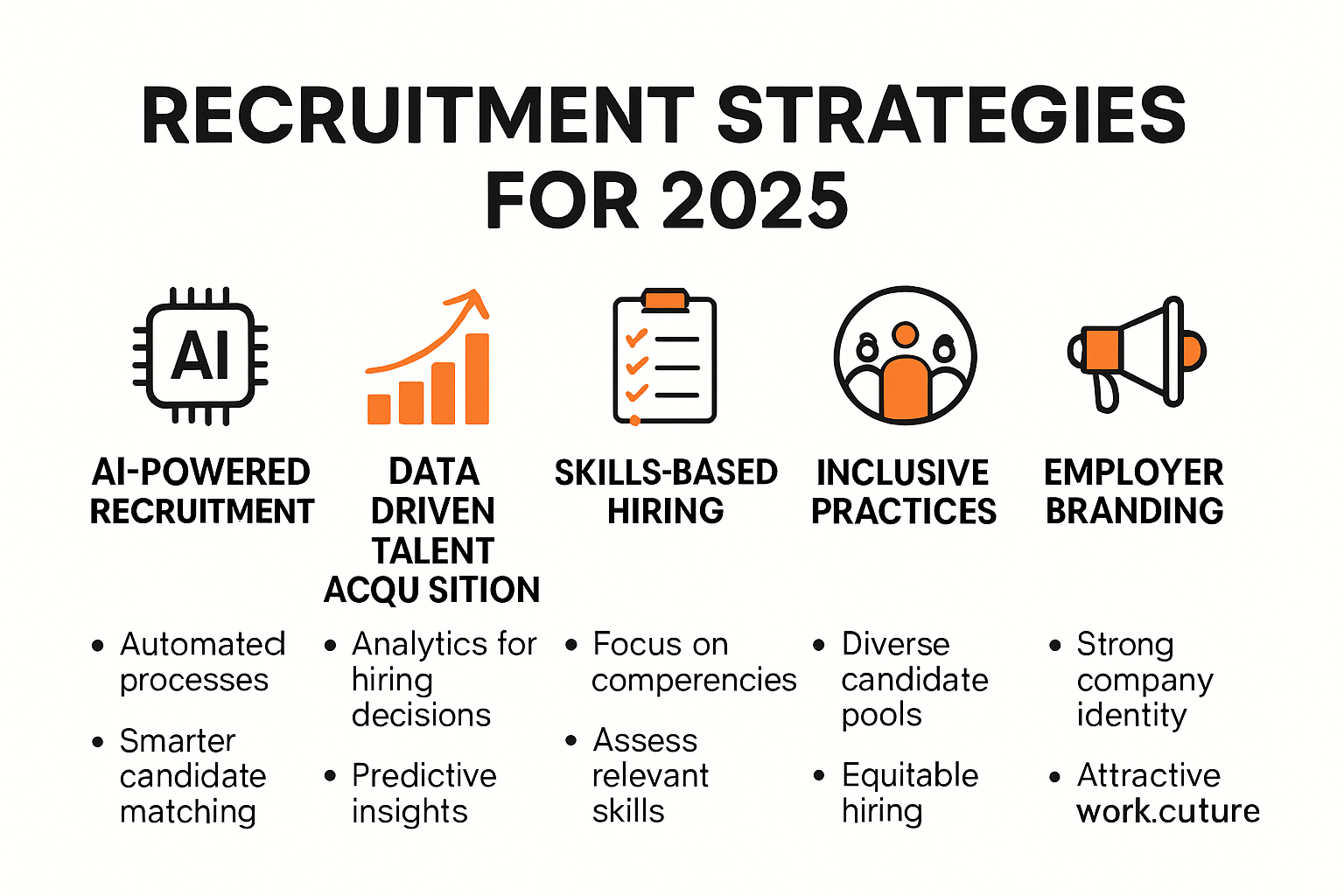
| Embrace AI-Powered Recruitment | Leverage AI technologies to automate tasks like resume screening and reduce biases, improving hiring quality and efficiency. |
| Utilize Data Analytics for Talent Acquisition | Implement advanced analytics to track recruitment metrics, predict candidate success, and identify skill gaps for better strategic planning. |
| Adopt Skills-Based Hiring | Shift focus from traditional credentials to demonstrable skills, enabling access to a broader and more diverse talent pool. |
| Enhance Employer Branding | Develop authentic employer value propositions and transparent communication strategies to attract talent aligned with company values and culture. |
| Operationalize Inclusive Practices | Implement standardized assessments and blind recruitment techniques to foster diversity and minimize bias in hiring processes. |
Embracing Digital Transformation in Recruitment
Digital transformation is fundamentally reshaping recruitment strategies across all sectors. Organizations are rapidly adopting advanced technologies to streamline hiring processes, enhance candidate experiences, and make more data-driven talent acquisition decisions.
AI-Powered Recruitment Technologies
Artificial intelligence is revolutionizing talent acquisition through intelligent automation. Discover our comprehensive recruitment strategies that leverage cutting-edge AI technologies. According to research from RapidInnovation, AI-powered recruitment tools are transforming hiring processes by automating critical tasks such as resume screening and reducing unconscious hiring biases.
These intelligent systems can analyze thousands of candidate profiles within minutes, identifying top talent with unprecedented speed and accuracy. Machine learning algorithms can now predict candidate performance, cultural fit, and potential long-term success more effectively than traditional screening methods. Companies implementing AI-driven recruitment technologies report significant improvements in hiring quality and reduced time-to-hire.
Data Analytics in Talent Acquisition
Strategic talent acquisition now depends heavily on advanced data analytics. Public Sector Experts research highlights that organizations can track sophisticated recruitment metrics, identify workflow bottlenecks, and forecast future talent requirements with unprecedented precision.
Advanced analytics platforms enable recruiters to:
- Performance Prediction: Analyze historical hiring data to forecast candidate success
- Talent Pool Mapping: Identify potential skill gaps and recruitment opportunities
- Diversity and Inclusion: Track and improve workforce representation metrics

Skills-Based Hiring Transformation
Traditional recruitment models are giving way to more dynamic, skills-focused approaches. Arxiv research indicates that organizations are increasingly prioritizing specific skills over traditional academic credentials. This approach allows companies to tap into broader talent pools, particularly in emerging technological domains like artificial intelligence and sustainability.
Skills-based hiring strategies involve:
- Competency Assessments: Using specialized tests and simulations
- Adaptive Screening: Evaluating candidates based on demonstrable skills
- Continuous Learning Potential: Prioritizing adaptability over static qualifications
Digital transformation in recruitment is not just a trend but a fundamental shift in how organizations identify, attract, and retain top talent. By embracing AI technologies, leveraging data analytics, and adopting skills-focused approaches, companies can build more agile, diverse, and high-performing workforce strategies for 2025 and beyond.
Leveraging Data and AI for Better Hiring
The intersection of data analytics and artificial intelligence is transforming recruitment practices, offering unprecedented opportunities for organizations to optimize their talent acquisition strategies. Learn more about effective recruitment techniques that harness the power of advanced technologies.
Predictive Hiring Analytics
Modern recruitment has evolved beyond traditional screening methods. Research from ArXiv analyzing UK job vacancies revealed a significant shift in hiring approaches, with AI roles growing by 21% while traditional educational requirements decreased by 15%. This trend underscores the growing importance of skill-based recruitment strategies that leverage sophisticated data analytics.
Predictive hiring analytics enable organizations to:
- Candidate Potential Assessment: Utilize machine learning algorithms to forecast long-term employee performance
- Talent Pool Optimization: Identify and target candidates with highest potential for specific roles
- Retention Prediction: Analyze historical data to predict employee longevity and cultural fit
To illustrate the impact of evolving hiring criteria, the table below summarizes key statistics from the referenced research:
| Hiring Approach | Growth/Change (2025) |
|---|---|
| AI-Related Job Roles | +21% |
| Traditional Educational Requirements | -15% |
Addressing AI Bias in Recruitment
While AI offers powerful recruitment tools, it also presents significant challenges in fairness and equity. Research from ArXiv highlights critical concerns about potential biases in AI-driven recruitment systems. Organizations must implement robust fairness metrics and mitigation strategies to ensure equitable candidate evaluation.
Key strategies for mitigating AI recruitment bias include:
- Algorithmic Transparency: Regularly audit AI systems for unintended discriminatory patterns
- Diverse Training Data: Ensure machine learning models are trained on representative, unbiased datasets
- Continuous Monitoring: Implement ongoing assessments of AI recruitment tools
Ethical AI and Advanced Screening
Advanced AI screening technologies present both opportunities and challenges. Analysis from ArXiv uncovered potential gender biases in generative AI models, particularly in high-wage role selections. This underscores the critical need for ethical considerations in AI-driven recruitment processes.
Effective AI recruitment strategies require:
- Comprehensive Skill Assessment: Move beyond traditional resume screening
- Contextual Understanding: Develop AI systems that comprehend nuanced candidate capabilities
- Human Oversight: Maintain critical human judgment in final hiring decisions
The future of recruitment lies in a balanced approach that combines technological innovation with human insight. By carefully leveraging data and AI, organizations can create more efficient, fair, and effective hiring processes that identify top talent while mitigating potential biases and limitations of automated systems.
Inclusive and Skills-Based Talent Acquisition
Talent acquisition in 2025 demands a radical reimagining of traditional recruitment approaches, prioritizing skills, diversity, and holistic candidate potential. Explore our comprehensive recruitment strategies that emphasize inclusive hiring practices and talent development.
Shifting from Credentials to Capabilities
Traditional hiring models that rely heavily on academic credentials are rapidly becoming obsolete. Research from ArXiv analyzing UK job market trends reveals a profound transformation: AI-related job roles experienced a 21% growth while traditional educational requirements decreased by 15%. This shift signals a critical evolution towards skills-based recruitment strategies.
Key implications of this transition include:
- Dynamic Skill Valuation: Prioritizing practical abilities over static qualifications
- Broader Talent Pools: Opening opportunities for candidates from diverse backgrounds
- Adaptive Learning Potential: Focusing on candidates’ capacity to learn and grow
Advancing Diversity through Inclusive Technologies
Technology can be a powerful enabler of inclusive recruitment when designed thoughtfully. Research from ArXiv demonstrates that implementing AI in early-stage recruitment interviews can reduce sentiment-driven biases by 41.2%, promoting more equitable hiring practices.
The following table highlights strategies and outcomes related to advancing diversity through inclusive recruitment technologies:
| Strategy | Outcome/Impact |
|---|---|
| AI in Early-Stage Interviews | 41.2% reduction in sentiment-driven biases |
| Algorithmic Fairness | Improved equitable candidate evaluation |
| Representative Training Data | Diverse and unbiased hiring models |
| Continuous Bias Auditing | Ongoing monitoring for fairness |
Strategies for building inclusive recruitment technologies:
- Algorithmic Fairness: Developing AI systems with built-in bias detection mechanisms
- Representative Training Data: Ensuring diverse datasets for machine learning models
- Continuous Bias Auditing: Regular assessment of recruitment algorithms
Operationalizing Inclusive Recruitment Practices
Inclusivity extends beyond technological solutions. A multinational recruitment company workshop highlighted that while AI-driven systems enhance efficiency, they must be carefully designed to prevent perpetuating existing biases.
Essential components of inclusive talent acquisition include:
- Standardized Assessment Frameworks: Creating objective evaluation criteria
- Blind Recruitment Techniques: Removing identifying information that could trigger unconscious bias
- Diverse Interview Panels: Ensuring multiple perspectives in candidate evaluation
The future of talent acquisition demands a holistic approach that balances technological innovation with human-centric, equitable practices. Organizations that successfully integrate skills-based assessment, advanced technologies, and inclusive strategies will be best positioned to attract and retain top talent in an increasingly complex global workforce.
Building Employer Brand and Candidate Experience
Employer branding has transformed from a peripheral marketing strategy to a critical component of talent acquisition in 2025. Discover our comprehensive recruitment best practices that help organizations create compelling employer narratives and exceptional candidate experiences.
Crafting Authentic Employer Value Propositions
In an era of increased candidate discernment, organizations must develop genuine and transparent employer value propositions. Research from Search UK reveals that 59% of job seekers prioritize roles aligned with their personal values, emphasizing the need for authentic organizational storytelling.
Key elements of a compelling employer brand include:
- Purpose-Driven Messaging: Clearly communicating organizational mission and impact
- Cultural Transparency: Showcasing genuine workplace dynamics
- Career Growth Narratives: Highlighting professional development opportunities
Technological Enhancement of Candidate Experience
Advanced technologies are revolutionizing how candidates interact with potential employers. A comprehensive study highlights emerging concerns around fairness in online recruitment, emphasizing the need for sophisticated, equitable interaction platforms.
Strategic technological interventions include:
- Personalized Communication Channels: Tailoring interactions to individual candidate preferences
- Transparent Recruitment Processes: Providing clear, real-time feedback mechanisms
- User-Friendly Application Experiences: Simplifying and streamlining digital recruitment touchpoints
Financial and Strategic Impact of Employer Branding
Investing in robust employer branding yields significant organizational benefits. Research from CloudHire demonstrates compelling financial outcomes: companies with strong employer brands experience a 50% reduction in recruitment costs and a 28% decrease in employee turnover.
The table below outlines the financial and strategic impacts of building a strong employer brand, referencing the research cited in the article:
| Employer Branding Benefit | Impact/Statistic |
|---|---|
| Recruitment Cost Reduction | 50% |
| Reduction in Employee Turnover | 28% |
| Enhanced Talent Attraction | Increased alignment with candidate values |
Strategic approaches to powerful employer branding involve:
- Consistent Brand Messaging: Aligning external communication with internal culture
- Employee Advocacy Programs: Empowering current employees as brand ambassadors
- Continuous Experience Optimization: Regularly gathering and implementing candidate feedback
Successful employer branding in 2025 requires a holistic approach that integrates technological innovation, authentic storytelling, and a genuine commitment to candidate experience. Organizations that master this complex ecosystem will distinguish themselves in an increasingly competitive talent marketplace, attracting top performers who seek meaningful professional relationships beyond traditional employment transactions.
Frequently Asked Questions
What are the top recruitment strategies for 2025?
The top recruitment strategies for 2025 include embracing AI-powered recruitment technologies, utilizing data analytics for talent acquisition, adopting skills-based hiring, enhancing employer branding, and operationalizing inclusive practices.
How can AI improve the recruitment process?
AI can improve the recruitment process by automating tasks like resume screening, predicting candidate performance, reducing biases, and analyzing large amounts of data quickly to identify top talent more effectively.
Why is skills-based hiring important in 2025?
Skills-based hiring is important in 2025 because it allows organizations to access a broader talent pool, prioritize candidates’ demonstrated capabilities over traditional credentials, and adapt to the evolving job market needs in emerging fields.
What role does employer branding play in recruitment?
Employer branding plays a critical role in recruitment by attracting candidates who align with the company’s values. A strong employer brand can lead to reduced recruitment costs, decreased employee turnover, and improved talent attraction.
Unlock the Power of Skills-Based Hiring and Training for 2025
Is your organization feeling the pressure to adapt to fast-changing recruitment strategies in 2025? Many companies are struggling to move beyond outdated methods and implement real solutions like AI-driven hiring, skills-based assessments, and inclusive recruiting. If finding and growing top talent feels more challenging than ever, you are not alone. The future demands data-driven decisions, robust training, and a relentless focus on candidate experience.

Now is the moment to build the workforce you need with practical guidance and fully accredited resources from Peuneo. Access our accredited training, on-demand consulting, and specialized online courses to close skills gaps and make your recruitment more competitive. Take the first step toward future-proofing your talent strategy by visiting our online learning portal and discover how Peuneo can help your business attract, assess, and develop the very best professionals. Skills transformation starts today.
Recommended
- Key Elements of Successful Recruitment in 2025: Essential Guide – Peuneo
- Understanding the Role of HR in Recruitment: Guide 2025 – Peuneo
- 2025: How to Optimize Your Recruitment Budget for Success – Peuneo
- How to Manage Recruitment Effectively in 2025 – Peuneo
- Conversion Rate Optimization Strategies for Marketers in 2025
- Top Local Online Marketing Strategies for 2025 Success | Ibrandmedia