

Legal compliance in recruitment sounds like a minefield for any organization. One misstep can cost big and in 2023, U.S. companies paid over $481 million in fines for hiring law violations. Think automated hiring tools are making things easier? Surprise. These very systems can actually amplify the risk of discrimination lawsuits. The safest organizations are the ones constantly rethinking their entire hiring process from the ground up.
Table of Contents
- Understanding Legal Compliance In Recruitment
- Key Laws And Regulations Impacting Hiring
- Best Practices For A Compliant Recruitment Process
- Common Challenges And How To Overcome Them
Quick Summary
| Takeaway | Explanation |
|---|---|
| Ensure Non-Discrimination in Recruitment | Follow laws prohibiting bias based on race, gender, disability, and more. This ensures fair treatment and protects organizations from legal trouble. |
| Implement Standardized Procedures | Develop clear and consistent criteria for job descriptions and candidate assessments to enhance transparency and compliance across recruitment efforts. |
| Train Hiring Personnel Regularly | Ongoing education for HR and hiring teams is essential to mitigate bias and understand legal requirements, fostering a compliant hiring process. |
| Audit Recruitment Technologies Frequently | Regularly review automated recruitment tools to prevent algorithmic bias and ensure they align with legal standards and considerations for diversity. |
| Maintain Comprehensive Documentation | Implement rigorous record-keeping to track recruitment processes and decisions, ensuring protection against legal challenges and compliance with regulations. |
Understanding Legal Compliance in Recruitment
Legal compliance in recruitment represents a critical framework that protects both employers and job candidates from discriminatory practices and potential legal risks. Organizations must navigate a complex landscape of regulations designed to ensure fair, transparent, and equitable hiring processes.
The Fundamental Principles of Recruitment Compliance
Recruitment legal compliance goes beyond simply following rules. It involves creating a systematic approach that promotes fairness, prevents discrimination, and maintains ethical standards throughout the hiring process. According to the Equal Employment Opportunity Commission (EEOC), organizations must implement practices that protect candidates from unfair treatment based on protected characteristics such as race, gender, age, disability, or national origin.
Key compliance principles include:
- Non-Discrimination: Ensuring all recruitment activities remain free from bias
- Equal Opportunity: Providing fair access to employment opportunities
- Transparent Processes: Maintaining clear and consistent hiring procedures
Critical Legal Considerations in Recruitment
Employers must be vigilant about multiple legal dimensions during recruitment. Research from the Society for Human Resource Management (SHRM) highlights several critical areas organizations must address:
Background checks require strict adherence to legal standards. Organizations must obtain explicit candidate consent, follow fair credit reporting regulations, and ensure that screening processes do not inadvertently discriminate against protected groups. This involves carefully crafted policies that balance organizational needs with individual privacy rights.
Interview practices demand meticulous attention to legal boundaries. Questions must remain job-related and avoid probing into personal areas that could be construed as discriminatory. HR professionals need comprehensive training to understand which interview questions are permissible and which could expose the organization to potential legal challenges.
Technology and Legal Compliance
The rise of digital recruitment tools introduces additional compliance complexities. Automated screening systems and artificial intelligence in hiring must be carefully designed to prevent algorithmic bias. Organizations must regularly audit their technological recruitment solutions to ensure they do not inadvertently perpetuate historical discrimination patterns.
Compliance is not a static concept but a dynamic process requiring continuous education, policy updates, and organizational commitment. By understanding and implementing robust legal compliance strategies, organizations can create fair, inclusive, and legally sound recruitment practices that protect both the employer and potential employees.
For those seeking to enhance their understanding of recruitment compliance, learn more about our compliance training requirements to develop comprehensive organizational strategies.
Key Laws and Regulations Impacting Hiring
The legal landscape of recruitment is complex and multifaceted, requiring organizations to navigate a comprehensive set of federal and state regulations designed to protect job candidates and ensure fair employment practices. Understanding these laws is crucial for developing robust and legally compliant hiring strategies.
Federal Anti-Discrimination Laws
According to the U.S. Equal Employment Opportunity Commission, several critical federal laws govern hiring practices and protect job candidates from discriminatory treatment. The Civil Rights Act of 1964, specifically Title VII, prohibits discrimination based on race, color, religion, sex, and national origin. The Americans with Disabilities Act (ADA) further extends protections to individuals with disabilities, mandating reasonable accommodations during recruitment and employment.
Key anti-discrimination protections include:
- Prohibiting Bias: Preventing discrimination across all stages of recruitment
- Equal Access: Ensuring fair opportunities for all qualified candidates
- Reasonable Accommodations: Supporting candidates with disabilities
Background Check and Privacy Regulations
Research from the Department of Labor highlights the intricate legal requirements surrounding background checks and candidate privacy. The Fair Credit Reporting Act (FCRA) establishes strict guidelines for obtaining and using background check information. Employers must secure explicit candidate consent, provide clear disclosure about background investigations, and follow specific adverse action procedures if employment decisions are based on background check results.
Employers must also consider state-level variations in background check regulations. Some jurisdictions have implemented “ban the box” laws that restrict when and how employers can inquire about criminal histories, promoting fair chances for candidates with previous legal challenges.
Immigration and Employment Verification Laws
The Immigration Reform and Control Act (IRCA) mandates that employers verify the employment eligibility of all new hires through the Form I-9 process. According to USAGov’s workplace regulations, organizations must carefully document and validate an employee’s right to work in the country.
This process involves:
- Collecting appropriate documentation
- Verifying identity and employment authorization
- Maintaining accurate employment records
- Avoiding discriminatory practices during verification
Navigating these complex legal requirements demands a proactive and systematic approach. Organizations must continually update their recruitment policies, train hiring managers, and implement robust compliance mechanisms.
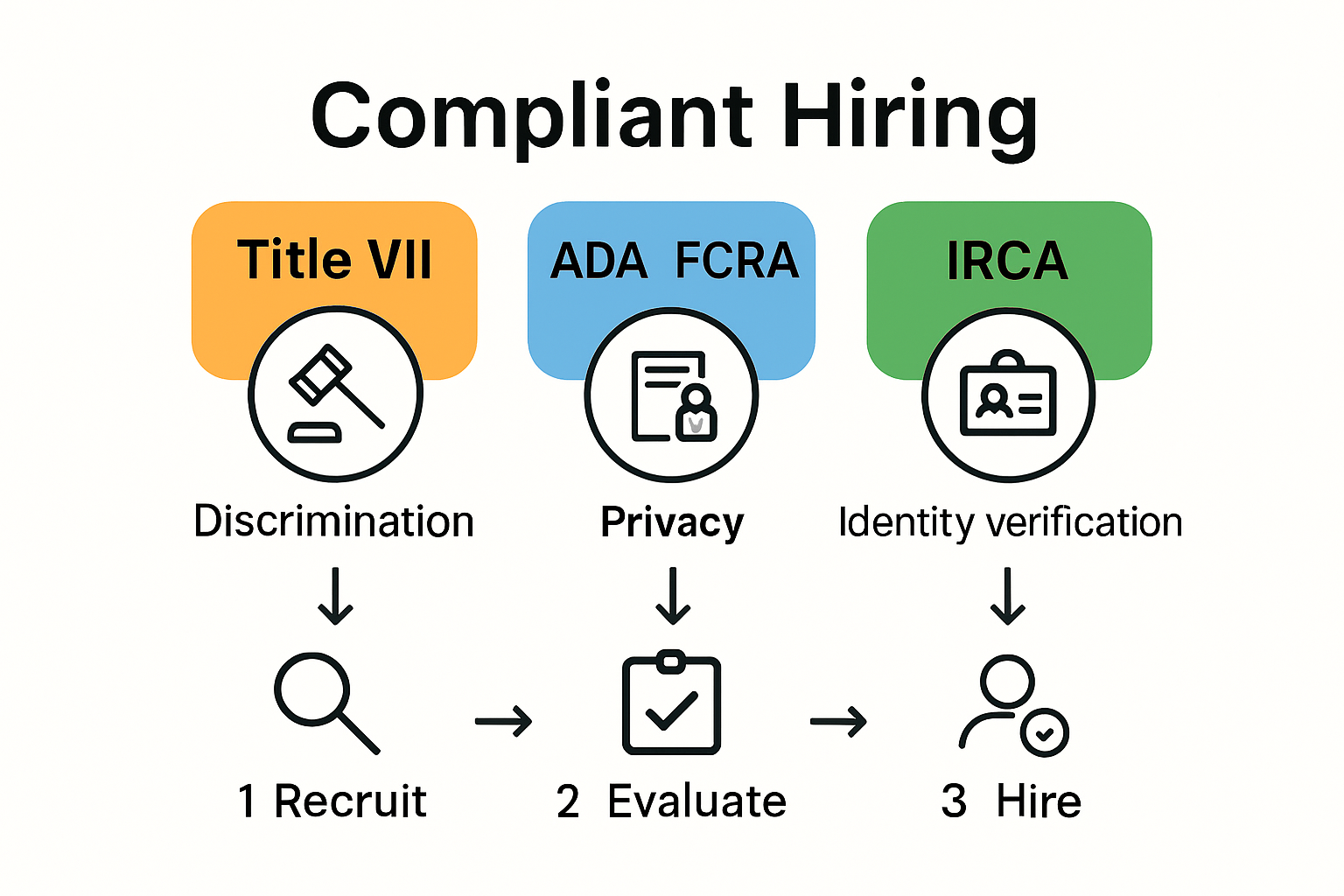
To help organizations understand the major federal laws influencing hiring practices, the following table summarizes key regulations and the protections they provide:
| Law/Regulation | Key Protections |
|---|---|
| Title VII of Civil Rights Act of 1964 | Prohibits discrimination based on race, color, religion, sex, national origin |
| Americans with Disabilities Act (ADA) | Requires reasonable accommodations for individuals with disabilities |
| Fair Credit Reporting Act (FCRA) | Sets procedures and consent requirements for background checks |
| Immigration Reform and Control Act (IRCA) | Mandates employment eligibility verification and recordkeeping |
| “Ban the Box” Laws (State/Local) | Restrict timing and use of criminal history inquiries |
For organizations seeking to develop comprehensive recruitment strategies that align with legal standards, explore our recruitment compliance training resources to ensure a legally sound hiring process.
Best Practices for a Compliant Recruitment Process
Creating a legally compliant recruitment process requires a strategic and comprehensive approach that goes beyond mere regulatory adherence. Organizations must develop systematic strategies that protect both the employer and potential candidates while maintaining transparency, fairness, and professionalism.
Developing Standardized Recruitment Procedures
According to the Society for Human Resource Management (SHRM), establishing consistent and well-documented recruitment procedures is fundamental to legal compliance. This involves creating clear, objective criteria for job qualifications, candidate evaluation, and selection processes that can be uniformly applied across all recruitment efforts.
Key elements of standardized procedures include:
- Objective Job Descriptions: Clearly defining role requirements without discriminatory language
- Consistent Evaluation Metrics: Developing uniform assessment criteria for all candidates
- Documented Decision-Making: Maintaining transparent records of recruitment decisions
Training and Awareness for Hiring Personnel
Research from the Equal Employment Opportunity Commission emphasizes the critical importance of comprehensive training for all personnel involved in the recruitment process. HR professionals, hiring managers, and interview teams must receive ongoing education about legal requirements, unconscious bias, and appropriate interviewing techniques.
Effective training programs should address:
- Recognizing and mitigating unconscious bias
- Understanding prohibited interview questions
- Implementing fair and consistent evaluation methods
- Protecting candidate privacy and confidentiality
Technology and Documentation Management
Modern recruitment processes increasingly rely on technology, which introduces additional compliance considerations. Organizations must carefully design digital recruitment tools to prevent algorithmic bias and ensure equal opportunity. This includes regularly auditing automated screening systems and maintaining comprehensive documentation of all recruitment activities.
Critical technological compliance strategies involve:
- Implementing bias-detection algorithms
- Securing candidate personal information
- Maintaining clear audit trails of recruitment decisions
- Ensuring accessibility of digital recruitment platforms
Compliance is an ongoing process that requires continuous adaptation and commitment. Organizations must remain proactive in understanding evolving legal landscapes, updating their practices, and fostering a culture of fairness and inclusivity.
For organizations looking to enhance their recruitment process efficiency and compliance, explore our comprehensive recruitment management guide to develop robust strategies that protect both the organization and potential candidates.
Common Challenges and How to Overcome Them
Legal compliance in recruitment presents numerous complex challenges that organizations must strategically navigate to protect both candidates and employers. Understanding these challenges and developing proactive solutions is crucial for maintaining a fair, transparent, and legally sound hiring process.
Addressing Unconscious Bias in Recruitment
Research from Harvard Business Review reveals that unconscious bias significantly impacts hiring decisions, often leading to discriminatory practices that can result in legal complications. Organizations must implement comprehensive strategies to mitigate these hidden prejudices that can inadvertently influence recruitment outcomes.
Effective approaches to reducing unconscious bias include:
- Structured Interview Protocols: Developing standardized questions and evaluation criteria
- Diverse Interview Panels: Incorporating multiple perspectives in candidate assessment
- Blind Recruitment Techniques: Removing identifying information that could trigger bias
- Regular Bias Training: Providing ongoing education for hiring personnel
Technology and Compliance Challenges
According to the Society for Human Resource Management, technological recruitment tools introduce significant compliance risks. Automated screening systems and artificial intelligence in hiring can unintentionally perpetuate discriminatory patterns if not carefully designed and regularly audited.
Key technological compliance challenges involve:
- Preventing algorithmic bias in screening processes
- Ensuring data privacy and protection
- Maintaining transparency in automated decision-making
- Providing reasonable accommodations for candidates with disabilities
Documentation and Record-Keeping Complexities
Maintaining comprehensive and accurate documentation throughout the recruitment process is critical for legal protection. Organizations must develop robust systems that capture detailed information while protecting candidate privacy and meeting regulatory requirements.
Critical documentation strategies include:
- Creating clear, consistent record-keeping protocols
- Securing candidate personal information
- Documenting recruitment decisions with objective criteria
- Implementing secure data management systems

The following table summarizes common recruitment challenges organizations face and strategies mentioned in the article to overcome them:
| Challenge | Description | Solution(s) |
|---|---|---|
| Unconscious Bias | Hidden prejudices influencing hiring decisions | Structured interviews, diverse panels, blind recruitment, bias training |
| Technology Compliance Risks | Automated tools causing bias or lack of transparency | Auditing tools, bias detection, ensuring data privacy |
| Documentation & Record-Keeping | Maintaining thorough, compliant records | Clear protocols, objective documentation, secure management |
Overcoming these challenges requires a proactive, systematic approach that combines ongoing education, technological innovation, and a commitment to fairness. Organizations must view legal compliance as a dynamic process that demands continuous adaptation and improvement.
For organizations seeking to develop more effective change management strategies in their recruitment processes, explore our comprehensive organizational change guide to enhance your approach to legal compliance and talent acquisition.
Frequently Asked Questions
What are the key principles of legal compliance in recruitment?
Legal compliance in recruitment is centered around non-discrimination, equal opportunity, and transparent processes that ensure fairness and ethical standards in hiring.
What federal laws govern anti-discrimination in hiring practices?
Key federal laws include the Civil Rights Act of 1964, which prohibits discrimination based on race, color, religion, sex, and national origin, and the Americans with Disabilities Act (ADA), which protects individuals with disabilities during recruitment.
How can organizations mitigate unconscious bias in the recruitment process?
Organizations can reduce unconscious bias by developing structured interview protocols, creating diverse interview panels, utilizing blind recruitment techniques, and providing regular bias training for hiring personnel.
What are best practices for maintaining compliance in recruitment documentation?
Best practices for recruitment documentation include creating clear record-keeping protocols, securing candidate personal information, documenting recruitment decisions based on objective criteria, and implementing secure data management systems.
Struggling With Compliance Risks in Your Hiring Process?
In today’s hiring landscape, small gaps in your legal compliance efforts can lead to serious penalties and loss of trust. This article shows how complex federal laws, unconscious bias, and fast-changing technology make recruitment compliance a real challenge for every organization. If you feel overwhelmed by non-compliance risks or unsure about how to train your team effectively, you are not alone. Many businesses face the same uncertainty when it comes to creating fair, fully documented, and legal recruitment procedures.

Take control of your recruitment process with targeted solutions from Peuneo. Our accredited training programs and expert consulting services are designed to align your hiring practices with the latest legal requirements and industry best practices. Protect your organization from costly legal pitfalls and build a culture of fairness. Visit Peuneo’s website today to explore online courses, consulting support, and hands-on compliance training designed for South African workplaces. The risks of non-compliance will only grow. Act now to safeguard your organization and stay ahead in a rapidly evolving regulatory environment.