
Workforce development is getting a lot of buzz as companies brace for a fast changing economy and tech keeps shaking up how we work. Most people focus on the next hot skill or which industries are hiring. But numbers do not lie. A stunning 85 percent of employers say they plan to upskill their workforce by 2030, making skills training a non negotiable part of staying competitive. This shift is not just about workers catching up. It is the key to economic resilience, business growth, and personal advancement all at the same time.
Table of Contents
- How Workforce Development Shapes Business Success
- Benefits For Government, Corporates, And Individuals
- Best Practices For Effective Workforce Training
- Future Trends In Workforce Development Strategies
Quick Summary
| Takeaway | Explanation |
|---|---|
| Workforce development is essential for business growth. | Strategic skill enhancement fosters productivity and innovation, helping companies stay competitive in fast-evolving markets. |
| Invest in employee training to boost retention. | Organizations with strong development programs see higher employee engagement and loyalty, significantly reducing turnover costs. |
| Adopt technology for adaptive learning environments. | Utilizing AI and immersive technologies enables personalized training, catering to individual skill gaps and learning styles for effective skill acquisition. |
| Emphasize continuous learning across all levels. | Establishing a culture of ongoing education helps employees stay relevant, facilitating adaptability to market demands and career progression. |
| Collaborate for interdisciplinary skill development. | Cross-functional training encourages diverse skill sets, enabling teams to tackle complex problems and innovate in collaborative environments. |
How Workforce Development Shapes Business Success
Workforce development emerges as a critical strategy for businesses seeking sustainable growth and competitive advantage in an increasingly complex economic environment. Organizations that prioritize strategic skill enhancement and continuous learning create powerful mechanisms for transforming their operational capabilities and human capital potential.
The Strategic Performance Impact
Businesses recognize that workforce development is no longer an optional investment but a fundamental requirement for maintaining organizational resilience. According to the comprehensive report by the Council for Adult and Experiential Learning, companies investing systematically in employee skills experience significant performance improvements. These improvements manifest through enhanced productivity, reduced skill gaps, and increased innovation capacity.
The data reveals that organizations with robust workforce development programs demonstrate measurably higher employee retention rates. When employees perceive meaningful opportunities for professional growth, they become more engaged and committed to their organization’s long term success. This engagement translates directly into improved operational efficiency and reduced recruitment costs.

Technology and Skill Adaptation
Technological disruption demands continuous workforce skill recalibration. Companies must create adaptive learning ecosystems that enable employees to rapidly acquire emerging competencies. By implementing comprehensive workforce development strategies, businesses can proactively address technological transitions, ensuring their human capital remains competitive and relevant.
Professional development programs help organizations build internal talent pipelines capable of navigating complex technological transformations. This approach minimizes external hiring risks and cultivates a culture of continuous learning and innovation. Our guide on workforce development strategies provides deeper insights into creating effective skill enhancement frameworks.
Economic Resilience Through Human Capital
Workforce development represents more than individual skill enhancement – it becomes a strategic mechanism for economic resilience. Organizations that invest in comprehensive training and development programs position themselves to rapidly respond to market changes, technological shifts, and emerging industry demands.
By treating human capital as a dynamic, renewable resource, businesses can create sustainable competitive advantages. Workforce development transforms traditional employment models, shifting from transactional workforce management to strategic talent cultivation. This approach enables companies to build agile, adaptable teams capable of driving innovation and maintaining operational excellence in an increasingly unpredictable global business environment.
Benefits for Government, Corporates, and Individuals
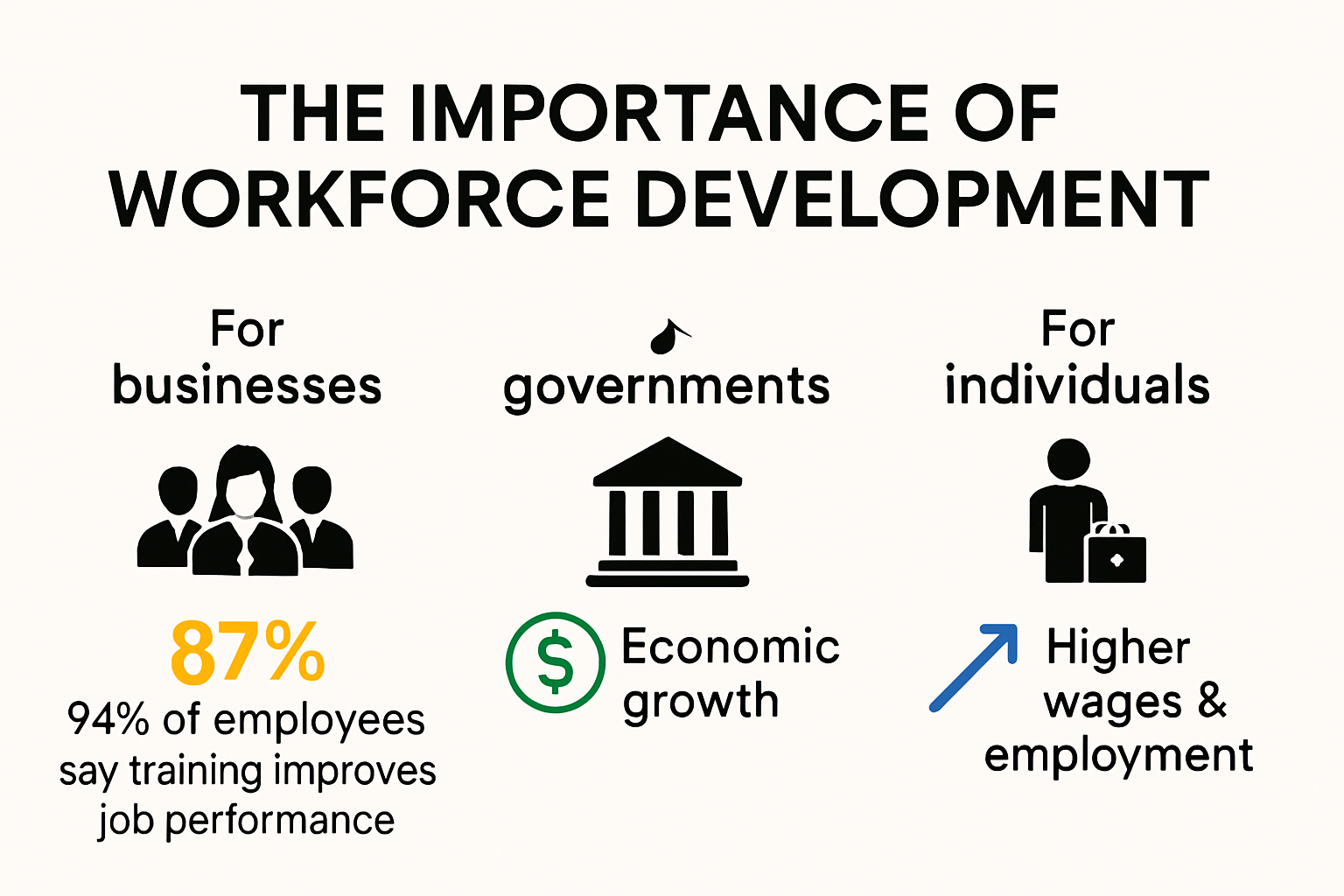
Workforce development creates a powerful ecosystem of mutual benefit that extends far beyond traditional training paradigms. By strategically investing in human capital, governments, corporations, and individuals can unlock transformative opportunities that drive economic growth, organizational performance, and personal advancement.
To clarify how workforce development delivers unique advantages for different stakeholders, the following table compares key benefits for government, corporates, and individuals:
| Stakeholder | Key Benefits | Example Impacts |
|---|---|---|
| Government | Economic resilience, reduced unemployment, higher tax revenue, lower social service costs | Reduced unemployment rates, improved tax base, lower welfare costs |
| Corporates | Better retention, higher productivity, internal talent pipelines, improved innovation | Lower recruitment costs, greater adaptability, business growth |
| Individuals | Skill enhancement, career advancement, increased earnings, greater adaptability | Higher marketability, better job opportunities, long-term relevance |
Government Economic Empowerment
According to the National Academies of Sciences, Engineering, and Medicine, workforce development represents a critical mechanism for national economic resilience. Governments recognize that comprehensive skill enhancement programs directly contribute to reducing unemployment, stimulating economic productivity, and creating a more competitive national workforce.
Strategic workforce development initiatives enable governments to address skill gaps systematically. By collaborating with educational institutions and private sector organizations, governments can design targeted training programs that align with emerging industry requirements. These programs reduce social service costs, enhance tax revenue generation, and create pathways for sustainable economic development.
Corporate Performance and Innovation
Corporations view workforce development as a strategic investment rather than an operational expense. Organizations that prioritize continuous learning and skill enhancement experience significant performance improvements. Comprehensive development programs enable businesses to build internal talent pipelines, reduce recruitment costs, and create adaptable workforce ecosystems.
Technological disruption demands ongoing skill recalibration. By implementing robust workforce development strategies, corporations can proactively address technological transitions, ensuring their human capital remains competitive and innovative. Our comprehensive guide to professional development offers deeper insights into creating effective organizational learning frameworks.
Individual Career Advancement
For individuals, workforce development represents a pathway to personal and professional transformation. Continuous learning enables professionals to enhance their marketability, increase earning potential, and navigate complex career landscapes. Skill development programs provide individuals with the tools to adapt to technological changes, explore new career opportunities, and maintain long term professional relevance.
Personal development goes beyond acquiring technical skills. Workforce development programs help individuals develop critical soft skills such as adaptability, communication, and problem solving. These competencies are increasingly valuable in a rapidly evolving professional environment, enabling individuals to become more resilient and versatile professionals.
The interconnected benefits of workforce development demonstrate its profound importance. By creating a collaborative approach that simultaneously supports governments, corporations, and individuals, these programs become powerful engines of economic and personal growth. The future of work demands continuous learning, and workforce development emerges as the critical mechanism for navigating this complex, dynamic landscape.
Best Practices for Effective Workforce Training
Effective workforce training requires a strategic, multifaceted approach that goes beyond traditional learning models. As industries evolve rapidly, organizations must develop comprehensive training frameworks that are adaptive, data-driven, and aligned with emerging workforce needs.
Below is a summary table of key best practices for effective workforce training, highlighting their focus and methods:
| Best Practice | Main Focus | Example Methods or Approaches |
|---|---|---|
| Strategic Training Alignment | Targeted, industry-relevant skills | Labor market analysis, industry partnerships |
| Innovative Learning Methodologies | Hands-on, practical skill acquisition | Apprenticeships, digital platforms, VR |
| Continuous Learning & Adaptability | Ongoing skills growth, flexibility | Stackable credentials, modular programs |
Strategic Training Alignment
According to the U.S. Department of Labor, successful workforce training hinges on creating robust industry partnerships and implementing data-driven decision-making processes. Organizations must move beyond generic training programs and develop targeted learning experiences that directly address specific skill gaps and industry requirements.
This approach involves continuous labor market analysis, close collaboration with industry experts, and dynamic curriculum design. By understanding emerging technological trends and skill requirements, training programs can create precise learning pathways that prepare professionals for actual workplace challenges. Employers increasingly seek training models that provide immediate, practical skills transferable across multiple professional contexts.
Innovative Learning Methodologies
Research from the National Academies highlights the importance of incorporating diverse learning methodologies. Modern workforce training should integrate multiple approaches, including experiential learning, digital platforms, and work-based learning models like apprenticeships. These strategies ensure that professional development goes beyond theoretical knowledge and provides hands-on, practical skill acquisition.
Technology plays a crucial role in transforming training approaches. Interactive digital platforms, virtual reality simulations, and adaptive learning technologies enable personalized training experiences. Our comprehensive guide to employee training offers deeper insights into implementing cutting-edge training strategies that meet the complex demands of modern professional environments.
Continuous Learning and Adaptability
Workforce training in 2025 must prioritize continuous learning and adaptability. Organizations should develop frameworks that encourage ongoing skill development, allowing professionals to regularly update their competencies. This involves creating learning cultures that view professional development as a dynamic, continuous process rather than a one-time event.
Implementing stackable credentials and modular training programs allows professionals to progressively build their skills. These approaches provide flexibility, enabling individuals to customize their learning journeys according to their specific career goals and industry requirements. By breaking down traditional learning barriers, organizations can create more inclusive and accessible training ecosystems.
The future of workforce training demands a holistic, adaptive approach. Successful programs will balance technological innovation, industry relevance, and individual learning needs. By embracing these best practices, organizations can develop training strategies that not only address current skill requirements but also anticipate and prepare for future professional challenges.
Future Trends in Workforce Development Strategies
The landscape of workforce development is undergoing unprecedented transformation, driven by technological disruption, changing economic dynamics, and evolving workplace expectations. Organizations must anticipate and adapt to emerging trends that will reshape how we approach professional skills and learning strategies.
Technology-Driven Learning Ecosystems
According to the World Economic Forum’s Future of Jobs Report, 85% of employers plan to upskill their workforce between 2025 and 2030. This strategic shift highlights the critical role of technology in creating adaptive learning environments. Emerging technologies like artificial intelligence, virtual reality, and adaptive learning platforms are revolutionizing how professionals acquire and enhance their skills.
Virtual and augmented reality technologies are transforming training methodologies. Our comprehensive guide to workforce development strategies explores how immersive technologies enable more engaging and interactive learning experiences. These technologies allow professionals to practice complex skills in simulated environments, reducing training risks and accelerating competency development.
Personalized and Adaptive Learning Pathways
Research from the Aspen Institute emphasizes the need for more responsive and personalized learning ecosystems. Future workforce development strategies will leverage advanced data analytics and artificial intelligence to create highly customized learning experiences tailored to individual professional needs, learning styles, and career trajectories.
Adaptive learning platforms will use sophisticated algorithms to assess individual skill gaps, recommend targeted learning modules, and track professional development progress in real-time. This approach moves beyond traditional one-size-fits-all training models, enabling more efficient and meaningful skill acquisition.
Collaborative and Interdisciplinary Skill Development
The future of workforce development will prioritize interdisciplinary learning and collaborative skill-building approaches. Professionals will need to develop versatile skill sets that transcend traditional disciplinary boundaries. This trend requires creating learning ecosystems that encourage cross-functional collaboration, knowledge sharing, and continuous adaptation.
Organizations will increasingly invest in platforms and programs that facilitate collaborative learning experiences. These might include cross-departmental projects, mentorship programs, and global learning networks that enable professionals to learn from diverse perspectives and expertise.
As workforce development strategies evolve, the focus will shift from static skill acquisition to dynamic, continuous learning journeys. By embracing technological innovation, personalization, and collaborative approaches, organizations can create robust, future-ready workforce development strategies that empower professionals to thrive in an increasingly complex and interconnected global work environment.
Frequently Asked Questions
What is workforce development?
Workforce development refers to strategies and initiatives aimed at enhancing the skills and competencies of employees to better meet the changing demands of the labor market.
Why is workforce development important for businesses in 2025?
In 2025, workforce development is crucial for businesses as it fosters productivity, innovation, and employee engagement, helping companies remain competitive in a rapidly evolving economy.
How can workforce development benefit individuals?
Workforce development offers individuals opportunities for skill enhancement, career advancement, and increased earning potential by providing training and development programs that align with market needs.
What trends are shaping workforce development strategies for the future?
Future workforce development strategies are being shaped by technology-driven learning ecosystems, personalized and adaptive learning pathways, and collaborative skill development approaches, focusing on continuous learning and adaptability.
Ready to Transform Your Workforce for 2025?
Are you struggling to fill critical skill gaps or feeling pressure to keep up with rapid technological changes? The article highlights how upskilling is no longer just an option—it is a necessity for building economic resilience, boosting retention, and staying ahead. With the demand for accredited training and practical skills at an all-time high, organizations and individuals need fast, flexible solutions that deliver real-world results.

At Peuneo, we specialize in accredited skills development, tailored training, and expert consulting designed for both government and corporate clients. Get immediate access to our online learning portal and a wide range of programs created to help you comply with industry standards and build a future-ready workforce.
Visit Peuneo’s main site today and discover how you can:
- Upskill your team with targeted online courses and training
- Streamline compliance and unlock growth with proven business solutions
Do not wait for skill gaps to hold your business or career back. Explore Peuneo now to start your workforce transformation.