


Most organizations know that standing still is a recipe for falling behind, yet about 70 percent of organizational change initiatives fail due to poor planning and execution. Here is the surprise. The biggest hurdle is not technology or strategy. It is the quiet resistance bubbling under the surface from your own people. Turning that resistance into resilience is what separates failed changes from transformations that actually last.
Table of Contents
- Understanding The Need For Change Management
- Key Steps To Implement Change Effectively
- Overcoming Common Challenges In Change Management
- Best Practices And Pro Tips For 2025
Quick Summary
| Takeaway | Explanation |
|---|---|
| Understanding Change Resistance | Organizations must recognize and address psychological barriers such as fear of the unknown and attachment to established workflows to mitigate employee resistance during transitions. |
| Creating a Compelling Change Vision | Establishing a clear and emotionally resonant vision for change is crucial. This vision should articulate specific goals, connect with employees, and define measurable objectives. |
| Building a Robust Change Management Team | A dedicated team with cross-functional representation and change management expertise is essential for effectively navigating the transformation process and driving momentum. |
| Prioritizing Effective Communication | Consistent, transparent, and two-way communication is vital for fostering trust and engagement among employees throughout the change process. |
| Adopting Agile Methodologies | Implementing iterative planning and cross-functional collaboration enables organizations to adapt quickly to changes and treat change as an ongoing learning opportunity. |
Understanding the Need for Change Management
Organizations today face unprecedented challenges that demand continuous adaptation and strategic transformation. Change management has emerged as a critical discipline for navigating complex business environments, ensuring sustainable growth and competitive advantage.
The Fundamental Drivers of Organizational Change
Modern organizations encounter multiple pressures that necessitate structured change management approaches. Discover essential leadership strategies for managing these transformative processes effectively. Technological disruptions, evolving market dynamics, and global economic shifts create environments where static business models quickly become obsolete.
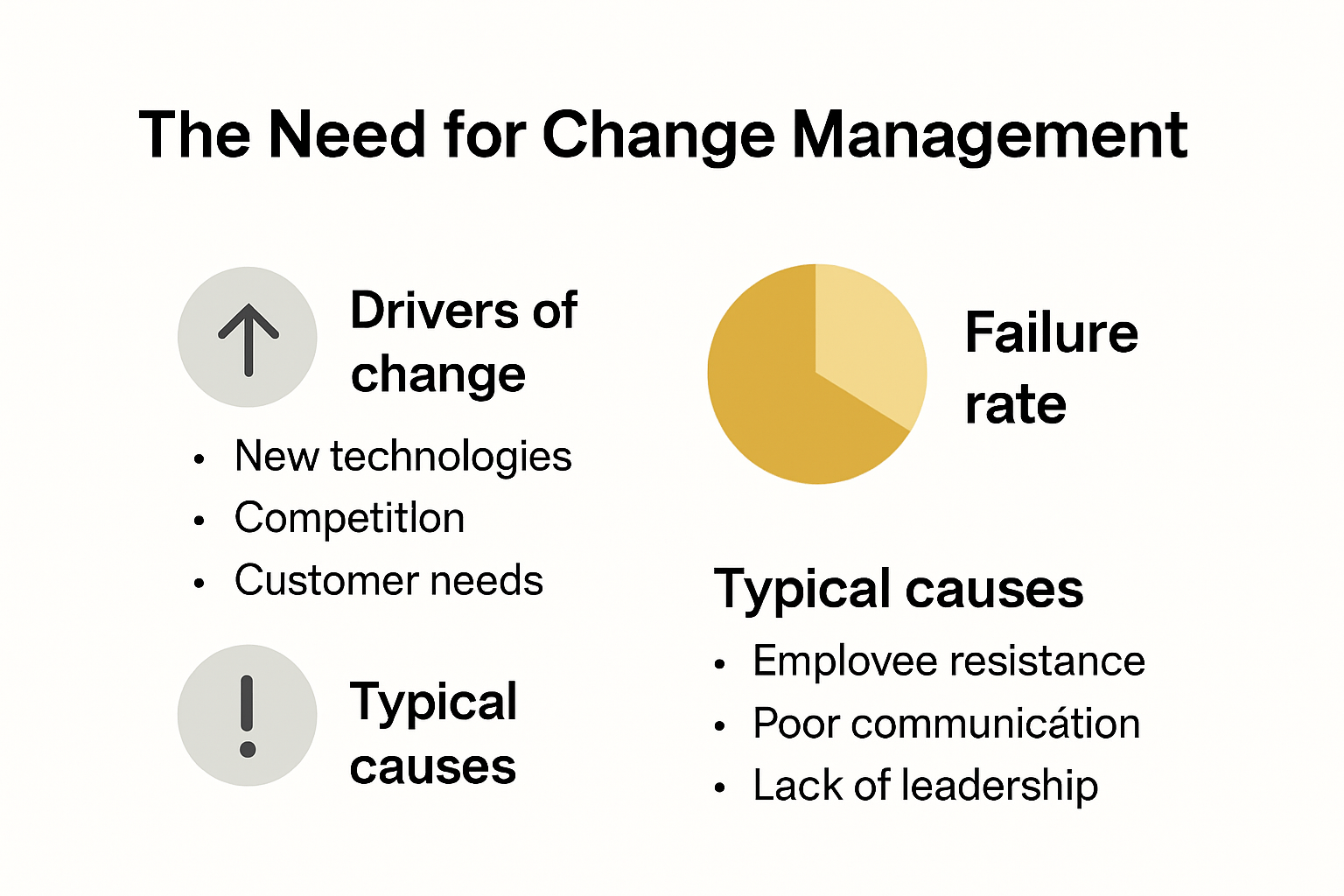
Research from Harvard Business Review reveals that approximately 70% of organizational change initiatives fail due to inadequate planning and poor implementation strategies. This staggering statistic underscores the critical need for systematic change management frameworks that address both operational and human dimensions of transformation.
Psychological and Organizational Resistance to Change
Change triggers complex psychological responses within organizations. Employees often experience uncertainty, fear, and potential resistance when confronted with significant organizational shifts. According to a systematic review in organizational psychology research, successful change management requires understanding and addressing these emotional and cognitive barriers.
Key psychological factors influencing change resistance include:
- Job Security Concerns: Employees worry about potential role modifications or job elimination
- Comfort with Existing Processes: Established routines create a sense of predictability and control
- Fear of the Unknown: Uncertainty about new workflows and expectations generates anxiety
To help visualize the main psychological and organizational barriers to change, the table below summarizes the key factors and their impact as discussed above.
| Psychological/Organizational Factor | Impact on Change Management |
|---|---|
| Job Security Concerns | Increases anxiety, leads to resistance and decreased morale |
| Comfort with Existing Processes | Drives reluctance to adopt new workflows |
| Fear of the Unknown | Generates uncertainty and resistance to new expectations |
Strategic Approach to Change Management
Effective change management demands a holistic, strategic approach that integrates technological, human, and organizational perspectives. Research from organizational transformation studies emphasizes the importance of developing comprehensive strategies that:
- Communicate transparently about change objectives
- Provide robust training and support mechanisms
- Create inclusive environments that encourage employee participation
- Develop flexible implementation roadmaps
By recognizing change as a complex, multifaceted process, organizations can transform potential disruptions into opportunities for innovation, growth, and sustained competitive advantage. Understanding the fundamental need for structured change management is the first critical step in building resilient, adaptable organizational capabilities.
Key Steps to Implement Change Effectively
Implementing change successfully requires a strategic and systematic approach that goes beyond mere planning. Organizations must execute carefully designed steps to ensure smooth transitions and minimize disruption.
To give you a clear overview of the essential steps for successful change implementation, here’s a table summarizing the step, key actions, and desired outcome for each phase detailed in this section.
| Step | Key Actions / Focus | Desired Outcome |
|---|---|---|
| Creating a Compelling Change Vision | Define strategic clarity, emotional connection, measurable goals | Clear purpose and direction |
| Building a Robust Change Management Team | Gather cross-functional, credible, expert members | Effective leadership and coordination |
| Executing and Sustaining Change | Incremental rollout, communication, employee support, short-term wins | High adoption and sustained progress |
Creating a Compelling Change Vision
Establishing a clear and inspiring vision forms the cornerstone of effective change management. Learn about advanced management techniques that support successful organizational transformations. According to research from the American Association of Medical Colleges, developing a precise vision involves several critical components:
- Strategic Clarity: Articulate specific goals and expected outcomes
- Emotional Connection: Create a narrative that resonates with employees
- Measurable Objectives: Define concrete metrics for tracking progress
The vision must communicate not just what will change, but why the change is necessary. As organizational change experts recommend, leaders should craft a narrative that demonstrates the potential positive impact on both the organization and individual employees.
Building a Robust Change Management Team
Successful change implementation demands a dedicated and influential coalition of leaders. This team should represent diverse perspectives across the organization and possess the following characteristics:
- Cross-Functional Representation: Include members from different departments
- Influential Leadership: Select individuals with credibility and strong communication skills
- Change Management Expertise: Ensure team members understand transformation principles
Research from organizational development studies emphasizes that the change management team acts as a critical catalyst, driving momentum and providing strategic guidance throughout the transformation process.
Executing and Sustaining Change
Implementation requires a phased approach that balances strategic planning with flexibility. Key execution strategies include:
- Incremental Implementation: Break complex changes into manageable stages
- Continuous Communication: Maintain transparent and frequent updates
- Employee Support Mechanisms: Provide training, resources, and psychological support
Agency for Healthcare Research and Quality recommends generating short-term wins to maintain motivation and demonstrate the tangible benefits of change. By celebrating early successes and maintaining adaptability, organizations can build momentum and reduce resistance.

Effective change management is not a linear process but a dynamic journey requiring constant reassessment, open communication, and a commitment to organizational learning and growth.
Overcoming Common Challenges in Change Management
Change management is a complex process fraught with potential obstacles that can derail organizational transformation efforts. Understanding and proactively addressing these challenges is crucial for successful implementation.
Addressing Employee Resistance
Explore advanced leadership strategies to effectively manage workforce transitions. Employee resistance represents one of the most significant barriers to organizational change. According to Harvard Business School research, resistance stems from multiple psychological and professional factors:
- Fear of the Unknown: Uncertainty about personal job roles and future responsibilities
- Perceived Loss of Control: Feeling marginalized during transformation processes
- Comfort with Existing Systems: Attachment to established workflow patterns
Research from Prosci Change Management suggests that leaders must develop empathetic, strategic approaches to mitigate resistance. This involves creating safe communication channels, providing transparent information, and demonstrating genuine understanding of employee concerns.
Ensuring Effective Communication
Ineffective communication can quickly undermine change management initiatives. Society for Human Resource Management highlights that successful communication strategies must be:
- Consistent: Deliver uniform messages across all organizational levels
- Transparent: Share both challenges and opportunities candidly
- Frequent: Maintain regular updates throughout the change process
- Two-Way: Encourage feedback and active dialogue
Organizations must recognize that communication is not just about broadcasting information but creating meaningful engagement. This approach helps build trust and reduces uncertainty during transformation periods.
Developing Organizational Adaptability
Building an adaptable organizational culture requires more than just implementing changes. Organizational development experts recommend developing systemic capabilities that support continuous transformation:
- Continuous Learning: Invest in ongoing skill development
- Flexible Organizational Structures: Create agile frameworks that can quickly respond to changes
- Leadership Development: Train managers to become change champions
By cultivating an environment that views change as an opportunity rather than a threat, organizations can transform potential resistance into collaborative innovation. This requires a holistic approach that integrates technological, human, and strategic dimensions of organizational development.
Successful change management is not about eliminating challenges but developing sophisticated organizational capabilities to navigate complexity with resilience and strategic intent.
Best Practices and Pro Tips for 2025
As organizations navigate increasingly complex business landscapes, change management strategies must evolve to meet emerging challenges and technological advancements. The year 2025 demands sophisticated, adaptive approaches that integrate cutting-edge technologies and human-centric methodologies.
Leveraging Technological Innovations
Explore project management strategies that align with technological transformations. According to Panorama Consulting research, artificial intelligence and advanced analytics are revolutionizing change management practices. Key technological innovations include:
- AI-Powered Sentiment Analysis: Utilizing natural language processing to understand employee reactions
- Real-Time Performance Tracking: Implementing dynamic dashboards for monitoring change initiatives
- Predictive Change Modeling: Using data analytics to anticipate potential resistance and intervention points
GP Strategies consulting emphasizes the importance of integrating technological tools with human-centered approaches, ensuring that technological innovations support rather than replace human connections.
Prioritizing Holistic Employee Experience
Successful change management in 2025 requires a comprehensive approach to employee well-being and engagement. Research from Reroute Consulting highlights critical strategies for supporting workforce transitions:
- Mental Health Support: Developing robust psychological safety mechanisms
- Continuous Learning Programs: Creating adaptive skill development pathways
- Flexible Work Arrangements: Designing inclusive transformation strategies
- Personalized Change Communication: Tailoring messaging to individual employee needs
Organizations must recognize that employee experience is not a peripheral concern but a central component of successful change management. This approach requires moving beyond traditional top-down communication models to create collaborative, empathetic transformation processes.
Adopting Agile and Adaptive Methodologies
The rapidly changing business environment demands more flexible and responsive change management approaches. Organizational development experts recommend implementing agile methodologies that emphasize:
- Iterative Planning: Breaking complex changes into manageable phases
- Continuous Feedback Loops: Creating mechanisms for real-time adjustment
- Cross-Functional Collaboration: Breaking down organizational silos
- Experimental Mindset: Treating change as a learning opportunity
Successful organizations in 2025 will view change not as a discrete event but as a continuous process of organizational learning and adaptation. This requires developing organizational cultures that embrace uncertainty, promote innovation, and maintain a forward-looking perspective.
Ultimately, effective change management transcends technological tools and strategic frameworks. It demands a holistic approach that balances technological innovation, human empathy, and strategic vision.
Frequently Asked Questions
What is change management?
Change management is a structured approach to transitioning individuals, teams, and organizations from a current state to a desired future state. It includes processes, tools, and techniques to manage the people side of change effectively.
Why do organizational change initiatives often fail?
About 70% of organizational change initiatives fail primarily due to poor planning and execution. Key factors include inadequate communication, lack of employee engagement, and resistance to change from within the organization.
How can I create a compelling change vision?
To create a compelling change vision, articulate specific goals and expected outcomes, develop an emotional connection with employees through a narrative, and define measurable objectives to track progress effectively.
What are some best practices for effective change management in 2025?
Best practices include leveraging technological innovations like AI for sentiment analysis, prioritizing holistic employee experiences by offering support and continuous learning, and adopting agile and adaptive methodologies that promote flexibility and responsiveness during the change process.
Ready to Turn Change Resistance Into Organizational Growth?
Are you struggling to move employees beyond fear, anxiety, or a reluctance to adapt when implementing change? The article highlighted the real challenge of poor change management: psychological resistance and lack of skills development that derail even the best-planned transformations. These pain points are real for leaders who want to drive lasting results but find themselves blocked by skill gaps, unclear communication, or uncertainty about the process.

Seize your opportunity to transform resistance into resilience by partnering with experts who understand the South African landscape in 2025. Peuneo offers accredited training, consulting, and tailored online courses designed to support your people every step of the way. Visit Peuneo’s main hub to see how practical upskilling, leadership development, and change management solutions can empower your organization. Act now and build a change-ready team that thrives during every transition.
Recommended
- 2025 Best Practices for Project Management Success – Peuneo
- Performance Management Systems: Key Benefits and Trends for 2025 – Peuneo
- Essential Skills for Managers in 2025: Guide for Leaders and Teams – Peuneo
- How to Lead a Team Effectively in 2025: Essential Strategies for Every Leader – Peuneo
- Top Leadership Development Strategies for 2025: Success Across Sectors – Peuneo
- Introduction to Project Management Strategies 2025 – Peuneo