
Leadership in 2025 is getting a serious makeover. The world no longer rewards just the loudest voice in the room. Instead, leaders who master emotional intelligence outperform their peers, with studies revealing those with high emotional intelligence are 58 percent more likely to drive team success. Think charisma and technical expertise are your golden tickets? Not anymore. The biggest breakthrough is that adaptability and continuous learning are now the real power moves, setting apart leaders who simply survive from those who actually thrive.
Table of Contents
- Understanding Core Leadership Skills In 2025
- Proven Methods To Grow Leadership Abilities
- Customizing Leadership Development For Different Audiences
- Integrating Leadership Skills Into Everyday Work
Quick Summary
| Takeaway | Explanation |
|---|---|
| Emphasize Emotional Intelligence | Develop emotional intelligence as a fundamental leadership skill to authentically connect with teams and drive organizational success. |
| Adopt Action Learning Methods | Utilize action learning by tackling real-world challenges to enhance leadership capabilities through experiential learning and reflection. |
| Customize Development Programs | Tailor leadership development initiatives to meet the unique needs of different professional levels and individual learning styles for more effective training. |
| Integrate Skills into Daily Work | Embed leadership development into organizational culture by creating opportunities for team members to practice and demonstrate leadership in their daily tasks. |
| Implement Real-Time Feedback | Establish continuous feedback mechanisms to provide immediate insights and facilitate ongoing improvement in leadership performance. |
Understanding Core Leadership Skills in 2025
Leadership in 2025 demands a radical reimagining of traditional management approaches. The rapidly evolving professional landscape requires leaders to develop a sophisticated set of skills that go beyond conventional command and control strategies. Modern leadership is about creating adaptive ecosystems where human potential and technological capabilities converge seamlessly.
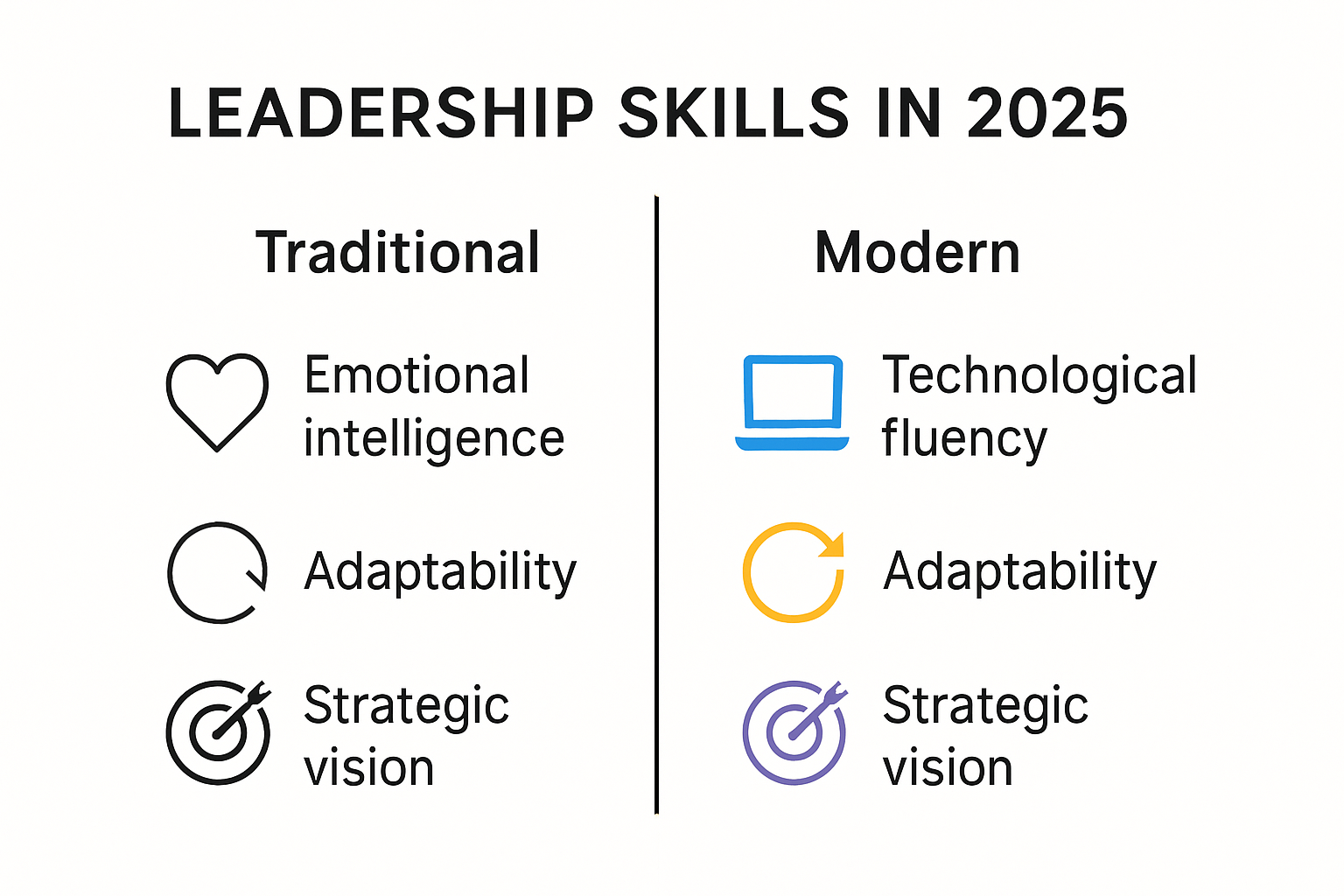
The Evolution of Leadership Competencies
The technological revolution and global interconnectedness have fundamentally transformed what it means to be an effective leader. According to research from IMD, agility and adaptability are now critical competencies for leaders navigating complex organizational environments. Leaders must now possess a multidimensional skill set that integrates emotional intelligence, technological understanding, and strategic vision.
Emotional intelligence has emerged as a cornerstone of effective leadership. Studies from top management research centers reveal that leaders who can authentically connect with their teams while maintaining strategic focus are more likely to drive organizational success. This requires a nuanced understanding of human dynamics, particularly in increasingly virtual and distributed work environments.
Communication and Technological Fluency
Effective communication remains paramount in 2025. Leaders must now articulate complex strategies across diverse teams, often spanning multiple geographic and cultural contexts. Research from the Center for Creative Leadership emphasizes that communication is no longer about information transmission but about creating meaningful dialogue and fostering collaborative environments.
Technological fluency has become equally critical. Leaders are expected to understand emerging technologies not just as tools but as transformative platforms that can reshape organizational capabilities. This doesn’t mean becoming technical experts but developing enough understanding to make strategic decisions that leverage technological innovations.
Adaptive Leadership in a Dynamic World
The most successful leaders in 2025 will be those who can rapidly learn, unlearn, and relearn. They must create organizational cultures that embrace continuous learning and view challenges as opportunities for growth. This requires a combination of strategic thinking, emotional resilience, and a commitment to personal and professional development.
Interested in diving deeper into leadership strategies? Explore our comprehensive guide on leadership development to understand how professionals can build these critical skills for future success. The landscape of leadership is changing, and those who adapt will not just survive but thrive in the complex ecosystems of modern organizations.
Proven Methods to Grow Leadership Abilities

Developing leadership abilities is a strategic and intentional process that requires continuous learning, self-reflection, and targeted skill enhancement. Professionals aspiring to become exceptional leaders must embrace a holistic approach that combines structured learning, practical experiences, and personal growth strategies.
Action Learning and Experiential Development
Action learning has emerged as a powerful method for leadership skill development. According to research from academic studies, this approach involves addressing real-world problems through a cyclical process of action, reflection, and learning. By engaging in complex organizational challenges, emerging leaders can develop critical thinking skills, problem-solving abilities, and strategic decision-making capabilities.
This method goes beyond traditional training by providing immersive experiences that challenge leaders to apply theoretical knowledge in practical contexts. Participants learn to analyze situations from multiple perspectives, develop innovative solutions, and reflect on their leadership approach. The iterative nature of action learning ensures continuous improvement and adaptability.
Mentorship and Structured Learning Programs
Mentorship represents a transformative approach to leadership development. Research from springer.com demonstrates that mentoring relationships contribute significantly to leadership identity formation and self-efficacy. By engaging with experienced professionals, aspiring leaders gain insights into complex organizational dynamics, receive personalized guidance, and develop essential interpersonal skills.
Formal leadership development programs complement mentorship by providing structured learning experiences. Studies from management research indicate that comprehensive programs combining theoretical knowledge with practical workshops and coaching can dramatically accelerate leadership skill acquisition. These programs typically focus on developing core competencies such as emotional intelligence, strategic thinking, and effective communication.
Continuous Personal Development Strategies
Successful leadership growth requires a commitment to continuous personal development. This involves creating a deliberate learning plan that encompasses professional training, self-reflection, and skill diversification. Professionals should actively seek opportunities that challenge their current capabilities and expand their leadership perspective.
Key strategies include pursuing cross-functional experiences, attending industry conferences, engaging in online learning platforms, and maintaining a growth mindset. Reading leadership literature, participating in professional networks, and seeking constructive feedback are additional methods that contribute to ongoing leadership skill enhancement.
Want to explore more about building leadership capabilities? Check out our comprehensive leadership development resources to discover tailored strategies for professional growth. Remember that leadership development is a journey of continuous learning and adaptation, requiring dedication, curiosity, and a genuine commitment to personal and organizational excellence.
Customizing Leadership Development for Different Audiences
Leadership development is not a one-size-fits-all approach. Different professional levels, organizational roles, and individual learning styles demand nuanced and targeted development strategies. Understanding how to customize leadership training for diverse audiences is crucial for creating meaningful and transformative learning experiences.
Designing Targeted Leadership Pathways
The following table summarizes the key focus areas for leadership development at different career stages, clarifying the skills and competencies emphasized for each role.
| Career Level | Key Focus Areas |
|---|---|
| Entry-Level | Foundational skills: effective communication, team collaboration, basic project management |
| Mid-Level | Advanced skills: strategic thinking, cross-functional leadership, organizational change management |
| Senior Leadership | Sophisticated skills: global business strategy, innovation leadership, complex organizational transformation |
Effective leadership development requires a strategic approach that recognizes the unique needs of professionals at different career stages. Research from Dr. Kendrick Scott highlights the importance of creating specialized training programs for entry-level, mid-level, and senior leadership roles.
For entry-level managers, the focus should be on foundational skills such as effective communication, team collaboration, and basic project management. Mid-level leaders require more advanced training that emphasizes strategic thinking, cross-functional leadership, and organizational change management. Senior executives need highly sophisticated programs concentrating on global business strategy, innovation leadership, and complex organizational transformation.
Personalized Learning Experience Design
The emergence of learner experience design (LXD) has revolutionized professional development approaches. Insights from elearning industry research demonstrate that modern leadership training must move beyond traditional content delivery to create engaging, personalized learning journeys.
This approach involves developing flexible, individualized learning sequences that combine formal training, informal learning opportunities, and social learning experiences. By utilizing detailed learner personas and understanding individual motivations, organizations can create more targeted and impactful development programs. The goal is to design learning experiences that adapt to individual learning styles, professional backgrounds, and specific organizational contexts.
Leveraging Technology and Persona-Based Learning
Technological research from academic sources suggests using personas—fictional archetypes representing key user types—can significantly enhance the scalability and effectiveness of professional development resources. By creating detailed profiles that capture the diverse needs, challenges, and aspirations of different professional groups, organizations can develop more nuanced and responsive leadership training programs.
This approach allows for the creation of highly contextualized learning experiences that address specific skill gaps, learning preferences, and career trajectory needs. Digital platforms and adaptive learning technologies enable the delivery of personalized content, real-time feedback, and interactive learning experiences that can be dynamically adjusted based on individual progress and performance.
Interested in exploring more about tailored leadership development strategies? Discover our comprehensive approach to employee development and learn how we create customized learning experiences that drive professional growth and organizational success. By recognizing the unique potential of each individual, we transform leadership development from a standardized process to a personalized journey of continuous improvement.
Integrating Leadership Skills Into Everyday Work
Leadership is not an isolated role or occasional responsibility but a continuous practice embedded in daily professional interactions. Transforming leadership from a theoretical concept to a practical, lived experience requires intentional strategies that integrate leadership skills seamlessly into everyday work environments.
Embedding Leadership Development in Organizational Culture
Research from Korn Ferry highlights the critical importance of aligning leadership initiatives with core organizational values. This means creating an ecosystem where leadership development is not a separate training module but an intrinsic part of daily workflow and organizational strategy.
Companies can achieve this by designing work processes that naturally encourage leadership behaviors. This involves creating opportunities for employees to demonstrate initiative, make collaborative decisions, and take ownership of projects. Team structures should be flexible, allowing individuals to rotate leadership responsibilities and develop skills through practical experience.
Project-Based Learning and Skill Integration
The following table outlines ways organizations can integrate leadership development into daily work, summarizing methods mentioned in the article.
| Integration Method | Description |
|---|---|
| Flexible Team Structures | Allow individuals to rotate leadership responsibilities through real project work |
| Embedded Leadership Modules | Incorporate leadership training (e.g., emotional intelligence, team-building) into projects |
| Collaborative Decision-Making | Create processes for employees to take initiative and collaborate on project decisions |
| Real-Time Feedback Tools | Use digital platforms for immediate performance feedback and targeted development |
Academic research from undergraduate engineering programs demonstrates the effectiveness of integrating leadership modules directly into team-based projects. By embedding components like emotional intelligence training, communication workshops, and team-building exercises within actual work assignments, organizations can create immersive learning experiences.
This approach transforms traditional leadership development from a passive learning model to an active, experiential process. Employees learn leadership skills not through theoretical lectures but by practicing them in real-world contexts. Project teams become living laboratories for leadership skill development, where individuals can experiment, receive feedback, and continuously improve their capabilities.
Real-Time Feedback and Continuous Improvement
Leadership development experts emphasize the importance of implementing real-time feedback mechanisms. These systems provide immediate insights into an individual’s leadership performance, allowing for rapid skill refinement and personalized development strategies.
Modern technological platforms can facilitate this continuous feedback loop by offering digital tools that track leadership behaviors, provide instant performance insights, and suggest targeted improvement strategies. These systems go beyond traditional annual performance reviews, creating a dynamic environment of ongoing professional growth.
Want to explore more about developing essential management skills? Check out our comprehensive guide for managers and discover how to transform leadership from a theoretical concept into a practical, everyday skill. Remember that true leadership is not about a title or position but about consistently demonstrating skills that inspire, guide, and elevate team performance.
Frequently Asked Questions
What are the essential leadership skills needed in 2025?
In 2025, essential leadership skills include emotional intelligence, effective communication, technological fluency, and adaptability. Leaders must also cultivate the ability to navigate complex, dynamic environments while fostering continuous learning within their teams.
How can I develop my leadership skills effectively?
To develop your leadership skills effectively, engage in action learning methods, seek mentorship, participate in structured learning programs, and commit to continuous personal development strategies. Real-world experience and reflection on these experiences are crucial for growth.
Why is emotional intelligence important for leaders in 2025?
Emotional intelligence is vital for leaders in 2025 because it enables them to authentically connect with their teams, understand human dynamics, and drive organizational success. Studies show that leaders with high emotional intelligence are significantly more likely to achieve team success.
How can organizations integrate leadership skills into daily work?
Organizations can integrate leadership skills into daily work by embedding leadership development into their culture, utilizing project-based learning, and implementing real-time feedback mechanisms. This approach encourages employees to practice leadership skills in actual work contexts, fostering continuous improvement.
Ready to Turn Leadership Theory Into Everyday Success?
You have just explored why adaptability, action learning, and emotional intelligence are non-negotiable for modern leaders. Yet the real challenge remains: How do you move beyond theory and actually embed these skills into your team’s daily actions? Many organizations struggle with tailoring learning experiences that address real-world problems and foster continuous feedback. This is where Peuneo comes in.

Stop letting skill gaps hold your business back. Discover Peuneo’s accredited training and consulting solutions designed specifically to embed leadership skills within your team’s workflow. Take the next step to activate transformative growth by exploring our online courses and expert support today. The future of leadership starts with the actions you take now. Join a community committed to elevating leadership excellence across every level.
Recommended Articles
- Top Leadership Development Strategies for 2025: Success Across Sectors – Peuneo
- Essential Skills for Managers in 2025: Guide for Leaders and Teams – Peuneo
- How to Lead a Team Effectively in 2025: Essential Strategies for Every Leader – Peuneo
- Career Development Strategies: Ultimate 2025 Growth Guide – Peuneo
- Essential Effective Management Techniques for 2025 – Peuneo
- Soft Skills for Managers: Essential Guide for 2025 Success – Peuneo