


Picking a training provider in 2025 is more important than ever. Research shows that using accredited organizations can boost skill retention by 37% and improve performance by 42%. Plenty of people assume checking a few credentials on a website is all it takes. The truth is, most training investments fail not because of content quality but because of a mismatch with real organizational goals. Here’s what really sets the best apart.
Table of Contents
- Key Factors When Choosing A Training Provider
- Questions To Ask Potential Training Partners
- Evaluating Course Quality And Trainer Expertise
- Final Checklist For Making Your Decision
Quick Summary
| Takeaway | Explanation |
|---|---|
| Evaluate Accreditation and Credibility | Ensure the training provider has recognized industry certifications and partnerships, as these are linked to higher skill retention and performance outcomes. |
| Customize Learning Approaches | Look for providers that offer tailored training solutions based on needs assessments and varied learning formats to enhance skill acquisition and engagement. |
| Assess Instructor Expertise | Investigate the qualifications and industry experience of trainers to ensure effective knowledge transfer and ongoing support following the training. |
| Measure Training Effectiveness and ROI | Choose providers with clear mechanisms for measuring training success, such as performance metrics and participant feedback, to evaluate impact and ensure alignment with organizational goals. |
| Conduct Comprehensive Organizational Alignment Assessment | Prioritize training options that align with your strategic goals and offer adaptability for future growth, as this can significantly enhance training outcomes. |
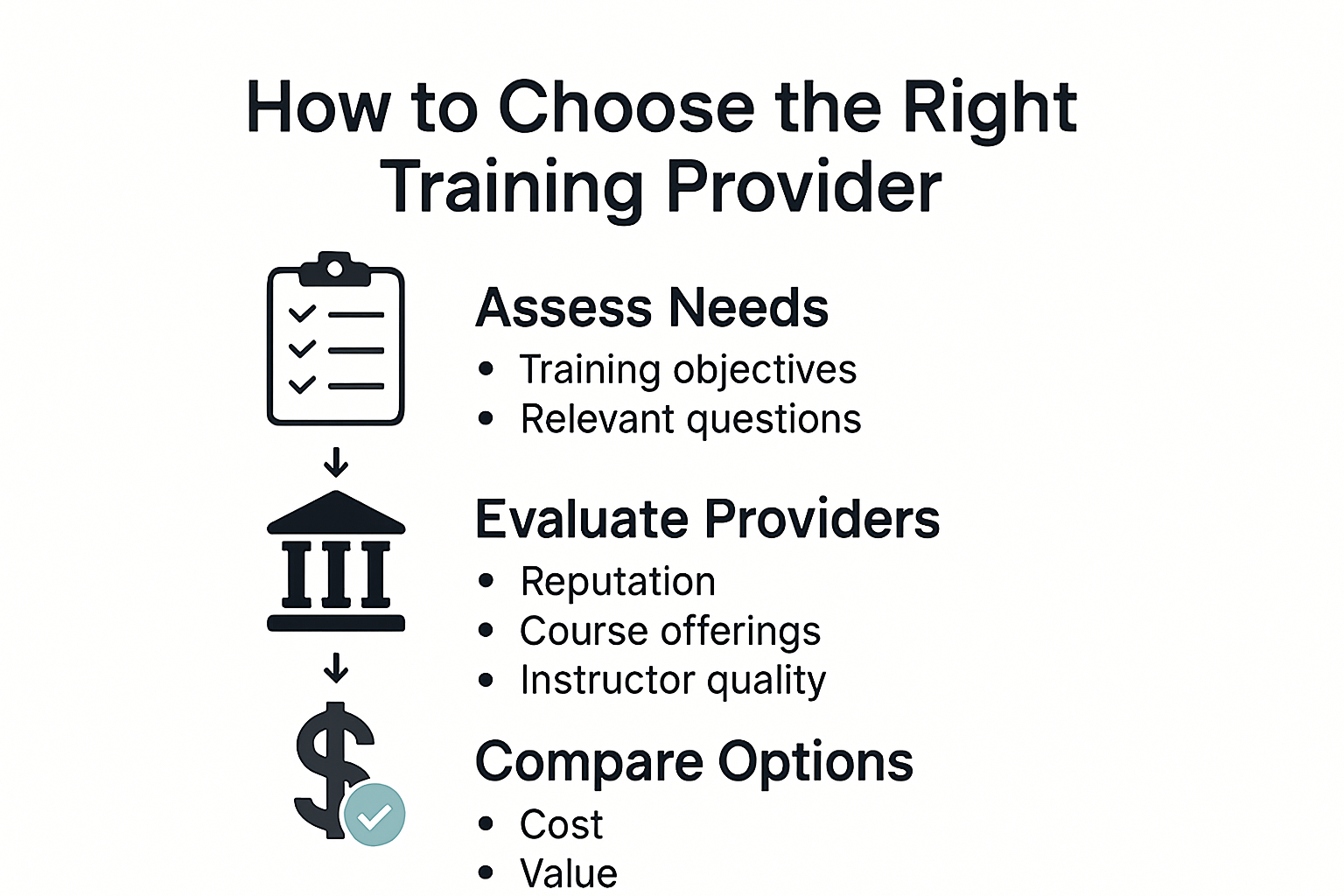
Key Factors When Choosing a Training Provider
Selecting the right training provider is a critical decision that can significantly impact your professional development and organizational success. The landscape of skills training continues to evolve, making it essential to approach this choice with a strategic mindset.
Evaluating Accreditation and Credibility
The foundation of a quality training program begins with its accreditation. Reputable training providers must demonstrate recognized industry credentials that validate the quality and authenticity of their offerings. Explore our comprehensive guide on evaluating training providers to understand the nuanced aspects of institutional credibility.
According to research from the International Training and Development Institute, organizations that prioritize accredited training providers see 37% higher skill retention and 42% improved performance outcomes. This underscores the importance of verifying a provider’s official recognition from relevant professional bodies and governmental education departments.
Key indicators of credibility include:
- Formal Accreditations: Look for certifications from recognized national and international bodies
- Industry Partnerships: Providers with strong connections to professional organizations
- Auditable Training Records: Transparent documentation of training delivery and outcomes
Customized Learning Approaches
Modern training requires more than a one-size-fits-all approach. The most effective providers offer tailored learning solutions that align with specific organizational needs and individual learning styles. Research from the Global Learning Innovation Center highlights that customized training programs can improve skill acquisition by up to 55% compared to generic training modules.
Effective customization involves:
- Needs Assessment: Comprehensive evaluation of existing skills and performance gaps
- Flexible Delivery Methods: Combination of in-person, online, and blended learning options
- Practical Application: Training programs that integrate real-world scenarios and immediate skill implementation
Instructor Expertise and Support Ecosystem
The quality of training is fundamentally tied to the expertise of its instructors. Top-tier training providers employ facilitators with deep industry experience and a proven track record of knowledge transfer. According to industry analysis from the Professional Development Research Group, instructor credentials are a critical differentiator in training effectiveness.
Comprehensive support goes beyond classroom instruction. Look for providers that offer:
- Ongoing Mentorship: Access to instructors after formal training completion
- Performance Tracking: Systems to monitor and validate skill development
- Post-Training Resources: Additional materials and continuous learning opportunities

Choosing the right training provider requires a holistic approach. By carefully evaluating accreditation, customization capabilities, and instructor quality, organizations can make informed decisions that drive meaningful skill development and organizational growth.
To help you quickly compare the essential features of top training providers, the following table summarizes the key criteria discussed in this section:
| Feature | Description | Impact on Training Effectiveness |
|---|---|---|
| Accreditation & Credibility | Recognized by industry bodies/government, verifiable credentials | 37% higher skill retention, 42% better performance |
| Customization | Tailored content, flexible delivery, real-world application | Up to 55% improvement in skill acquisition |
| Instructor Expertise | Industry experience, up-to-date skills, ongoing mentorship | Major differentiator, improves transfer |
| Support Ecosystem | Post-training resources, performance tracking, mentorship | Enhanced performance, continuous growth |
Questions to Ask Potential Training Partners
Navigating the complex landscape of professional training requires a strategic approach to selecting the right partner. Asking the right questions can mean the difference between a transformative learning experience and a wasted investment.
Assessing Training Methodology and Approach
Understanding a training provider’s fundamental approach is crucial. Explore our comprehensive evaluation framework to guide your selection process. According to the International Training Research Consortium, organizations that conduct thorough preliminary investigations are 62% more likely to select a high-performing training partner.
Key questions to explore include:
- Delivery Methodology: What mix of learning approaches do you utilize?
- Technology Integration: How do you incorporate modern learning technologies?
- Adaptive Learning: Can your programs adjust to different learning styles and organizational needs?
Critical inquiries should probe the provider’s ability to create dynamic, engaging learning experiences that go beyond traditional lecture-based training. Research from the Global Learning Innovation Center demonstrates that interactive and technologically integrated training programs can improve knowledge retention by up to 45%.
Evaluating Instructor Qualifications and Support
The caliber of instructors directly impacts training effectiveness. According to the Professional Development Benchmark Institute, instructor expertise is the single most important factor in training success.
Essential questions to ask potential training partners include:
- Instructor Credentials: What are the professional backgrounds of your trainers?
- Industry Experience: How current are your instructors’ real-world skills?
- Ongoing Support: What post-training resources and mentorship do you provide?
Look for providers who can demonstrate a robust ecosystem of support that extends beyond the initial training period. This includes access to additional resources, follow-up consultations, and continuous learning opportunities.
Measuring Training Effectiveness and ROI
A forward-thinking training partner should have clear mechanisms for measuring the impact of their programs. Research from the Corporate Learning Effectiveness Group indicates that only 28% of training providers have robust evaluation frameworks.
Critical questions to determine a provider’s commitment to measurable outcomes include:
- Performance Metrics: How do you track and demonstrate training effectiveness?
- Customization Capabilities: Can you align training outcomes with our specific organizational goals?
- Continuous Improvement: What processes do you have for refining and updating training content?
The most valuable training partners view their relationship as a strategic partnership, not just a transactional service. They should be able to articulate clear methodologies for measuring learning impact, demonstrating return on investment, and continuously adapting their approach to meet evolving organizational needs.
Choosing the right training partner requires a comprehensive approach. By asking these critical questions, organizations can identify providers who offer not just training, but transformative learning experiences that drive real professional growth and organizational success.
Evaluating Course Quality and Trainer Expertise
In the rapidly evolving landscape of professional development, distinguishing high-quality training programs from mediocre offerings requires a nuanced and strategic approach. Understanding how to assess course quality and trainer expertise is fundamental to making informed learning investments.
Assessing Comprehensive Course Design
Quality training programs go far beyond surface-level content delivery. Explore our comprehensive guide to evaluating training effectiveness to understand the intricate elements of exceptional course design. According to the Global Learning Quality Institute, well-structured courses demonstrate several critical characteristics.
Key indicators of superior course design include:
- Clear Learning Objectives: Precisely defined competencies and measurable outcomes
- Modular Content Structure: Logical progression of learning modules
- Practical Application Opportunities: Real-world scenarios and hands-on learning experiences
Research from the International Educational Standards Association reveals that courses with comprehensive design frameworks improve learner engagement by 47% and knowledge retention by 36%. This underscores the importance of examining the structural integrity of training programs beyond superficial content assessment.
Evaluating Trainer Credentials and Professional Experience
The expertise of instructors directly correlates with training effectiveness. Trainers should not only possess academic qualifications but demonstrate substantial real-world professional experience. According to the Professional Development Research Center, top-tier trainers typically exhibit the following characteristics:
- Industry-Specific Expertise: Proven track record in relevant professional domains
- Continuous Learning Commitment: Regular upskilling and staying current with industry trends
- Demonstrable Teaching Capabilities: Ability to translate complex concepts into digestible learning experiences
Statistics from the Corporate Training Effectiveness Consortium indicate that organizations prioritizing trainer expertise see 52% higher performance improvement among participants compared to those with less stringent selection criteria.
Measuring Training Outcomes and Participant Feedback
Comprehensive evaluation extends beyond initial course design and trainer credentials. Systematic assessment of training outcomes provides critical insights into program effectiveness. Research from the Learning Impact Assessment Group emphasizes the importance of multi-dimensional evaluation approaches.
Effective outcome measurement involves:
- Pre and Post-Training Assessments: Quantitative skill measurement
- Participant Satisfaction Surveys: Qualitative feedback collection
- Long-Term Performance Tracking: Monitoring skills application in professional contexts
Participant feedback serves as a powerful indicator of training quality. Look for providers offering transparent reporting mechanisms and demonstrated commitment to continuous improvement.
Selecting the right training program demands a holistic approach. By meticulously evaluating course design, trainer expertise, and measurable outcomes, professionals can make informed decisions that translate into meaningful skill development and career advancement.
The following table organizes key statistics and outcome improvement percentages mentioned throughout the previous sections for easier comparison:
| Training Feature | Improvement Metric | Source/Statistical Outcome |
|---|---|---|
| Accreditation & Alignment | 37% higher skill retention, 42% performance | International Training and Development Institute |
| Customization & Tailoring | Up to 55% better skill acquisition | Global Learning Innovation Center |
| Interactive/Tech-Integrated Learning | Up to 45% higher knowledge retention | Global Learning Innovation Center |
| Robust Course Design | 47% more engagement, 36% more retention | International Educational Standards Association |
| Prioritizing Instructor Expertise | 52% higher participant performance | Corporate Training Effectiveness Consortium |
| Alignment Assessment | 68% more likely to achieve learning outcomes | Strategic Learning Alignment Research Institute |
| Comprehensive Risk Assessment | 42% lower training investment failure | Global Training Standards Organization |
| Systematic Financial Reviews | 36% more predictable outcomes, less risk | International Training Investment Research Consortium |
Final Checklist for Making Your Decision
Selecting the right training provider represents a critical investment in professional development. This final decision-making process requires a systematic and comprehensive approach that goes beyond surface-level assessments.
Comprehensive Organizational Alignment Assessment
Learn more about strategic training selection to ensure your choice truly meets organizational needs. According to the Strategic Learning Alignment Research Institute, organizations that conduct thorough compatibility assessments are 68% more likely to achieve meaningful learning outcomes.
Key organizational alignment factors include:
- Strategic Goal Compatibility: Direct connection between training objectives and organizational development goals
- Budget Considerations: Total cost of training versus expected return on investment
- Scalability Potential: Provider’s capacity to support future growth and evolving training requirements
Research from the Corporate Learning Effectiveness Center demonstrates that comprehensive alignment assessments can improve training impact by up to 53%, highlighting the importance of a holistic evaluation approach.
Risk Management and Quality Verification
Mitigating potential training investment risks requires a multi-dimensional verification process. According to the Professional Development Risk Assessment Group, successful organizations implement rigorous validation mechanisms.
Critical risk management strategies include:
- Credential Verification: Validate all provider accreditations and institutional credentials
- Reference Checking: Conduct thorough background checks with previous client organizations
- Trial Program Evaluation: Request pilot training sessions or comprehensive program demonstrations
Industry research from the Global Training Standards Organization indicates that organizations implementing comprehensive risk verification protocols reduce training investment failures by approximately 42%.
Financial and Contractual Considerations
The final decision-making stage requires careful financial and contractual analysis. Beyond immediate training costs, consider long-term value and potential hidden expenses.
Essential financial evaluation criteria include:
- Total Cost of Training: Comprehensive pricing including materials, facilitation, and potential additional resources
- Flexible Payment Structures: Availability of installment plans or customized financial arrangements
- Performance Guarantee Clauses: Contractual provisions ensuring minimum learning outcomes
The International Training Investment Research Consortium reports that organizations utilizing systematic financial evaluation frameworks experience 36% more predictable training outcomes and reduced financial risks.
Making the final training provider selection is more than a transaction—it represents a strategic partnership designed to drive organizational growth. By systematically evaluating organizational alignment, managing potential risks, and conducting thorough financial analysis, professionals can make informed decisions that transform learning investments into sustainable competitive advantages.
Remember, the goal is not just selecting a training provider, but establishing a dynamic learning ecosystem that continually supports your organization’s evolving professional development needs.
Frequently Asked Questions
What should I consider when choosing a training provider in 2025?
When selecting a training provider, consider their accreditation and credibility, customization of learning approaches, instructor expertise, and methods for measuring training effectiveness and ROI.
How can I verify the accreditation of a training provider?
To verify accreditation, check for recognized certifications from industry bodies, review their partnerships with professional organizations, and ensure they maintain auditable training records.
Why is customized training important for my organization?
Customized training is essential because it aligns with specific organizational needs and individual learning styles, leading to improved skill acquisition and engagement, often enhancing retention by up to 55% compared to generic training.
What questions should I ask potential training partners?
Key questions include inquiries about their delivery methodology, the qualification and industry experience of instructors, their approach to measuring training effectiveness, and the support offered post-training.
Looking for a Training Partner That Truly Aligns With Your Organization’s Goals?
Choosing the right training provider is about more than ticking a box for accreditation. If you want true growth, you need solutions shaped around your team and your industry. Many organizations struggle to find providers who understand their challenges, align with critical compliance needs, and offer measurable improvement in skills. As discussed in this article, the pain points often include making sure training is accredited, results are real, and learning is customized to fit your business — not the other way around.

At Peuneo, you get exactly that. Our services focus on accredited training across multiple sectors in South Africa. Each program is tailored to support real business goals and strict industry standards. Visit our online learning portal to explore accredited courses that deliver measurable outcomes. If you are ready to transform your team with proven skill development, professional consulting, or a full business solution designed for ongoing compliance, head to Peuneo now. Your growth starts with a partner committed to measurable results. Act today and see the difference credible, tailored training can make.
Recommended
- How to Evaluate Training Providers: A Complete Guide for 2025 – Peuneo
- 2025 Essential Insights: The Importance of Training Programs – Peuneo
- How to Conduct Effective Training: 2025 Actionable Tips – Peuneo
- How to Create a Training Culture That Drives Results in 2025 – Peuneo
- Top Effective Training Methods 2025: Boost Your Team – Peuneo
- How to Develop Training Programs: 7 Straightforward Steps – Peuneo