


Recruitment mistakes do not just stall growth. They quietly drain the budget and squander a company’s future potential. Shockingly, a single bad hire can cost between 50 and 250 percent of that employee’s annual salary. That much damage comes before you even consider the lost productivity and plummeting morale left behind. Yet most companies only notice these consequences after the damage is done. The real risk is not just making a bad choice, but missing the chance to build teams that truly thrive.
Table of Contents
- Understanding The Impact Of Common Recruitment Mistakes
- Key Mistakes In Screening And Selection Processes
- How To Build A Fair And Effective Recruitment Strategy
- Practical Tips For Training And Continuous Improvement
Quick Summary
| Takeaway | Explanation |
|---|---|
| The Financial Burden of Poor Recruitment | A bad hire can cost organizations between 50% to 250% of an employee’s annual salary, affecting productivity, morale, and overall team dynamics. |
| Importance of Comprehensive Candidate Verification | Nine in ten businesses experience discrepancies during candidate screening, highlighting the need for rigorous verification of employment history, educational credentials, and professional certifications. |
| Skills-Based Talent Acquisition | Hiring for skills rather than educational background significantly improves job performance and retention rates, as skills-based recruitment shifts focus to a candidate’s true capabilities. |
| Leveraging Technology with Human Oversight | While AI can enhance recruitment efficiency by reducing time-to-hire, it is crucial to maintain human judgment and oversight to avoid biases and improve candidate evaluation. |
| Continuous Learning as a Strategic Imperative | With predictions that 50% of employees will need to upskill by 2025, organizations must create robust training programs and prioritize continuous improvement to adapt to technological advancements. |
Understanding the Impact of Common Recruitment Mistakes
Recruitment mistakes can create significant ripple effects that extend far beyond initial hiring processes. Organizations that fail to recognize and address these critical errors risk substantial financial losses, diminished team performance, and long-term reputational damage.
The Hidden Costs of Poor Recruitment Strategies
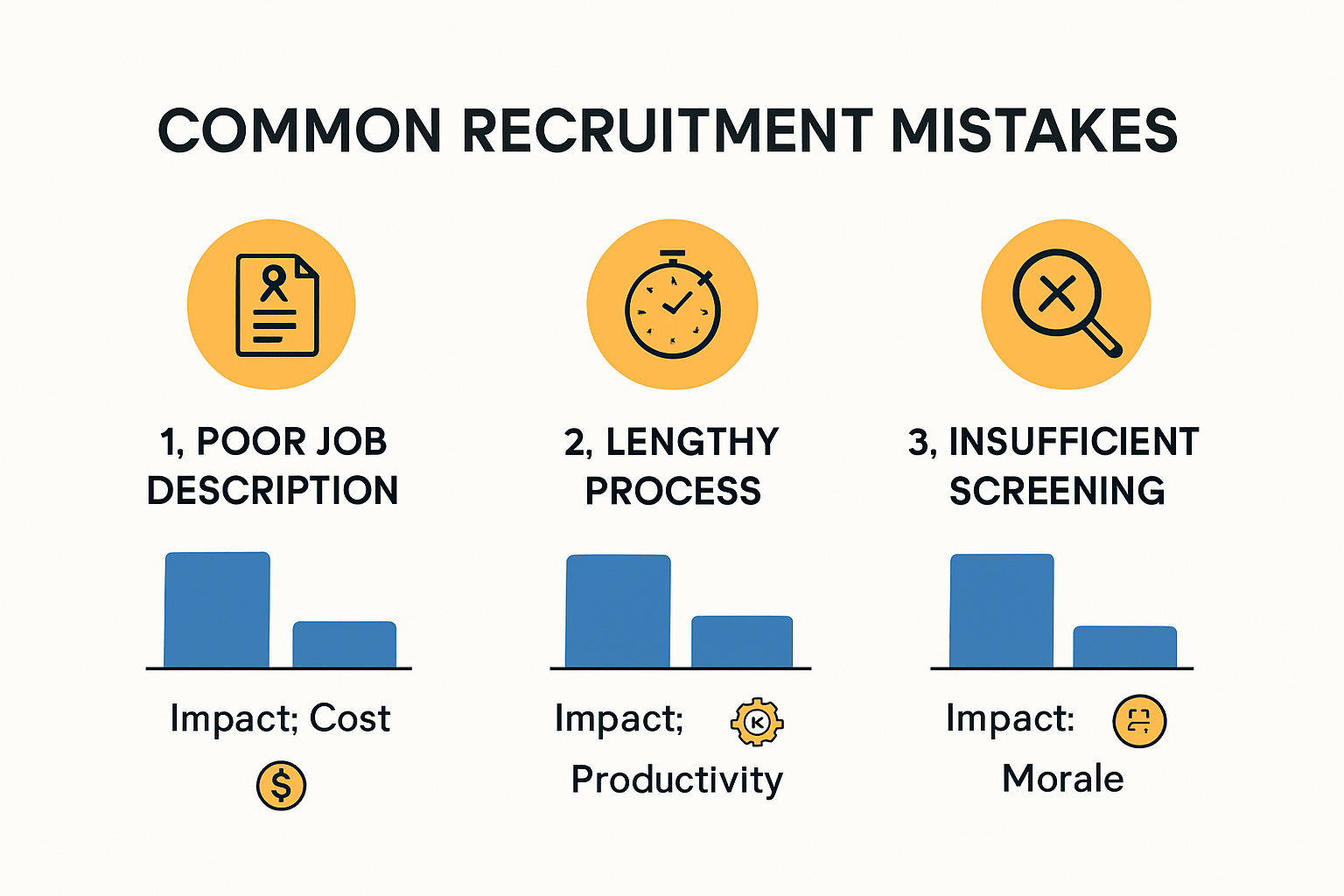
Every recruitment mistake carries a substantial economic burden. Research reveals that a bad hire can cost organizations between 50% to 250% of an employee’s annual salary. Research from SmartRecruiters highlights that inefficient recruitment processes impact 22% of organizations, with tracking applicants becoming increasingly challenging.
These mistakes manifest through multiple channels:
- Financial Impact: Direct costs of rehiring and training new employees
- Productivity Loss: Decreased team efficiency and workflow disruption
- Morale Reduction: Existing team members become demotivated by constant personnel changes
Moreover, candidate experience statistics indicate that 53% of candidates encounter misleading hiring practices, with 34% feeling “ghosted” after just one week. Such experiences severely damage an organization’s employer brand and future recruitment potential.
Psychological and Organizational Consequences
Beyond immediate financial implications, recruitment mistakes create profound psychological impacts within organizations. When wrong candidates are selected, teams experience decreased trust, increased stress, and reduced collaborative capabilities. The psychological strain of constant team restructuring can lead to decreased overall organizational resilience.
Interestingly, our recruitment best practices guide offers deeper insights into mitigating these risks. Strategic recruitment isn’t just about filling positions but creating sustainable, high-performing teams.
Statistically, the recruitment landscape is challenging: approximately 118 people apply for each advertised job. This high volume increases the probability of overlooking qualified candidates or making hasty decisions. Organizations must develop sophisticated screening mechanisms that balance efficiency with comprehensive candidate evaluation.
Understanding these multifaceted impacts transforms recruitment from a transactional process to a strategic organizational capability. Proactive approaches that prioritize comprehensive candidate assessment, transparent communication, and alignment with organizational culture can dramatically reduce the likelihood of costly recruitment mistakes.
The key lies in recognizing that each recruitment decision represents more than just filling a role. It’s an investment in organizational potential, team dynamics, and future success.
Key Mistakes in Screening and Selection Processes
Screening and selection processes represent critical touchpoints in recruitment where organizations frequently encounter significant challenges. The wrong approach can lead to missed opportunities, poor candidate matches, and substantial organizational risks.
Overlooking Comprehensive Candidate Verification
Many organizations make fundamental errors during candidate screening that compromise their hiring quality. Research from Global Verification Network reveals that a substantial number of candidates provide false information on resumes and applications. This underscores the critical need for rigorous background checks.
Key verification challenges include:
- Employment History: Confirming previous work experiences and roles
- Educational Credentials: Validating academic qualifications
- Professional Certifications: Ensuring claimed credentials are legitimate
According to PeopleManagement research, nine in ten businesses report candidate discrepancies during screening processes. The most common inconsistencies relate to employment history (64%) and educational qualifications, highlighting the importance of thorough verification protocols.

Technology Bias in Candidate Screening
The increasing reliance on artificial intelligence and automated screening tools introduces complex challenges. Research from HireVire warns that AI-driven screening can inadvertently exclude qualified candidates due to algorithmic biases or non-standard resume formatting.
Organizations must strike a delicate balance between technological efficiency and human judgment. Automated systems should complement, not replace, human evaluation. This means developing screening processes that:
- Recognize diverse resume formats
- Account for non-traditional career paths
- Incorporate human oversight to mitigate algorithmic limitations
Learn more about effective recruitment strategies that integrate technology without compromising candidate quality.
The most sophisticated screening processes view candidate evaluation as a holistic assessment. They go beyond simple credential matching and seek to understand a candidate’s potential, adaptability, and cultural alignment. Successful organizations recognize that technical skills represent only one dimension of candidate suitability.
Ultimately, effective screening and selection demand a nuanced, multifaceted approach. By acknowledging potential pitfalls and implementing robust verification mechanisms, organizations can transform their recruitment processes from passive filtering to strategic talent acquisition.
How to Build a Fair and Effective Recruitment Strategy
Building a fair and effective recruitment strategy requires a comprehensive approach that goes beyond traditional hiring practices. Organizations must develop systematic methods that prioritize candidate potential, eliminate biases, and align talent acquisition with strategic organizational goals.
Skills-Based Talent Acquisition
Research from McKinsey reveals a critical insight: hiring for skills is five times more predictive of job performance compared to educational background. Surprisingly, employees without traditional degrees demonstrate 34% higher retention rates than those with standard academic credentials.
Key components of skills-based recruitment include:
- Competency Mapping: Identifying precise skill requirements for each role
- Performance Potential: Evaluating candidates based on demonstrable capabilities
- Adaptability Assessment: Understanding a candidate’s learning and growth potential
This approach shifts recruitment from credential checking to genuine talent evaluation. Organizations must design assessment frameworks that reveal a candidate’s true capabilities beyond standard resume metrics.
Leveraging Technology with Human Intelligence
AI-powered recruitment systems can reduce time-to-hire by an average of 40%, enabling more data-driven and potentially unbiased hiring decisions. However, technology must complement human judgment, not replace it.
Effective technological integration requires:
- Algorithmic transparency
- Regular bias audits
- Human oversight in critical decision points
Explore our comprehensive recruitment best practices to understand how technology can enhance rather than dominate your hiring strategy.
Strategic Labor Market Intelligence
Gartner research emphasizes the importance of using labor market intelligence to define critical skills needs. Modern recruitment strategies must align with real-time talent supply, competitive landscapes, and hiring complexity.
Organizations should develop dynamic recruitment strategies that:
- Monitor emerging skill trends
- Understand regional talent availability
- Create flexible talent acquisition frameworks
A fair recruitment strategy transcends traditional boundaries. It requires continuous learning, adaptability, and a commitment to recognizing diverse talent pathways. By integrating skills-based assessment, responsible technological use, and strategic market intelligence, organizations can build recruitment processes that are not just effective but genuinely transformative.
The future of recruitment is not about filling positions. It is about unlocking human potential and creating environments where diverse talents can thrive.
Practical Tips for Training and Continuous Improvement
In the rapidly evolving recruitment landscape, training and continuous improvement are no longer optional luxuries but essential strategies for organizational survival and growth. Adapting to technological shifts and changing workforce dynamics requires a proactive approach to skill development and learning culture.
Embracing Upskilling as a Strategic Imperative
Research indicates that by 2025, half of all employees will need to upskill to keep pace with technological advancements. This stark prediction underscores the critical need for organizations to implement robust continuous learning initiatives.
Key strategies for effective upskilling include:
- Internal Academies: Creating structured learning pathways
- Strategic Partnerships: Collaborating with educational providers
- Dedicated Learning Time: Allocating work hours for skill development
However, Escoffier Global research reveals a significant gap: only 29% of HR professionals prioritize internal training as a skill development strategy. This presents both a challenge and an opportunity for forward-thinking organizations.
Transforming Learning through Technology and Recognition
Modern training approaches go beyond traditional classroom models. Organizations are shifting towards ongoing, measurable learning experiences that leverage digital technologies and provide tangible recognition for skill acquisition.
Innovative approaches include:
- Micro-credentials
- Digital skill badges
- Experiential learning programs
Explore our comprehensive training methods to understand how technology can revolutionize your organizational learning strategy.
Measuring and Incentivizing Continuous Improvement
Successful training programs are not just about delivering content but creating a culture of continuous learning. Organizations must develop mechanisms to measure learning outcomes, reward skill acquisition, and create clear pathways for professional growth.
Effective measurement strategies involve:
- Setting clear skill development goals
- Creating transparent progression frameworks
- Implementing regular skill assessments
- Providing meaningful rewards for learning
The future of recruitment and organizational success lies in treating learning as a continuous journey, not a destination. By creating adaptive, technology-enabled learning environments that recognize and reward skill development, organizations can build resilient, future-ready workforces.
Ultimately, continuous improvement is about cultivating a mindset of curiosity, adaptability, and perpetual growth. It requires commitment from leadership, investment in learning technologies, and a genuine belief in the potential of human development.
Frequently Asked Questions
What are the common recruitment mistakes organizations make?
Common recruitment mistakes include overlooking comprehensive candidate verification, relying too heavily on technology without human oversight, and failing to adopt a skills-based talent acquisition approach.
How can poor recruitment impact an organization’s bottom line?
A single bad hire can cost organizations between 50% to 250% of that employee’s annual salary, resulting in increased hiring costs, lost productivity, and diminished team morale.
What is skills-based talent acquisition, and why is it important?
Skills-based talent acquisition focuses on hiring candidates based on their demonstrated skills rather than their educational qualifications. This approach has been shown to improve job performance and employee retention rates.
How can organizations improve their recruitment strategy?
Organizations can improve their recruitment strategy by implementing thorough candidate verification processes, integrating technology with human judgment, and continuously training recruitment teams to adapt to changing labor market demands.
Ready to Eliminate Costly Recruitment Errors?
Hiring mistakes can quietly drain your budget, leave skills gaps in your teams, and hurt your company’s morale. The article above highlights how unreliable screening, lack of candidate verification, and outdated training approaches often prevent organizations from building thriving teams. If you want to transform these challenges into strengths, the solution starts with smarter skills development and compliance-focused training.

Take the first step toward hiring with confidence. Visit Peuneo’s online learning portal to explore accredited training options, expert consulting, and real solutions designed to help you avoid the recruitment pitfalls discussed in the article. Act now to ensure your team is equipped for 2025 and beyond. Explore more about how to build a future-ready workforce with Peuneo today.