

Professional development used to be a nice-to-have for ambitious employees. Now, it is transforming entire companies in 2025. Organizations investing in employee skill development see productivity jump by 40 percent and respond to market shifts 35 percent faster. Most people expect these programs to simply fill skill gaps or boost resumes. The reality is, professional development is reshaping the way companies innovate, save money, and attract top talent in ways that might surprise you.
Table of Contents
- How Professional Development Drives Workplace Success
- Key Benefits For Organizations And Government Agencies
- Advantages For Individual Learners And Industry Professionals
- Best Practices For Maximizing Professional Development
Quick Summary
| Takeaway | Explanation |
|---|---|
| Strategic Skill Alignment | Organizations that invest in employee skill development see significantly higher productivity and faster response to market changes, establishing a link between individual growth and organizational success. |
| Continuous Learning Drives Innovation | Firms with robust professional development programs are more likely to be innovation leaders, as a culture of continuous learning fosters creative problem-solving and adaptability. |
| Cost-Effective Talent Management | Upskilling existing employees is substantially cheaper than hiring new personnel, making professional development a financially prudent strategy for workforce optimization. |
| Building Confidence and Credibility | Engaging in professional development enhances individual confidence and credibility, which increases attractiveness to employers in a competitive job market. |
| Personalized Learning Ecosystems | Leveraging technology for personalized professional development creates more impactful learning experiences tailored to individual skills and career aspirations, driving meaningful growth. |
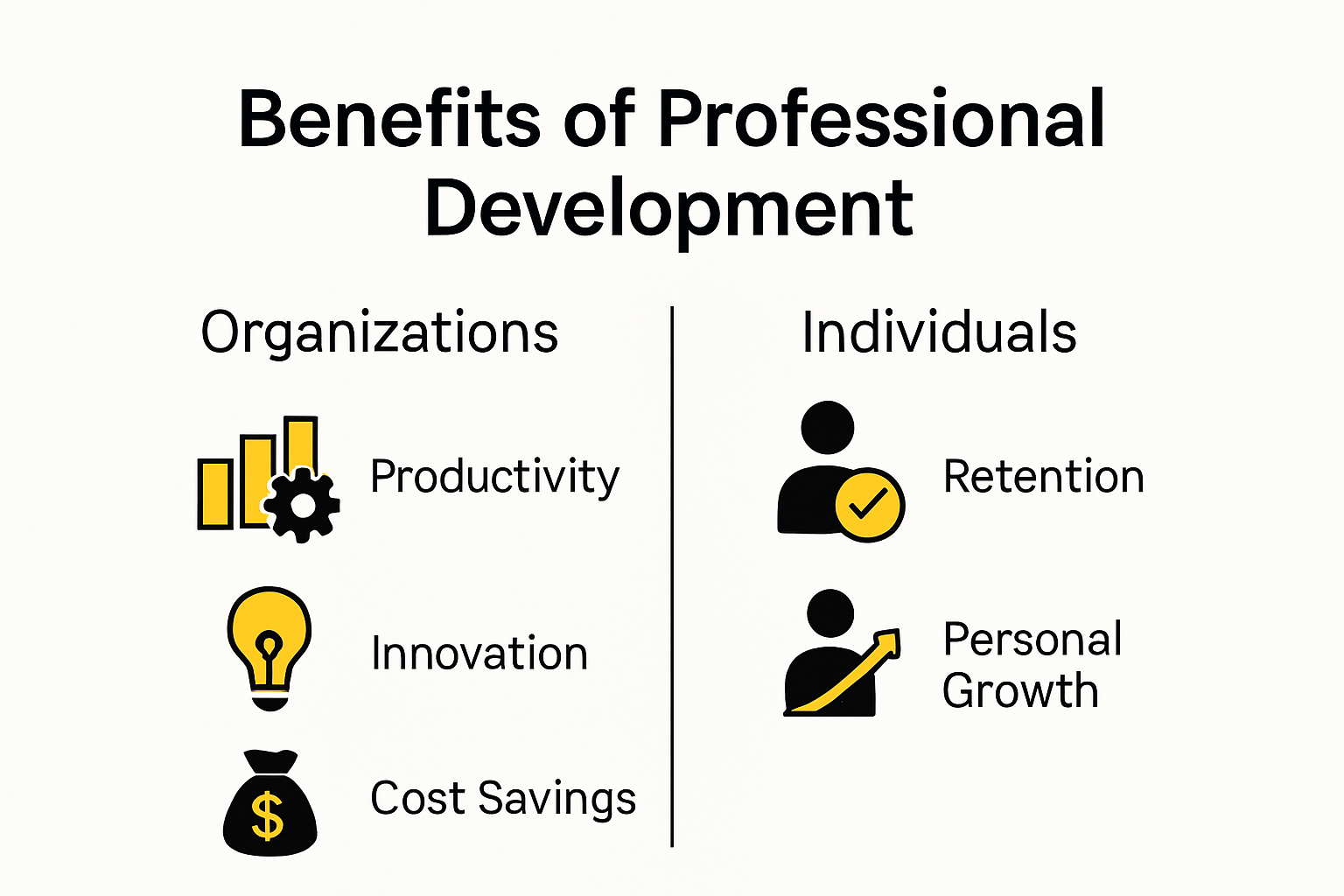
How Professional Development Drives Workplace Success
Professional development has transformed from a optional perk to a critical strategic imperative for organizations seeking sustainable success in 2025. The complex interplay between individual skill enhancement and organizational performance creates a powerful ecosystem of continuous growth and innovation.
Strategic Skill Alignment and Performance Optimization
Modern workplace dynamics demand a proactive approach to skill development. Organizations recognize that professional development is not just about training employees but about creating a responsive workforce capable of adapting to rapidly changing technological and market landscapes. Research from Harvard Professional Development Center reveals that companies investing systematically in employee skill development experience 40% higher productivity and 35% faster response to market changes.
The core of workplace success lies in aligning individual capabilities with organizational goals. When employees receive targeted professional development opportunities, they become more engaged, motivated, and equipped to contribute meaningfully. This alignment creates a symbiotic relationship where individual growth directly translates into organizational resilience.
Innovation Through Continuous Learning
Continuous learning has emerged as the primary driver of workplace innovation. A comprehensive study by Wharton Business School indicates that organizations with robust professional development programs are 2.5 times more likely to be innovation leaders in their industries.
Professional development programs do more than teach technical skills. They cultivate a mindset of curiosity, critical thinking, and adaptability. Employees learn to approach challenges creatively, challenge existing paradigms, and develop solutions that push organizational boundaries. This learning culture becomes a competitive advantage, enabling companies to stay ahead in rapidly evolving business environments.

Measuring and Sustaining Professional Growth
Successful professional development requires strategic measurement and continuous refinement. Organizations must implement comprehensive frameworks that track skill progression, performance improvements, and return on learning investments. Insights from the University of Minnesota’s Continuing Education Research suggest that data-driven professional development approaches can increase employee retention by up to 60%.
The most effective professional development strategies are personalized, technology-enabled, and aligned with both individual aspirations and organizational objectives. By creating clear pathways for growth and providing resources for continuous learning, companies can transform professional development from a transactional process into a strategic talent management approach.
For professionals committed to their career trajectory, our comprehensive guide on career development offers deeper insights into creating a robust personal growth strategy. Understanding the intricate relationship between individual skills and organizational success is the first step toward building a thriving, dynamic professional ecosystem.
Key Benefits for Organizations and Government Agencies
Professional development represents a strategic investment that delivers transformative benefits for organizations and government agencies in 2025. Beyond traditional training approaches, these programs create comprehensive ecosystems of talent enhancement, organizational resilience, and strategic capability building.
Talent Attraction and Retention Strategies
In an increasingly competitive talent marketplace, professional development has become a critical differentiator for organizations. Research from Harvard Professional Development Center reveals that 94% of employees are more likely to remain with employers who invest in their career growth. This statistic underscores the profound impact of structured learning programs on workforce stability.
Government agencies and private sector organizations now recognize that robust professional development initiatives serve multiple strategic objectives. They not only enhance individual skills but also create a compelling employer value proposition. By demonstrating genuine commitment to employee advancement, institutions can attract high-caliber professionals and reduce expensive recruitment and onboarding cycles.
Cost-Effective Workforce Optimization
Professional development represents a financially prudent approach to workforce management. Research from municipal workforce studies indicates that upskilling existing employees costs approximately $20,269, compared to $36,956 for hiring and training new personnel. This significant cost differential makes continuous learning an economically smart strategy for both public and private sector organizations.
Moreover, targeted professional development programs enable organizations to address skill gaps precisely, reducing inefficiencies and improving overall workforce productivity. By creating customized learning pathways aligned with strategic objectives, institutions can develop internal talent pipelines that are responsive to emerging technological and market demands.
Enhancing Organizational Adaptability
In an era of rapid technological transformation, organizational adaptability has become paramount. LinkedIn’s workforce research demonstrates that 83% of employees prioritize skill improvement, recognizing its critical role in professional relevance and career progression.
Government agencies and organizations that implement comprehensive professional development frameworks position themselves to navigate complex challenges more effectively. These programs cultivate a culture of continuous learning, encouraging employees to develop critical thinking skills, embrace innovation, and remain agile in dynamic work environments.
For leaders seeking to design impactful professional development strategies, our project management insights provide additional perspectives on implementing effective learning initiatives. Understanding the nuanced relationship between individual skill development and organizational performance is crucial for creating sustainable, future-ready workforce strategies.
To help visualize the statistical impact and cost advantages of various professional development strategies mentioned, the following table summarizes key figures and comparative benefits for organizations:
| Benefit/Metric | Statistic/Detail | Source/Context |
|---|---|---|
| Productivity Increase | 40% higher productivity | Harvard Professional Development Center research |
| Faster Market Response | 35% faster response to market changes | Harvard Professional Development Center research |
| Innovation Leadership Likelihood | 2.5x more likely to lead in innovation | Wharton Business School study |
| Employee Retention with Development Programs | Up to 60% higher retention | University of Minnesota Continuing Education Research |
| Employee Preference for Growth Opportunities | 94% prefer employers investing in career | Harvard Professional Development Center; LinkedIn workforce |
| Cost to Upskill Employee | $20,269 | Municipal workforce studies |
| Cost to Hire/Train New Employee | $36,956 | Municipal workforce studies |
| Employees Prioritizing Skill Improvement | 83% | LinkedIn workforce research |
Advantages for Individual Learners and Industry Professionals
Professional development in 2025 represents a transformative journey for individual learners and industry professionals, offering unprecedented opportunities for personal growth, career advancement, and strategic skill enhancement. The landscape of professional learning has evolved from traditional training models to dynamic, personalized skill development pathways.
Personal Career Acceleration and Skill Mastery
Individual learners stand at the forefront of their professional evolution through targeted development initiatives. Research from the Professional Achievement Center reveals that employees engaged in regular training experience 27% higher productivity and 32% increased engagement levels. These statistics underscore the profound impact of continuous learning on professional performance.
Professional development goes beyond acquiring technical skills. It encompasses developing critical soft skills such as adaptive thinking, emotional intelligence, and strategic communication. Industry professionals who invest in comprehensive learning programs position themselves as valuable assets in increasingly competitive job markets. The ability to demonstrate versatility and a commitment to personal growth becomes a significant differentiator in career progression.
Confidence Building and Professional Credibility
Insights from the Darden Executive Education Research highlight that professional development significantly enhances individual confidence and professional credibility. Learners who actively pursue skill enhancement create a compelling narrative of continuous improvement, making them more attractive to current and potential employers.
The modern professional landscape demands adaptability. By embracing learning opportunities, individuals can stay ahead of technological disruptions, industry shifts, and emerging skill requirements. This proactive approach transforms potential career uncertainties into opportunities for growth and innovation.
Strategic Personal Brand Development
Professional development becomes a strategic tool for personal brand management. A comprehensive study on workforce trends indicates that 94% of professionals prioritize employers and opportunities that support their continuous learning journey. This statistic reveals a fundamental shift in how individuals perceive career growth.
Networking opportunities embedded within professional development programs offer additional value. Learners connect with industry experts, peers, and potential mentors, expanding their professional networks and creating pathways for future opportunities. These connections often prove as valuable as the skills acquired during training programs.
For professionals seeking structured guidance on navigating their development journey, our current training trends guide provides comprehensive insights into emerging learning strategies. Understanding the intricate relationship between personal growth and professional success is crucial in building a resilient and dynamic career in 2025 and beyond.
Below is a summary table outlining the major advantages of professional development for individual learners and industry professionals, as discussed in the section:
| Advantage | Description |
|---|---|
| Career Acceleration | Employees engaged in regular training are 27% more productive, 32% more engaged |
| Skill Mastery | Enhances both technical and soft skills (adaptive thinking, EI, communication) |
| Confidence & Credibility | Boosts professional confidence and credibility, appealing to current/future employers |
| Personal Brand Development | Aids in managing and strengthening personal career brands |
| Networking Opportunities | Professional programs facilitate peer and mentor connections |
| Adaptability to Change | Empowers individuals to proactively adapt to industry shifts and new technologies |
| Increased Market Value | Versatility and ongoing learning distinguish professionals in competitive markets |
Best Practices for Maximizing Professional Development
Maximizing professional development requires a strategic, holistic approach that aligns individual aspirations with organizational objectives. In 2025, successful professional development transcends traditional training models, embracing personalized, technology-enabled learning ecosystems that drive meaningful growth and performance.
Strategic Learning Alignment and Personalization
Research from Training Zone emphasizes the critical importance of integrating professional development directly with organizational objectives. This alignment ensures that learning initiatives are not isolated experiences but purposeful pathways that simultaneously support individual growth and company performance.
Personalization emerges as a key strategy in effective professional development. Advanced learning platforms now utilize artificial intelligence and data analytics to create tailored learning journeys. These customized approaches consider an individual’s current skills, career trajectory, organizational role, and potential future requirements. By mapping precise skill development pathways, organizations can ensure more targeted and impactful learning experiences.
Technology-Enabled Learning Ecosystems
Technology has revolutionized professional development, creating dynamic, accessible, and interactive learning environments. Microlearning modules, virtual reality simulations, and adaptive learning platforms enable professionals to acquire skills efficiently and engage with content in more meaningful ways. LinkedIn’s workforce research highlights that technology-driven learning approaches increase knowledge retention by up to 50% compared to traditional training methods.
Successful technology integration goes beyond simply digitizing content. It involves creating immersive, collaborative learning experiences that encourage knowledge sharing, peer interaction, and real-time skill application. Gamification elements, interactive workshops, and scenario-based learning further enhance engagement and practical skill development.
Continuous Feedback and Performance Measurement
Effective professional development requires robust measurement mechanisms. Organizations must move beyond traditional assessment models to implement comprehensive, continuous feedback systems. Research from Gartner suggests that continuous performance tracking enables more agile skill development, allowing individuals and organizations to rapidly adapt to changing market demands.
Key performance indicators should extend beyond completion rates to measure tangible outcomes such as skill proficiency, job performance improvement, and direct contribution to organizational objectives. This data-driven approach enables more precise investment in learning initiatives and demonstrates the clear return on professional development investments.
Our skills development guide provides additional insights into creating comprehensive, forward-thinking professional development strategies. By understanding the nuanced interplay between individual potential and organizational capabilities, professionals can craft meaningful, impactful learning journeys that drive sustainable career growth.
Frequently Asked Questions
What are the benefits of professional development for organizations in 2025?
Investing in professional development leads to a 40% increase in productivity and a 35% faster response to market changes for organizations. It also aids in talent attraction and retention, reduces recruitment costs, and enhances organizational adaptability.
How does professional development impact individual employees in 2025?
For individual employees, professional development enhances skills and confidence, increases marketability, and fosters career growth. Engaged employees are 27% more productive and 32% more engaged when they participate in continuous learning initiatives.
What role does technology play in professional development?
Technology enables personalized learning experiences through advanced platforms that utilize AI and data analytics. This creates more impactful, efficient, and interactive learning environments, significantly improving knowledge retention and engagement compared to traditional methods.
Why is continuous feedback important in professional development?
Continuous feedback is crucial as it allows for agile skill development, ensuring that training remains relevant to changing market needs. It also helps in measuring the effectiveness of learning initiatives and demonstrating the return on investment in professional development.
Unlock Sustainable Growth with Accredited Professional Development
Have you ever felt your team is falling behind in a fast-paced, skills-driven market? Many organizations struggle with outdated training, high turnover, or the need to quickly adapt to rapid changes. As highlighted in this article, investing in personalized and strategic professional development is the key to driving measurable results. Challenges such as talent retention, skills gaps, and the demand for continuous learning are real barriers for both companies and individuals striving for excellence. Imagine your employees gaining confidence and your organization achieving 40 percent higher productivity, all while ensuring compliance and unlocking lasting innovation.

Now is the time to turn these advantages into everyday reality. At Peuneo, you will find accredited training, expert consulting, and a modern online learning portal—all designed to align with your unique business goals. Discover how our career development programs and skills development solutions help South African organizations and professionals accelerate growth, retain top talent, and achieve compliance. Visit https://peuneo.co.za today to take the next step toward building a high-performance culture. Start now to maximize your team’s potential before competitors move ahead.
Recommended
- Top Leadership Development Strategies for 2025: Success Across Sectors – Peuneo
- Career Development Programs: A Roadmap to Professional Success – Peuneo
- 2025 Training Course Benefits: Boost Skills & Growth – Peuneo
- 2025 Trends in Employee Development: 5 Key Strategies – Peuneo
- Career Development Strategies: Ultimate 2025 Growth Guide – Peuneo
- How to Create a Personal Development Plan for Success in 2025 – Peuneo
- Why Humanize Content in 2025: Boost Connection and Results