

Recruiting top talent used to take months, but the rules have changed. Now, companies using smart technology can shrink their hiring time by up to 40 percent, which flips the traditional timeline on its head. The twist is this speed does not mean cutting corners, it actually opens the door to a better candidate experience and higher-quality hires if you know what to tweak.
Table of Contents
- Key Stages In The Recruitment Timeline
- Factors That Impact Recruitment Speed
- Best Practices For Streamlined Hiring
- Adapting Recruitment Timelines For Different Sectors
Quick Summary
| Takeaway | Explanation |
|---|---|
| Strategic Recruitment Planning is Essential | Develop a comprehensive recruitment strategy that includes workforce analysis, job role mapping, and talent market research to identify precise hiring needs early in the process. |
| Leverage Technology to Enhance Efficiency | Utilize advanced recruitment technologies, such as Applicant Tracking Systems and AI screening tools, to streamline the hiring process and reduce recruitment timelines by up to 40%. |
| Create a Positive Candidate Experience | Ensure a candidate-centric approach by providing timely communication, personalized interactions, and transparent evaluation processes throughout the recruitment journey. |
| Adapt Recruitment Strategies by Sector | Tailor recruitment timelines and practices according to the specific demands of different sectors, such as rapid hiring in tech or thorough credential checks in healthcare. |
| Continuous Process Improvement is Key | Organizations should remain flexible, continuously adapting their processes to balance thorough evaluations with agility in today’s competitive job market. |
Key Stages in the Recruitment Timeline
Recruitment is a strategic process that requires careful planning and execution. Understanding the key stages of the recruitment timeline helps organizations attract, evaluate, and hire top talent efficiently. The recruitment journey encompasses multiple critical phases that transform potential candidates into valuable team members.
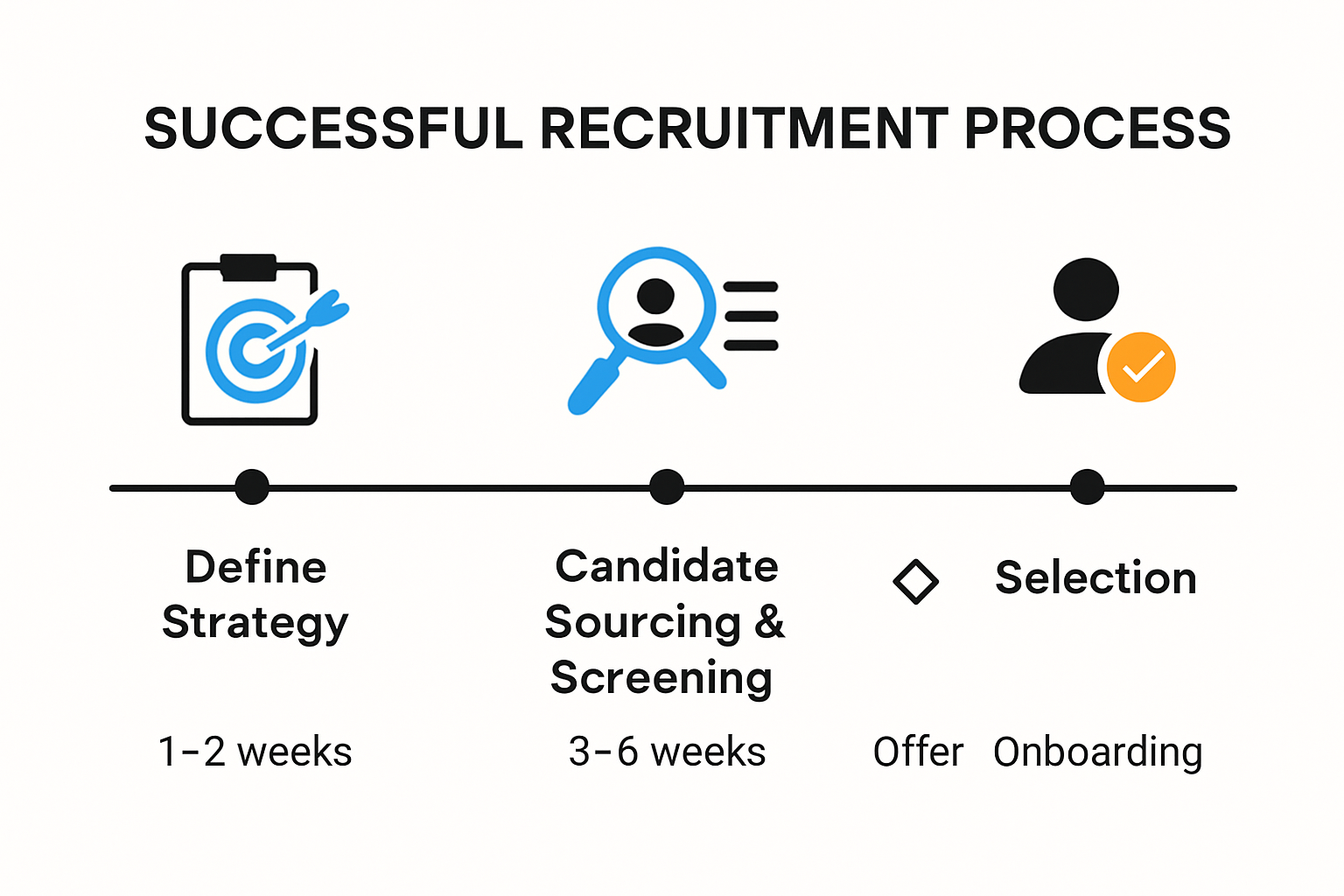
Defining the Recruitment Strategy
Before launching a recruitment effort, organizations must develop a comprehensive strategy. Research from Deloitte highlights that successful recruitment begins with clear workforce planning. This stage involves analyzing current workforce capabilities, identifying skill gaps, and determining precise recruitment needs.
Key elements of strategic recruitment planning include:
- Workforce Analysis: Conducting a thorough assessment of existing team skills and future organizational requirements
- Job Role Mapping: Creating detailed job descriptions that accurately reflect role expectations and necessary competencies
- Talent Market Research: Understanding current talent availability and competitive compensation trends
Candidate Sourcing and Screening
Once the strategic foundation is established, organizations move into active candidate sourcing. McKinsey’s Talent Management Research suggests that modern recruitment extends beyond traditional job postings. Effective sourcing now involves multiple channels including professional networks, social media platforms, referral programs, and targeted recruitment campaigns.
The screening process has become increasingly sophisticated. Advanced screening techniques now incorporate:
- Automated Resume Parsing: Using AI technologies to quickly evaluate candidate qualifications
- Skills Assessment Tools: Implementing digital platforms that objectively measure candidate capabilities
- Cultural Fit Evaluation: Developing assessment methods that evaluate candidate alignment with organizational values
Selection and Onboarding
The final stages of recruitment focus on selecting the most suitable candidates and integrating them seamlessly into the organization. This phase requires a structured approach that balances rigorous evaluation with a welcoming, supportive environment. Check out our comprehensive guide on recruitment practices for deeper insights into effective selection strategies.
Successful selection and onboarding involve:
- Multi Stage Interview Processes: Implementing comprehensive evaluation methods that assess technical skills, soft skills, and cultural compatibility
- Transparent Communication: Maintaining clear and consistent communication with candidates throughout the selection process
- Structured Onboarding: Designing comprehensive integration programs that help new employees quickly become productive team members

The recruitment timeline is not a linear process but a dynamic journey that requires continuous adaptation. Organizations must remain flexible, leveraging technology and maintaining a human-centric approach to attract and retain exceptional talent in an increasingly competitive job market.
Here is a table summarizing the three main recruitment stages, their key activities, and best practices, to provide a clear step-by-step overview of the recruitment process:
| Recruitment Stage | Key Activities | Best Practices |
|---|---|---|
| Defining Recruitment Strategy | Workforce analysis, job role mapping, talent market research | Clear role definition, strategic workforce planning |
| Candidate Sourcing & Screening | Multi-channel sourcing, resume parsing, skills & cultural fit assessments | Use AI tools, digital skills assessments, objective criteria |
| Selection & Onboarding | Multi-stage interviews, transparent comms, structured onboarding | Consistent communication, comprehensive onboarding programs |
Factors That Impact Recruitment Speed
Recruitment speed plays a critical role in securing top talent in a competitive job market. Organizations must understand and strategically manage various factors that influence the pace of their hiring processes. The ability to efficiently identify, attract, and onboard qualified candidates can significantly impact an organization’s competitive advantage.
Technological Infrastructure and Tools
Modern recruitment speed heavily depends on technological capabilities. Research from Gartner indicates that organizations leveraging advanced technological solutions can reduce recruitment timelines by up to 40%. Sophisticated recruitment technologies streamline multiple aspects of the hiring process, enabling faster candidate identification and evaluation.
Key technological factors impacting recruitment speed include:
- Applicant Tracking Systems (ATS): Automated platforms that quickly sort and rank candidate applications
- AI Screening Tools: Advanced algorithms that rapidly assess candidate qualifications
- Digital Assessment Platforms: Online tools that facilitate faster skills evaluation
Organizational Recruitment Processes
Internal recruitment processes and organizational structure significantly influence hiring speed. McKinsey’s Workforce Management Research highlights that organizations with streamlined decision-making processes can reduce recruitment cycles by approximately 30%. Efficient internal coordination and clear communication channels are essential for accelerating talent acquisition.
Critical process-related factors include:
- Decision-Making Hierarchies: Simplified approval processes that reduce bureaucratic delays
- Interdepartmental Collaboration: Smooth communication between HR, hiring managers, and department leaders
External Market Dynamics
External market conditions play a substantial role in recruitment speed. Talent availability, industry competition, and economic factors can significantly impact how quickly organizations can fill critical positions. Check out our comprehensive guide on managing recruitment effectively for deeper insights into navigating complex talent markets.
External factors influencing recruitment speed include:
- Talent Pool Availability: Regional and industry-specific talent supply
- Competitive Compensation Structures: Market-aligned salary and benefits packages
- Industry-Specific Talent Demand: Sector-specific skill shortages and recruitment challenges
Successful organizations recognize that recruitment speed is not about rushing the process but about creating efficient, strategic approaches that balance thoroughness with agility. By understanding and proactively managing technological, procedural, and market-related factors, companies can develop robust recruitment strategies that attract top talent quickly and effectively.
Below is a summary table that compares key internal and external factors impacting recruitment speed alongside their effects on the hiring process:
| Factor Type | Example Factor | Effect on Recruitment Speed |
|---|---|---|
| Technological | Advanced ATS, AI screening tools | Streamlines screening, reduces time-to-hire by 40% |
| Organizational | Simplified decision hierarchies | Cuts approval delays, reduces cycles by ~30% |
| Organizational | Interdepartmental collaboration | Ensures coordination, speeds up hiring |
| External | Talent pool availability | Impacts vacancy fill rate, varies by region/sector |
| External | Competitive compensation | Attracts quicker response from top candidates |
| External | Industry-specific demand | Longer cycles in high-demand/low-supply industries |
Best Practices for Streamlined Hiring
Streamlined hiring requires a strategic approach that balances efficiency with comprehensive candidate evaluation. Organizations must develop robust practices that minimize recruitment friction while ensuring they attract and select the most qualified talent. The goal is to create a smooth, transparent, and engaging recruitment experience that benefits both the organization and potential employees.
Optimizing Job Descriptions and Candidate Attraction
Research from LinkedIn reveals that clear, compelling job descriptions can increase candidate application rates by up to 50%. Effective job descriptions go beyond listing technical requirements and provide insights into organizational culture, growth opportunities, and unique value propositions.
Key strategies for creating attractive job descriptions include:
- Clarity and Precision: Clearly articulating role responsibilities and expectations
- Cultural Context: Highlighting organizational values and work environment
- Growth Potential: Emphasizing career development and learning opportunities
Leveraging Technology for Efficient Screening
Technological integration plays a crucial role in streamlining hiring processes. Deloitte’s Human Capital Trends Report indicates that organizations using advanced screening technologies can reduce recruitment cycles by 40% while improving candidate quality. Automated tools enable more objective and comprehensive candidate evaluations.
Effective technological screening approaches include:
- AI-Powered Matching Algorithms: Using advanced technologies to align candidate skills with job requirements
- Video Interview Platforms: Facilitating initial candidate assessments remotely
- Skills Assessment Tools: Implementing standardized digital evaluation methods
Creating a Candidate-Centric Experience
Successful recruitment goes beyond technical efficiency. Check out our comprehensive guide on recruitment best practices to understand how creating a positive candidate experience can transform recruitment outcomes. Organizations must design processes that respect candidates’ time, provide transparent communication, and create meaningful engagement.
Candidate experience enhancement strategies include:
- Rapid Communication: Providing timely updates and feedback throughout the recruitment process
- Personalized Interactions: Tailoring communication to individual candidate profiles
- Transparent Evaluation Processes: Clearly explaining assessment and selection methodologies
Streamlined hiring is an holistic approach that combines technological innovation, strategic communication, and human-centered design. By implementing these best practices, organizations can develop recruitment processes that efficiently identify top talent while creating positive experiences that attract exceptional candidates. The most successful approaches recognize that recruitment is not just about filling positions but about building long-term organizational capabilities through strategic talent acquisition.
Adapting Recruitment Timelines for Different Sectors
Recruitment timelines are not universal. Each industry sector presents unique challenges and requirements that significantly impact talent acquisition strategies. Organizations must develop nuanced approaches that recognize the distinct characteristics of their specific professional domains. Understanding these sector-specific dynamics is crucial for creating effective and efficient recruitment processes.
Technology and Innovation Sectors
Research from PwC reveals that technology and innovation sectors experience the most aggressive recruitment timelines. These industries demand rapid talent acquisition due to fast-evolving technological landscapes and intense competitive pressures. Recruitment cycles in tech sectors often compress traditional hiring processes, requiring organizations to act with unprecedented speed and precision.
Key characteristics of technology sector recruitment include:
- Accelerated Screening Processes: Utilizing advanced AI and automated screening technologies
- Skills-Based Evaluation: Prioritizing technical competencies over traditional credentials
- Competitive Compensation Structures: Offering flexible, performance-driven compensation packages
Healthcare and Regulated Industries
Healthcare and highly regulated sectors present complex recruitment challenges that demand meticulous screening and verification processes. The Joint Commission Research indicates that these industries require comprehensive background checks, professional certification verifications, and stringent compliance evaluations. Recruitment timelines in these sectors are inherently longer and more methodical.
Critical recruitment considerations for regulated industries include:
- Extensive Credential Verification: Thorough professional qualification checks
- Compliance-Driven Screening: Rigorous background and legal requirement assessments
- Multi-Stage Interview Processes: Comprehensive evaluation methodologies
Creative and Service-Oriented Sectors
Check out our comprehensive guide on recruitment strategies across sectors to understand the nuanced approaches required. Creative and service-oriented industries prioritize cultural fit and interpersonal skills, which necessitate more qualitative and relationship-driven recruitment approaches. These sectors often emphasize personality assessments and practical skill demonstrations over traditional screening methods.
Distinctive recruitment strategies for creative sectors include:
- Portfolio-Based Evaluations: Assessing practical skills through work samples
- Cultural Compatibility Assessments: Evaluating candidate alignment with organizational values
- Collaborative Interview Formats: Engaging candidates through interactive evaluation processes
Successful recruitment in 2025 demands sophisticated, adaptable approaches that recognize the unique characteristics of different industry sectors. Organizations must develop flexible strategies that balance efficiency, thoroughness, and sector-specific requirements. By understanding and implementing tailored recruitment timelines, companies can effectively attract, evaluate, and secure top talent across diverse professional landscapes.
Frequently Asked Questions
What is the average timeline for successful recruitment in 2025?
The average timeline for successful recruitment can vary greatly, but companies leveraging technology can reduce their hiring time by up to 40%, shifting traditional timelines significantly.
How can technology improve the recruitment process?
Technology enhances the recruitment process by streamlining candidate sourcing and screening through tools like Applicant Tracking Systems (ATS) and AI screening technologies, enabling faster evaluations and decisions.
What best practices can organizations implement for streamlined hiring?
Organizations can optimize job descriptions, leverage technology for efficient screening, and focus on creating a positive candidate experience to streamline their hiring processes effectively.
How can recruitment timelines be adapted for different sectors?
Recruitment timelines should be tailored to sector-specific needs; for example, the tech sector may require quicker hiring due to fast-paced changes, while healthcare may necessitate more thorough credential verification processes.
Ready to Accelerate Your Recruitment in 2025?
Is your organization struggling with slow hiring cycles or complex credential checks? According to the guide above, reducing recruitment timelines and improving candidate experience are top priorities for companies looking to stay competitive in South Africa’s fast-moving talent market. Many businesses face challenges in streamlining their hiring process, ensuring compliance, and providing clear candidate communication. The key to overcoming these pain points is a combination of workforce planning, advanced screening tools, and specialized skills development.

Peuneo understands the pressure of modern talent acquisition. Our accredited training and consulting solutions are designed to help you transform recruitment efficiency while ensuring both quality and compliance. Partner with us to unlock rapid screening, professional upskilling, and expert support tailored to your sector. Take action now to build a future-ready workforce and gain an edge in 2025. Explore our website or learn more about our accredited training offerings and business solutions. The next step in your recruitment success story starts here.
Recommended
- Key Elements of Successful Recruitment in 2025: Essential Guide – Peuneo
- Top Recruitment Strategies for 2025: A Guide for All Sectors – Peuneo
- Understanding the Role of HR in Recruitment: Guide 2025 – Peuneo
- How to Manage Recruitment Effectively in 2025 – Peuneo
- Finding Consulting Clients in 2025: Guide for IT Pros Canada & USA
- Conversion Rate Optimization Strategies for Marketers in 2025