


Negotiation is an essential skill in today’s dynamic environments. Research shows that nearly 70% of negotiations fail to reach a satisfactory outcome. But here’s the kicker: most of these failures stem from a lack of effective communication and preparation. Rather than being innate, successful negotiation skills can be cultivated through focused training. Experience the transformative power of mastering negotiation techniques and watch your career soar.
Table of Contents
- Core Negotiation Techniques For Success
- Effective Communication In Negotiations
- Real-World Negotiation Training Applications
- Advanced Tips And Expert Insights
Quick Summary
| Takeaway | Explanation |
|---|---|
| Preparation and Research are Crucial | Thorough research on both your position and the other party’s needs is essential for successful negotiation outcomes, as it helps identify value-creating opportunities and establish a strong negotiating stance. |
| Effective Communication Is Key | Mastering active listening, strategic questioning, and both verbal and non-verbal communication can significantly enhance negotiation effectiveness, fostering a collaborative atmosphere and leading to better agreements. |
| Adaptability Enhances Success | The ability to adapt tactics based on changing dynamics during negotiations is vital. Flexibility allows negotiators to pivot their approach while remaining committed to their core objectives. |
| Leverage Technology and Data | Incorporating digital tools and data analysis into negotiation strategies can provide a competitive edge, facilitating more informed decision-making and improving negotiation outcomes. |
| Emotional Intelligence Is Important | Recognizing and managing emotions, both your own and others’, can help build rapport and create a productive negotiation environment, essential for achieving favorable outcomes. |
Core Negotiation Techniques for Success

Mastering negotiation requires more than just natural talent—it demands a structured approach and specific techniques that can be learned through quality negotiation skills training. These core techniques form the foundation of effective negotiation practices across industries and contexts.
Preparation and Research
Successful negotiation begins long before you enter the room. The preparation phase is where negotiations are often won or lost. Professional negotiation skills training courses emphasize thorough research as the cornerstone of negotiation success.
Start by gathering all available information about the other party’s needs, constraints, alternatives, and decision-making processes. Understanding their priorities helps you identify potential value-creating opportunities. Equally important is knowing your own position—define your walkaway point (BATNA – Best Alternative To a Negotiated Agreement), aspiration point, and areas where you can be flexible.
Prepare supporting data and evidence to strengthen your position. When you enter negotiations armed with facts rather than just opinions, your arguments carry more weight. Many negotiation training courses teach participants how to organize this research efficiently using preparation frameworks and checklists.
Strategic Communication Techniques
Communication forms the backbone of negotiation. How you express yourself can significantly impact outcomes. Effective negotiators master several key communication techniques:
-
Active listening: This involves fully concentrating on the speaker, understanding their message, responding thoughtfully, and remembering the discussion. Negotiation skills workshops often dedicate significant time to practicing this skill through role-playing exercises.
-
Strategic questioning: Open-ended questions reveal valuable information and create dialogue. Closed questions help confirm understanding and pin down specifics. Learning when to use each type is covered extensively in negotiation trainings.
-
Framing and reframing: How information is presented influences how it’s received. Skilled negotiators learn to frame proposals in terms of benefits to the other party and reframe problematic positions to find common ground.
According to APAC Business Headlines, crafting a compelling value proposition that addresses the specific needs and pain points of the other party is considered an essential negotiation tactic for 2025. This approach leads to stronger agreements and better long-term outcomes than aggressive bargaining.
Value-Creating Strategies
Top negotiation courses emphasize that the best negotiations aren’t zero-sum games where one party’s gain equals another’s loss. Instead, they teach value-creating strategies that expand opportunities for mutual gain.
This approach involves identifying multiple issues for negotiation rather than focusing narrowly on price. By trading across these issues based on different priorities, both parties can achieve better outcomes. For example, if delivery timing is more important to you than payment terms, while the reverse is true for your counterpart, you can trade favorable terms on each issue.
Research supports this approach. When negotiators focus exclusively on claiming value rather than creating it, they often leave significant potential benefits unrealized. Training in negotiation skills helps participants recognize these opportunities through exercises that reveal hidden value.
Adaptability and Flexibility
No negotiation unfolds exactly as planned. The ability to adapt tactics based on changing circumstances is crucial. Research indicates that adaptability and flexibility are identified as key traits of successful negotiators in 2025, enabling professionals to pivot their tactics based on real-time feedback without compromising core objectives.
Effective negotiators remain flexible in their approach while staying firm on their core interests. This balance between adaptability and principle is often practiced through scenario-based learning in negotiation skills workshops.
Leveraging Technology and Data
In today’s digital environment, negotiation has evolved beyond traditional face-to-face interactions. Modern negotiation training courses now include modules on virtual negotiation techniques and digital tools that support the negotiation process.
According to experts, leveraging data-driven insights and AI-driven platforms that provide predictive modeling, sentiment analysis, and real-time speech analytics gives negotiators a competitive edge in 2025, enabling more informed decisions that drive superior outcomes. These technological advances are increasingly featured in advanced negotiation skills training programs.
By mastering these core techniques through structured negotiation skills training, professionals can significantly enhance their ability to achieve favorable outcomes while building stronger relationships. The systematic approach to learning and practicing these skills makes negotiation an ability that can be developed rather than just an innate talent.
Effective Communication in Negotiations
Communication lies at the heart of every successful negotiation. While negotiation strategies and tactics are important, how we convey our messages often determines whether a deal succeeds or fails. Training in negotiation skills frequently emphasizes communication as the foundation upon which all other negotiation techniques are built.
The Power of Active Listening
Active listening goes beyond simply hearing words—it involves fully understanding the complete message being communicated. According to Crestcom, active listening is a critical component of negotiation skills, as it helps negotiators gain insight into others’ motivations, uncover hidden needs, and foster trust, creating an atmosphere of collaboration rather than confrontation.
In practice, active listening in negotiations includes:
- Maintaining eye contact and demonstrating engagement
- Asking clarifying questions to ensure understanding
- Paraphrasing to confirm comprehension of key points
- Avoiding interruptions that can derail productive dialogue
- Noticing emotional undertones that may reveal unstated priorities
Negotiation skills workshops often incorporate exercises specifically designed to improve active listening. These might include role-playing scenarios where participants must accurately summarize another person’s position before responding, helping develop this crucial skill.
Verbal and Non-Verbal Communication
Effective negotiators understand that communication extends far beyond words. The most comprehensive negotiation courses address both verbal precision and non-verbal cues that can significantly impact outcomes.
Verbal communication in negotiations requires clarity, conciseness, and appropriate tone. Experienced negotiation trainers teach participants to avoid jargon, use accessible language, and structure messages logically. They emphasize the importance of asking well-crafted questions that reveal interests without appearing confrontational.
According to experts at NAGAP, effective communication in negotiations requires clear articulation of ideas, supported by evidence and data, while also maintaining awareness of body language and what remains unsaid, particularly during emotionally charged situations.
Non-verbal communication—including posture, facial expressions, gestures, and even seating arrangements—can dramatically influence negotiation dynamics. Studies show that over 65% of communication is non-verbal, making body language interpretation an essential component of negotiation skills training.
Managing Emotions During Negotiations
Emotions are inevitable in negotiation settings. Rather than attempting to eliminate them, skilled negotiators learn to recognize and manage emotional currents. Emotional intelligence—the ability to identify, understand, and manage emotions—has become a central focus in advanced negotiation trainings.
As negotiation expert Brooks notes, “Suppressing emotions isn’t the answer; instead, it’s important to regulate them,” which helps build rapport, defuse tension, and guide discussions toward productive outcomes. This insight from Crestcom highlights the importance of emotional awareness in negotiation.
Negotiation skills courses now routinely include techniques for:
- Recognizing emotional triggers in yourself and others
- Maintaining composure during tense exchanges
- Using empathy to build connection and trust
- Reframing emotional reactions into productive discussions
Cross-Cultural Communication in Negotiations
In today’s global business environment, negotiators frequently engage with counterparts from different cultural backgrounds. Effective negotiation skills training addresses these cross-cultural dimensions, preparing participants to navigate different communication norms and expectations.
Cultural variations in communication can include different approaches to directness, formality, time orientation, and non-verbal cues. What constitutes appropriate eye contact, personal space, or even negotiation pacing varies widely across cultures. Training negotiation skills with a cross-cultural component helps professionals avoid misunderstandings that can derail otherwise promising deals.
Many negotiation courses now include cultural intelligence components, teaching participants to research cultural norms before international negotiations and remain flexible in their communication approach.
Digital Communication in Negotiations
The rise of virtual negotiations has introduced new communication challenges and opportunities. Training programs for negotiation skills increasingly address effective communication in digital environments.
Video conferencing, email exchanges, and other digital communication channels each present unique considerations. Negotiators must learn to compensate for reduced non-verbal cues in virtual settings, maintain engagement through screens, and navigate potential technical disruptions.
By mastering these communication dimensions through focused negotiation skills training, professionals can dramatically enhance their effectiveness at the bargaining table. The ability to truly connect, understand, and persuade through skillful communication remains the cornerstone of negotiation success across contexts and industries.
Real-World Negotiation Training Applications
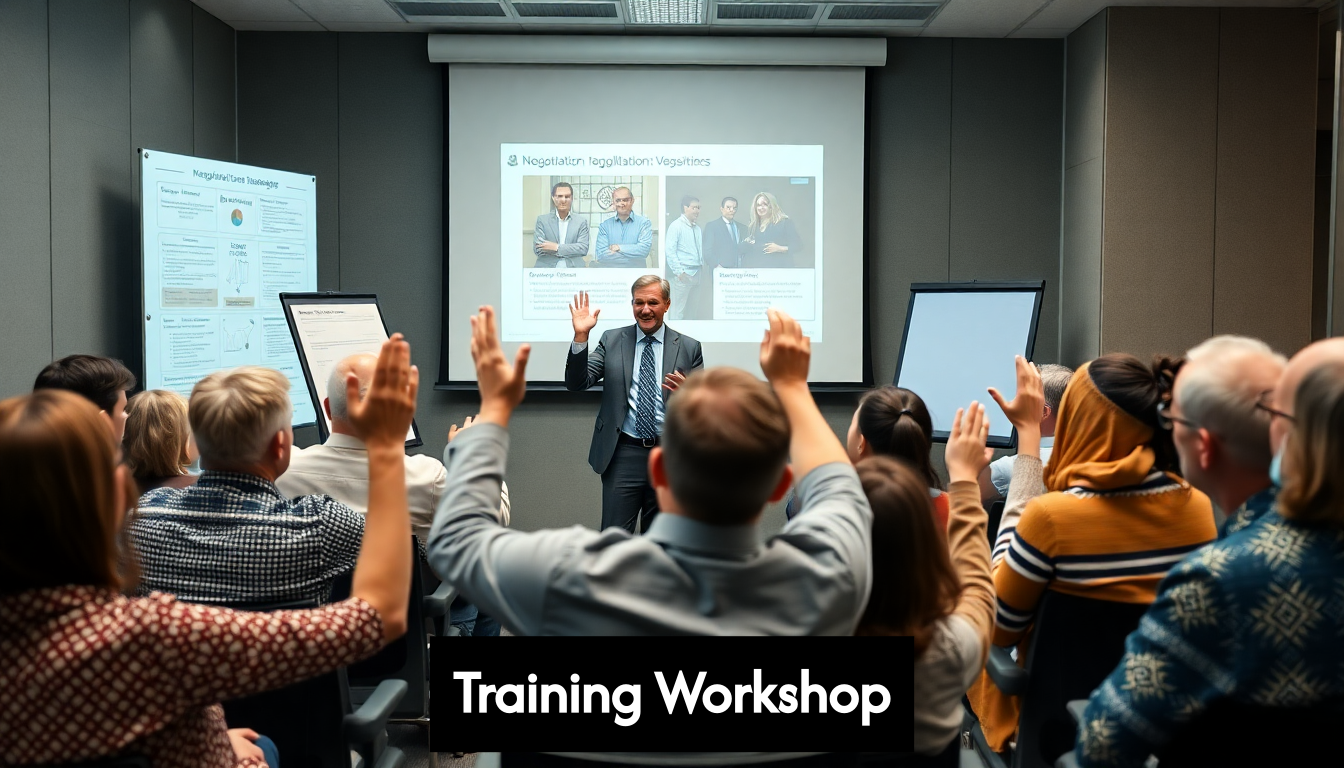
Negotiation skills training truly proves its value when concepts move from theoretical understanding to practical application. In this section, we’ll explore how negotiation training translates to real-world scenarios across various professional contexts and how different programs approach practical implementation.
Corporate Negotiation Training
In the corporate world, negotiation skills training programs often focus on specific business challenges like contract negotiations, vendor management, and internal resource allocation. These applications directly impact an organization’s bottom line and operational effectiveness.
Corporate negotiation training typically employs industry-specific case studies and simulations that mirror actual business scenarios. Participants practice techniques like strategic concession-making, identifying hidden value opportunities, and managing complex stakeholder interests—all within contexts that directly relate to their day-to-day responsibilities.
Many companies implement post-training reinforcement through coaching and mentoring programs where experienced negotiators guide newer practitioners through actual negotiations. This hands-on approach helps bridge the gap between classroom learning and real-world application, ensuring that skills transfer effectively to high-stakes situations.
Government and Diplomatic Applications
Government agencies and diplomatic services require specialized negotiation skills training that addresses unique public sector challenges. These often include legislative negotiations, interagency coordination, international relations, and public-private partnerships.
According to the UNITAR Master in International Leadership and Negotiation program, real-world applications are emphasized by equipping students with advanced negotiation skills tailored for leadership roles in multinational and multilateral environments, preparing them for practical challenges in diverse international settings.
These programs typically focus on consensus-building techniques, managing political considerations, and navigating complex stakeholder environments. Special attention is given to cross-cultural negotiation skills essential in international contexts, where understanding cultural norms and communication styles becomes critical.
Academic and Research-Based Programs
Leading academic institutions offer negotiation courses that combine theoretical foundations with practical applications through rigorous research-based approaches. These programs often feature robust methodologies for analyzing negotiation dynamics and measuring outcomes.
Harvard’s Advanced Negotiation Skills Training leverages interactive exercises and case analyses to enable participants to design and execute more effective strategies for handling complex, high-stakes, multiparty, and cross-cultural negotiations. This approach bridges theory and practice through structured experiential learning.
Similarly, Cornell University’s Negotiation Mastery specifically integrates practical application by training participants to manage emotions, mitigate risk, and handle power dynamics and ethical challenges commonly encountered in live negotiation scenarios.
Industry-Specific Applications
Negotiation skills training increasingly includes industry-specific programs tailored to unique sectoral challenges. These specialized courses recognize that negotiation dynamics vary significantly across industries.
For example, healthcare negotiation training addresses the complex interplay between clinical outcomes, cost constraints, and stakeholder interests unique to medical settings. Participants learn to navigate negotiations involving insurers, pharmaceutical companies, healthcare providers, and patients—each with different priorities and constraints.
In the legal profession, negotiation skills workshops focus on settlement negotiations, plea bargaining, and alternative dispute resolution. Technology sector training emphasizes intellectual property negotiations and rapidly evolving partnership structures in fast-changing markets.
Virtual and Technology-Enhanced Training
The shift toward remote work has accelerated the development of virtual negotiation training applications. Modern negotiation skills courses utilize technology to create realistic simulations and provide real-time feedback on negotiation performance.
Video analysis tools allow participants to review their negotiation techniques, identifying strengths and areas for improvement in communication style, body language, and strategic approach. AI-powered negotiation simulators provide safe environments to practice complex scenarios with immediate feedback.
Virtual reality applications are emerging as particularly powerful tools for immersive negotiation training. These platforms simulate high-pressure environments while allowing instructors to control variables and create targeted learning experiences that would be difficult to replicate in traditional training settings.
Post-Training Implementation
Effective negotiation skills training includes structured follow-up processes to ensure real-world implementation. These might include negotiation planning templates, decision trees for common scenarios, or coaching support during actual negotiations.
The most successful programs create communities of practice where participants can share experiences, discuss challenges, and refine their approaches based on real-world applications. These communities extend the learning beyond formal training sessions and create sustainable skill development over time.
By connecting theoretical concepts to specific workplace challenges, quality negotiation training programs ensure that participants not only learn skills but apply them effectively in the scenarios that matter most to their professional success.
Advanced Tips and Expert Insights
Once you’ve mastered the fundamentals of negotiation through basic training, advancing to more sophisticated techniques can dramatically elevate your effectiveness. This section explores advanced strategies and insights from negotiation experts that can help experienced negotiators refine their approach.
Moving Beyond Tactical Thinking
According to Harvard’s Program on Negotiation, expert negotiation requires transitioning from basic tactics to strategic planning and systematic thinking. Successful negotiators design and execute complex negotiations effectively while creating value for themselves and their organization.
This shift from tactical to strategic thinking involves developing a comprehensive negotiation architecture—a structured approach that considers all variables, stakeholders, and potential outcomes before engagement begins. Advanced negotiation skills training teaches professionals to map complex negotiation landscapes, identifying leverage points and strategic opportunities that remain invisible to less experienced negotiators.
Rather than focusing on individual negotiation moments, expert negotiators consider how each interaction fits within broader relationships and long-term objectives. They anticipate several moves ahead, similar to chess masters who envision potential scenarios long before they materialize.
Psychological Insights and Cognitive Biases
Advanced negotiation courses delve deeply into the psychological dimensions of negotiation, exploring how cognitive biases affect decision-making at the bargaining table. Understanding these biases—both in yourself and your counterparts—creates opportunities for more effective engagement.
Expert negotiators learn to recognize common psychological patterns such as:
- Anchoring effects: How initial offers disproportionately influence the negotiation range
- Loss aversion: The tendency to prefer avoiding losses over acquiring equivalent gains
- Overconfidence bias: The tendency to overestimate one’s abilities or the likelihood of positive outcomes
- Reactive devaluation: The tendency to devalue proposals simply because they come from an opponent
By understanding these psychological principles, advanced negotiators can structure proposals that account for cognitive biases and frame options in ways that increase acceptance probability. They can also identify when their own thinking might be influenced by similar biases, allowing for more rational decision-making.
Cross-Cultural Mastery
As global business becomes increasingly interconnected, the ability to negotiate across cultural boundaries has become an essential advanced skill. Oxford Management highlights that understanding different behaviors and attitudes related to various cultures and how to leverage them in your favor is a critical component of advanced negotiation skills.
Expert negotiators go beyond basic cultural awareness to develop nuanced understanding of how cultural frameworks influence negotiation approaches. They recognize that cultural differences affect everything from communication styles and decision-making processes to attitudes toward conflict and relationship building.
Advanced training in cross-cultural negotiation teaches professionals to adapt their strategies based on specific cultural contexts while remaining authentic to their core objectives. This might involve adjusting communication styles, recalibrating expectations around timeframes, or modifying approaches to building trust.
Complex Multi-Party Negotiations
While basic negotiation training typically focuses on two-party scenarios, advanced courses prepare professionals for complex multi-party negotiations involving numerous stakeholders with diverse interests. These situations require sophisticated coalition-building skills and an understanding of group dynamics.
Expert negotiators learn to map stakeholder interests in complex scenarios, identifying potential allies and opponents. They develop strategies for building supportive coalitions while neutralizing opposition through creative problem-solving and interest alignment.
Advanced negotiation skills training helps professionals improve outcomes, boost bargaining power, identify barriers to success, develop more effective thinking, and negotiate across international or cultural boundaries, as noted by Harvard.
Innovative Value Creation
Expert negotiators move beyond basic value-creation techniques to develop innovative approaches to unlocking mutual gains. They excel at identifying non-obvious trade opportunities and creating value through creative deal structures.
Advanced training teaches negotiators to disaggregate issues into their constituent parts, allowing for more flexible trading. It also emphasizes contingent agreements and other risk-sharing mechanisms that help parties overcome differences in risk tolerance or future expectations.
By mastering these advanced negotiation skills, professionals can achieve breakthrough results in situations that would stymie less experienced negotiators. The return on investment for advanced negotiation skills training often manifests in more creative solutions, stronger relationships, and deal terms that create sustainable value for all parties involved.
The Path to Negotiation Mastery
Advanced negotiation skills don’t develop overnight—they require deliberate practice, ongoing learning, and reflective analysis. Expert negotiators consistently analyze their performance, seeking patterns and opportunities for improvement. They study both successful and unsuccessful negotiations, extracting lessons that can be applied to future scenarios.
Continuous improvement in negotiation skill comes from consistently challenging yourself with increasingly complex situations while maintaining a learning mindset. The transition from competent negotiator to true expert happens gradually through this process of constant refinement and expansion of capabilities.
Frequently Asked Questions
What are the core techniques for mastering negotiation skills?
Mastering negotiation requires preparation and research, strategic communication techniques, value-creating strategies, adaptability, and leveraging technology and data.
How can effective communication improve negotiation outcomes?
Effective communication enhances negotiation by fostering a collaborative atmosphere, improving understanding through active listening, and utilizing both verbal and non-verbal techniques to convey messages clearly.
What role does emotional intelligence play in negotiations?
Emotional intelligence is crucial in negotiations as it helps negotiators recognize and manage emotions—both their own and those of others—leading to better rapport and more productive discussions.
How can I apply negotiation skills training in my industry?
Negotiation skills training can be tailored to specific industries, such as corporate negotiation, government diplomacy, academic settings, or healthcare, allowing professionals to practice and implement techniques relevant to their unique challenges.
Unlock Your Negotiation Potential with Peuneo
Are you one of the 70% of negotiators struggling to reach satisfactory outcomes in your discussions? Don’t let ineffective communication and lack of preparation hold you back from seizing valuable opportunities. At Peuneo (Pty) Ltd, we’re here to turn your challenges into triumphs with our comprehensive Negotiation Skills Training—tailored to cultivate essential techniques like active listening, strategic questioning, and value-creating strategies, just as outlined in our latest article on negotiation mastery.
!
Take the first step toward becoming a negotiation expert today! With our accredited training programs, you can enhance your skills across various sectors while ensuring compliance with industry standards. Enroll now at https://peuneo.co.za and transform your negotiation approach from good to great! Act Now! Your success in negotiation is just a click away.