


Negotiation skills can make or break a manager’s success, especially as workplaces get more complex. Surprise though. Even with tech everywhere and remote meetings on the rise, only about 29 percent of organizations rate their negotiation strategies as highly effective. That leaves most managers winging tough conversations and missing out on long-term value. The real edge comes from understanding not just how to cut a deal, but how to build trust, spot the real interests behind every offer, and turn conflict into collaboration. The strategies shaping negotiation in 2025 might look familiar, but their impact is anything but ordinary.
Table of Contents
- Core Negotiation Skills Every Manager Needs
- Real-World Applications In Modern Workplaces
- Building Long-Term Value Through Effective Negotiation
- Practical Tips And Training Resources For 2025
Quick Summary
| Takeaway | Explanation |
|---|---|
| Core Skills Include Active Listening and Emotional Intelligence | Successful negotiation requires managers to actively listen and understand emotions, facilitating constructive dialogue during negotiations. |
| Adapt to Technology-Driven Environments | Emphasizing the importance of leveraging data analytics and mastering virtual communication techniques will be crucial for effective negotiations in the modern workplace. |
| Embrace Interest-Based Negotiation Strategies | Managers should focus on understanding the true interests of all parties involved to create sustainable agreements rather than merely transactional ones. |
| Continuous Learning and Improvement are Key | Development in negotiation skills should involve structured training, self-assessment, and a commitment to personal growth to adapt to evolving business challenges. |
| Balance Profitability with Responsibility | Negotiations should integrate financial goals with social and environmental considerations to sustain long-term organizational value. |
Core Negotiation Skills Every Manager Needs
Successful negotiation is a critical skill that distinguishes exceptional managers from average ones. In an increasingly complex business environment, managers must develop a robust toolkit of negotiation techniques to navigate challenging conversations, resolve conflicts, and drive organizational success.
Understanding the Negotiation Landscape
Negotiation skills are not about winning at all costs but creating mutually beneficial outcomes. According to Harvard’s Program on Negotiation, effective managers recognize that negotiation is fundamentally about understanding multiple perspectives and finding common ground.
The core negotiation skills for managers extend beyond traditional transactional approaches. They require a strategic mindset that combines emotional intelligence, analytical thinking, and interpersonal communication. Our comprehensive guide on negotiation skills training breaks down the essential competencies managers need to master.
Key Negotiation Competencies
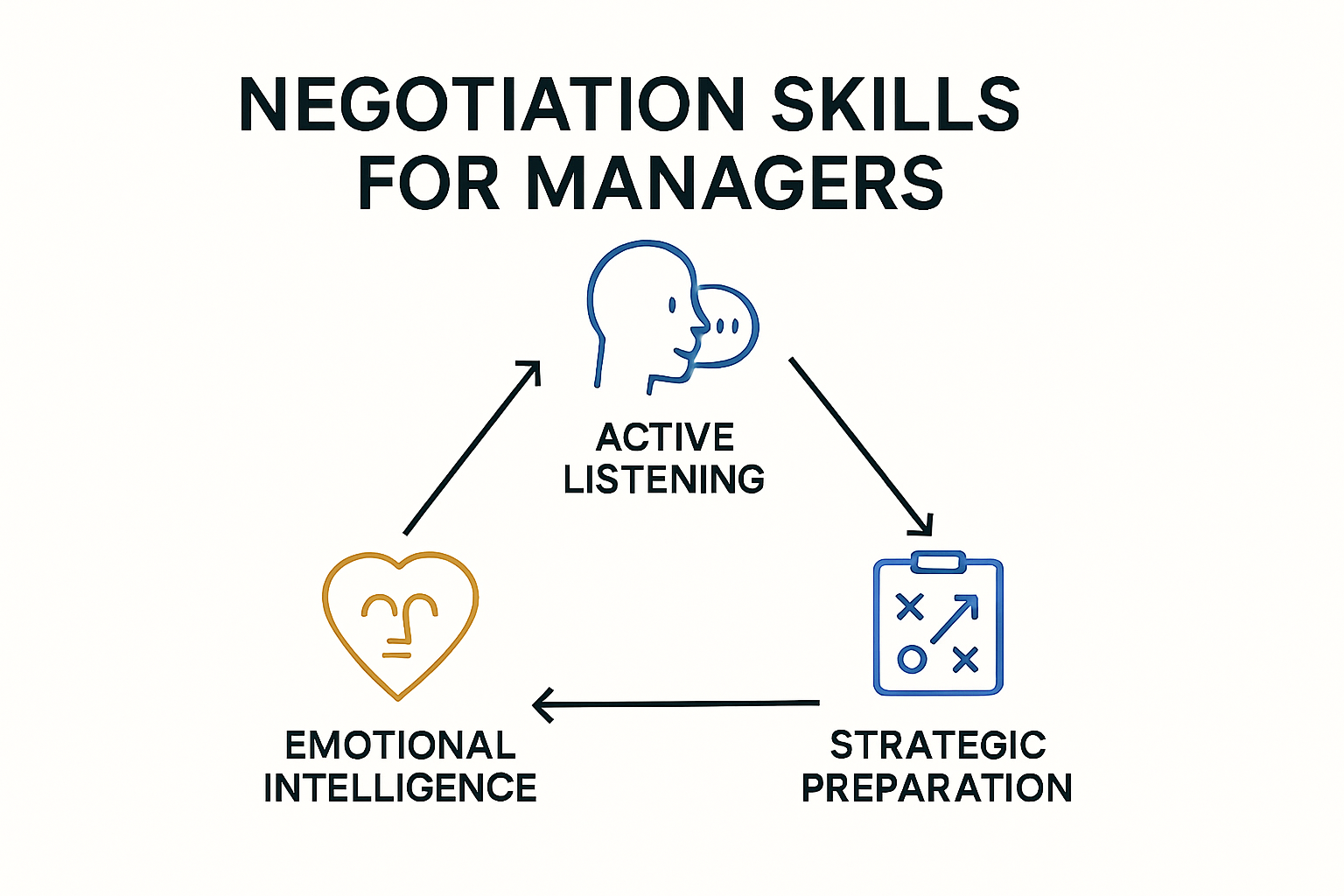
Managerial negotiation skills encompass several critical components:
-
Active Listening: The foundation of successful negotiations. Managers must listen not just to words but to underlying interests, concerns, and motivations.
-
Emotional Intelligence: Understanding and managing emotions during high-stakes discussions prevents escalation and promotes constructive dialogue.
-
Strategic Preparation: Systematic planning involves researching all parties’ potential interests, anticipated objections, and desired outcomes before entering negotiations.
Research from Coursera’s Negotiation Skills Course highlights that successful negotiators blend technical knowledge with nuanced interpersonal skills. This means understanding cultural contexts, reading non-verbal cues, and adapting communication styles dynamically.
Developing a Negotiation Mindset
Managerial negotiation is not about defeating the other party but creating sustainable agreements. This requires:
- Viewing negotiations as collaborative problem-solving sessions
- Maintaining professional ethics and integrity
- Being willing to walk away if agreements do not meet fundamental organizational needs
Practical preparation involves role-playing scenarios, studying past negotiation experiences, and continuously refining communication techniques. Managers who invest time in developing these skills transform potential conflicts into opportunities for organizational growth and relationship building.
The landscape of negotiation is evolving rapidly. Technological advancements, remote work environments, and increasing global interconnectedness demand more sophisticated negotiation approaches. Managers who remain adaptable, emotionally intelligent, and strategically minded will successfully navigate these complex interactions.

Real-World Applications in Modern Workplaces
In the rapidly evolving business landscape of 2025, negotiation skills have transcended traditional boardroom interactions to become a critical competency across diverse professional environments. Managers must now adapt their negotiation strategies to address complex challenges spanning technology, remote work, and global interconnectedness.
Navigating Technology-Driven Negotiations
Modern workplace negotiations are increasingly influenced by technological platforms and digital communication channels. According to Research from Procurement Tactics, companies are experiencing significant financial impacts based on negotiation effectiveness. Data-driven negotiation approaches have become essential, with organizations leveraging quantitative insights to drive decision-making.
Technology has transformed negotiation dynamics, enabling managers to:
- Analyze Complex Data: Use advanced analytics to understand negotiation patterns
- Remote Communication: Master virtual negotiation techniques
- Global Collaboration: Navigate cross-cultural communication barriers
Sector-Specific Negotiation Strategies
Our comprehensive guide on skills development highlights the nuanced negotiation requirements across different industries. In manufacturing, negotiations focus on supply chain optimization. Financial services require intricate regulatory navigation. E-commerce demands contract negotiation skills that balance technological efficiency with human relationship building.
Research from IBM indicates that transparent policies and substantiated numerical results are increasingly critical. Managers must develop a skill set that combines technological proficiency with emotional intelligence.
Emerging Negotiation Challenges
The modern workplace presents unique negotiation scenarios that demand sophisticated approaches:
- Hybrid work model contract negotiations
- Salary discussions in dynamic economic environments
- Technology integration and digital transformation agreements
Successful managers recognize that negotiation is no longer a standalone skill but an integrated competency requiring continuous adaptation. The ability to read digital communication nuances, understand technological constraints, and maintain human connection becomes paramount.
By 2025, negotiation skills will be less about winning and more about creating sustainable, mutually beneficial outcomes that support organizational resilience and individual growth. Managers who can blend data-driven insights with empathetic communication will distinguish themselves in an increasingly complex professional landscape.
Building Long-Term Value Through Effective Negotiation
In 2025, negotiation has evolved from a transactional skill to a strategic capability that defines organizational success. Managers must now approach negotiations as opportunities for creating sustainable value, moving beyond short-term gains to build lasting relationships and competitive advantages.
Strategic Interest-Based Negotiation
Interest-based negotiation represents a fundamental shift in how managers approach complex business interactions. According to Aligned Negotiation Strategies, this approach focuses on understanding the underlying motivations and needs of all parties, rather than getting stuck on rigid positional demands.
Our expert negotiation skills training guide emphasizes that successful long-term negotiations require:
- Deep Understanding: Uncovering the genuine interests behind stated positions
- Creative Problem-Solving: Developing solutions that address multiple stakeholder needs
- Relationship Preservation: Maintaining professional relationships beyond individual transactions
Balancing Profitability and Responsibility
Modern negotiations demand a holistic approach that integrates financial objectives with broader organizational values. Research from leading business strategists indicates that companies must now balance profits with social and environmental responsibility. This means negotiations are no longer just about financial terms but about creating sustainable value.
Companies like Tesla provide a compelling example. According to industry analysis, their strategic approach to long-term lithium supply agreements demonstrates how sophisticated negotiation can secure future market leadership while managing resource constraints.
Developing a Value-Creation Mindset
Effective long-term negotiation requires managers to:
- View negotiations as collaborative problem-solving opportunities
- Develop a comprehensive understanding of all stakeholders’ broader objectives
- Create win-win scenarios that extend beyond immediate financial considerations
The most successful negotiators in 2025 will be those who can:
- Integrate technological insights
- Understand complex organizational ecosystems
- Demonstrate emotional intelligence
- Maintain ethical standards
Ultimately, building long-term value through negotiation is about creating a strategic approach that transforms potential conflicts into opportunities for mutual growth. Managers who can navigate this complex landscape will not just close deals but build sustainable competitive advantages that propel their organizations forward in an increasingly dynamic business environment.
Practical Tips and Training Resources for 2025
As managers navigate the complex negotiation landscape of 2025, continuous learning and strategic skill development become paramount. The most successful professionals will leverage cutting-edge training resources and practical approaches that transform theoretical knowledge into actionable negotiation capabilities.
Structured Learning Approaches
Our comprehensive guide on effective training methods highlights the importance of targeted, immersive negotiation skill development. According to Harvard Professional Development, advanced negotiation training now goes beyond traditional dealmaking to focus on holistic value creation.
Key components of effective negotiation training include:
- Simulation-Based Learning: Realistic scenarios that mimic complex business interactions
- Personalized Feedback: Detailed analysis of individual negotiation styles
- Technology-Enhanced Training: Virtual platforms that provide immediate performance insights
Practical Skill Enhancement Techniques
Managerial negotiation training in 2025 requires a multifaceted approach. Aligned Negotiation Strategies recommends several practical techniques for skill development:
- Practice active listening under simulated pressure conditions
- Develop emotional intelligence through targeted exercises
- Learn to recognize and navigate different negotiation styles
- Build confidence through structured role-playing scenarios
The Management Training Institute suggests a five-phase approach to negotiation mastery, which includes:
- Comprehensive preparation
- Strategic information gathering
- Developing multiple solution scenarios
- Implementing flexible communication strategies
- Post-negotiation reflection and learning
Continuous Improvement Framework
Successful managers in 2025 will treat negotiation skills as an ongoing development journey. This means:
- Regular self-assessment of negotiation performance
- Seeking mentorship from experienced negotiators
- Staying updated with emerging negotiation technologies
- Investing in personalized coaching and feedback
Technology plays a crucial role in modern negotiation training. Artificial intelligence and advanced analytics now provide managers with unprecedented insights into their negotiation patterns, helping them identify strengths and areas for improvement.
Ultimately, mastering negotiation skills is about more than learning techniques. It requires a growth mindset, continuous curiosity, and a commitment to understanding the complex human dynamics that drive successful business interactions. Managers who approach negotiation as a craft to be continuously refined will distinguish themselves in an increasingly competitive professional landscape.
Frequently Asked Questions
What are the core negotiation skills every manager needs?
Successful managers need skills like active listening, emotional intelligence, and strategic preparation to navigate complex negotiations and achieve mutually beneficial outcomes.
How can technology improve negotiation skills in modern workplaces?
Technology enhances negotiation by providing data analytics for informed decision-making, mastering virtual communication techniques, and facilitating global collaboration.
What is interest-based negotiation and why is it important?
Interest-based negotiation focuses on understanding the true motivations of all parties involved, promoting collaborative problem-solving, and fostering sustainable agreements rather than strictly transactional ones.
How can managers continuously improve their negotiation skills?
Managers can continuously improve through structured learning approaches, practical skill enhancement techniques, ongoing self-assessment, and seeking mentorship from experienced negotiators.
Ready to Strengthen Your Negotiation Power in 2025?
Today’s managers face more than just tough conversations. The real challenge is turning complex workplace negotiations into growth opportunities while balancing remote work, data-driven decisions, and rising expectations. The article highlighted the struggle to master negotiation with emotional intelligence, virtual skills, and long-term thinking. If these hurdles feel familiar, you’re not alone. Peuneo’s accredited training solutions are built for forward-thinking leaders who want to stay ahead.

Take the first step toward unlocking your full negotiation potential. Our Peuneo online learning portal offers expert-led courses designed for the realities of 2025. Enroll now and discover hands-on skills that help you turn conflict into collaboration and create real value. The future of negotiation starts with you. Visit Peuneo (Pty) Ltd today and see how our tailored training and consulting can transform your management team.