


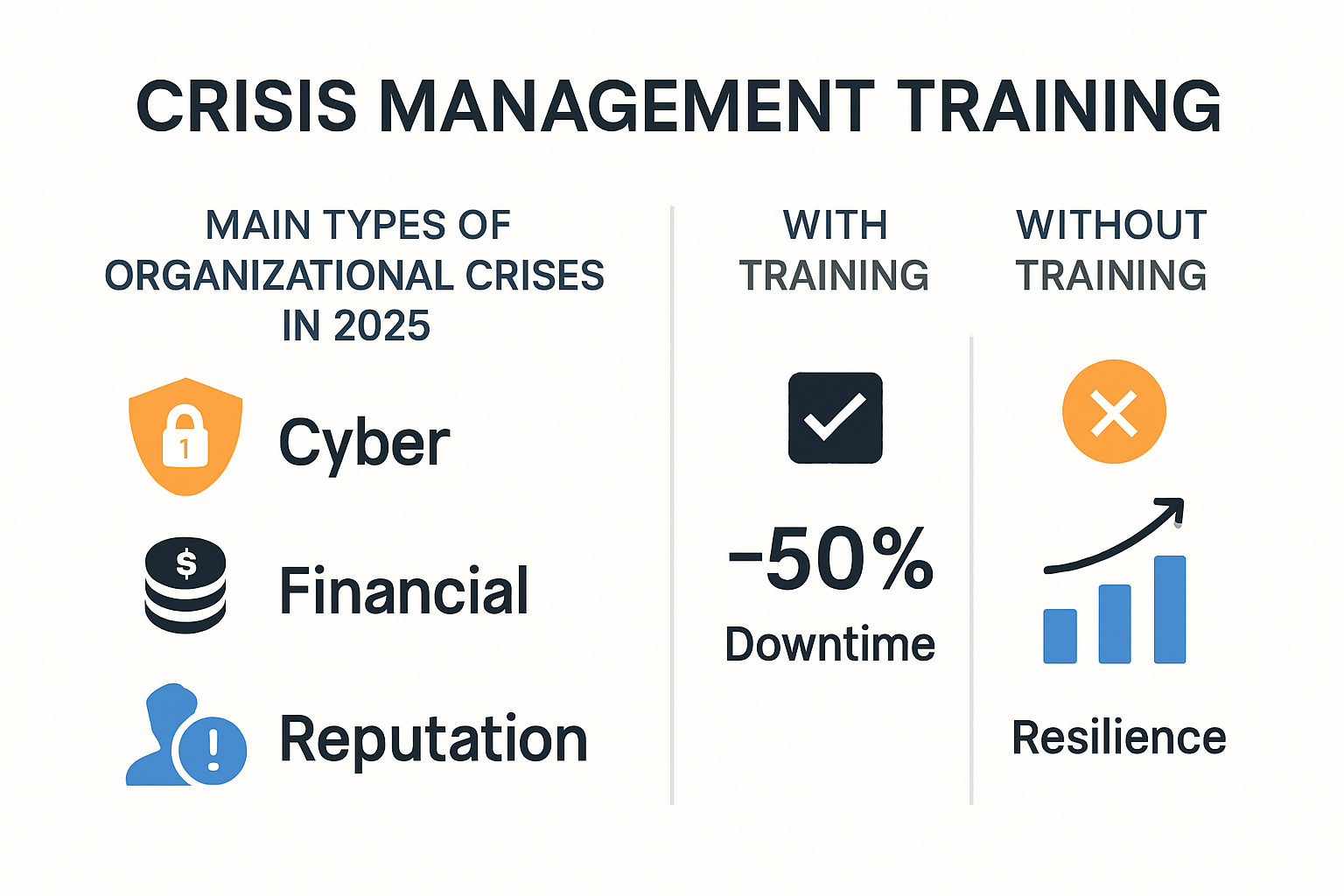
Crisis management training is now a top priority as organizations face a surge in unexpected threats. Here is a shocker: companies with specialized crisis management training report up to 50 percent less operational downtime during major incidents compared to those without. While most leaders assume crisis preparation is just about avoiding disasters, the real value comes from building teams that can turn chaos into growth.
Table of Contents
- Why Crisis Management Training Matters Today
- Key Skills Developed During Training
- Benefits For Organizations And Professionals
- Choosing The Right Crisis Management Program
Quick Summary
| Takeaway | Explanation |
|---|---|
| Importance of Crisis Management Training | Organizations must invest in crisis management training to maintain operational stability and resilience in increasingly complex environments. |
| Key Skills Development | Training fosters essential skills such as strategic decision-making, advanced communication, and adaptive problem-solving, preparing individuals to manage crises effectively. |
| Organizational Benefits | Effective crisis management training enhances organizational performance through improved risk mitigation, operational continuity, and strategic adaptability. |
| Choosing the Right Program | Organizations should assess crisis management programs based on comprehensive curricula, industry alignment, and the ability to provide continuous learning and development opportunities. |
Why Crisis Management Training Matters Today
In an increasingly complex and unpredictable global environment, crisis management training has become more critical than ever for organizations seeking to maintain operational stability and resilience. The rapidly evolving landscape of technological, social, and economic challenges demands that businesses and institutions develop robust strategies to anticipate, respond to, and recover from potential disruptions.
Understanding Modern Crisis Dynamics
Modern organizations face an unprecedented range of potential crises that can emerge suddenly and escalate quickly. Explore our comprehensive training approaches that prepare teams to navigate these complex scenarios. According to research from Forbes, organizations with proactive crisis management training experience significantly reduced operational downtime and enhanced recovery capabilities.
The complexity of contemporary crises extends beyond traditional emergency scenarios. Today’s challenges include cybersecurity threats, global pandemic responses, reputational risks, technological disruptions, and sudden market shifts. These multifaceted challenges require employees who can think critically, communicate effectively, and make strategic decisions under pressure.
Building Organizational Resilience
Crisis management training is not merely about preparing for potential disasters but about building a comprehensive culture of preparedness and adaptability. Access Newswire highlights that comprehensive training enhances organizational resilience by equipping employees with skills to identify, assess, and respond effectively to emerging challenges.
Effective training programs focus on developing several key competencies:
- Strategic Thinking: Enabling employees to analyze complex scenarios and develop adaptive responses
- Communication Skills: Ensuring clear, transparent communication during high-stress situations
- Emotional Intelligence: Managing personal and team stress during critical moments
- Decision Making: Making rapid, informed choices with limited information
Moreover, crisis management training transcends technical skills. It cultivates a mindset of continuous learning, adaptability, and proactive problem solving. Organizations that invest in such training create a workforce capable of transforming potential threats into opportunities for growth and innovation.
By 2025, the ability to navigate uncertainty will be a fundamental organizational competency. Crisis management training represents a strategic investment in human capital, ensuring that teams are not just reactive but genuinely prepared to thrive in an increasingly volatile global environment. The goal is not just survival but the ability to maintain operational excellence and strategic momentum even during unprecedented challenges.
Key Skills Developed During Training
Crisis management training is a comprehensive process that transforms individuals and teams into highly adaptive, resilient professionals capable of navigating complex challenges. Discover strategies for skill enhancement that go beyond traditional learning approaches. The training focuses on developing a sophisticated set of skills that are critical for effective organizational response and individual performance during high-stakes situations.
To provide a clear overview, the table below summarizes the key skills developed during crisis management training and their primary focus areas:
| Skill Area | Description | Primary Focus |
|---|---|---|
| Strategic Decision Making | Assessing situations rapidly to make informed choices | Rapid analysis & risk evaluation |
| Advanced Communication | Conveying information clearly under pressure | Stakeholder management & transparency |
| Adaptive Problem Solving | Adjusting strategies quickly to meet changing scenarios | Flexibility & creative solutions |
| Emotional Intelligence | Handling stress and supporting team dynamics | Stress management & team cohesion |
| Situational Awareness | Distinguishing critical data from noise | Context analysis & timely action |
Strategic Decision Making Under Pressure
According to Everbridge research, situational awareness is a fundamental skill developed through rigorous crisis management training. Participants learn to rapidly assess complex environments, distinguish critical information from noise, and make informed decisions with limited resources. This skill goes far beyond traditional problem solving by emphasizing:
- Rapid Context Analysis: Quickly understanding the full scope of a crisis
- Predictive Thinking: Anticipating potential consequences of immediate actions
- Risk Assessment: Evaluating multiple scenarios simultaneously
Professionals emerge from these programs with an enhanced ability to maintain composure and clarity when confronting unprecedented challenges. The training simulates high-stress scenarios that require split-second judgments, helping participants develop mental resilience and strategic thinking capabilities.
Advanced Communication and Coordination
Koenig Solutions research highlights that effective communication is a cornerstone of successful crisis management. Training programs focus intensively on developing communication skills that transcend traditional interpersonal interactions. Participants learn to:
- Craft clear, concise messages during high-stress scenarios
- Manage stakeholder expectations
- Navigate complex communication channels
- Maintain transparency while protecting organizational interests

These communication skills are not just about transmitting information but about creating a coordinated response that maintains organizational integrity and public trust. Participants learn to communicate across different levels of an organization, with external stakeholders, and through various media platforms.
Adaptive Problem Solving and Resilience
The ultimate goal of crisis management training is to cultivate a mindset of adaptability and continuous learning. Professionals develop the ability to improvise, pivot strategies quickly, and transform potential threats into opportunities for growth. This approach goes beyond traditional training by emphasizing:
- Flexibility in approach
- Creative problem solving
- Emotional intelligence
- Psychological resilience
By 2025, organizations recognize that crisis management training is not just a skill development program but a strategic investment in human capital. The ability to navigate uncertainty, communicate effectively, and make intelligent decisions under pressure will distinguish high-performing teams from their competitors. Participants emerge not just as better employees but as transformative leaders capable of guiding organizations through complex challenges.
Benefits for Organizations and Professionals
Crisis management training represents a strategic investment that delivers transformative advantages for both organizations and individual professionals. Explore professional development pathways that unlock unprecedented growth potential. The benefits extend far beyond immediate crisis response, creating a comprehensive ecosystem of organizational resilience and individual skill enhancement.
The following table outlines the primary benefits of crisis management training for both organizations and professionals:
| Benefit Area | For Organizations | For Professionals |
|---|---|---|
| Risk Mitigation | Limits financial/reputational damage | Enhances decision-making skills |
| Operational Continuity | Ensures productivity during disruption | Builds confidence in complex scenarios |
| Strategic Adaptability | Enables flexible responses to challenges | Improves leadership potential |
| Long-term Resilience | Fosters culture of preparedness and learning | Increases marketability and career growth |
| Innovation | Turns threats into opportunities for advancement | Cultivates creative problem-solving |
Organizational Performance and Strategic Advantage
According to UK Government Resilience Framework, effective crisis management training significantly improves organizational capabilities. Companies that invest in comprehensive training programs experience substantial performance improvements, including:
- Risk Mitigation: Reducing potential financial and reputational damages
- Operational Continuity: Maintaining productivity during challenging scenarios
- Strategic Adaptability: Developing flexible response mechanisms
These training programs transform organizational culture by embedding proactive problem solving approaches. By cultivating a workforce prepared to navigate complex challenges, organizations create sustainable competitive advantages that distinguish them in rapidly changing business environments.
Professional Career Development
Institute of Internal Communication research highlights how crisis management training serves as a critical career acceleration mechanism. Professionals who undergo comprehensive training experience significant personal and professional growth, including:
- Enhanced leadership potential
- Improved decision making capabilities
- Greater employment marketability
- Increased confidence in handling complex scenarios
These skills are particularly valuable in industries experiencing rapid technological and structural transformations. Professionals become more attractive to employers by demonstrating advanced adaptive capabilities and strategic thinking skills.
Long-Term Resilience and Innovation
Institute of Development Studies emphasizes that crisis management training fosters a culture of continuous learning and innovation. The training goes beyond traditional skill development by cultivating:
- Psychological resilience
- Cross-functional collaboration
- Innovative problem solving approaches
- Proactive risk assessment capabilities
By 2025, organizations recognize that crisis management training is not merely a defensive strategy but a proactive approach to building organizational and individual capabilities. Professionals emerge from these programs as versatile leaders who can transform challenges into opportunities. The training creates a symbiotic relationship between organizational needs and individual aspirations, ensuring that both entities can thrive in an increasingly complex and unpredictable global environment.
Ultimately, crisis management training represents an investment in human potential. It prepares professionals to become adaptive, strategic thinkers who can guide organizations through unprecedented challenges while simultaneously advancing their personal career trajectories.
Choosing the Right Crisis Management Program
Selecting an appropriate crisis management training program requires careful consideration of multiple strategic factors. Learn about targeted professional development that aligns with organizational objectives. The right program can transform an organization’s approach to risk management and resilience.
Comprehensive Curriculum Assessment
Research from the National Center for Biotechnology Information emphasizes the critical importance of integrating organizational values into crisis management training. When evaluating potential programs, organizations should focus on comprehensive curricula that address multiple dimensions of crisis response:
- Theoretical Foundation: In-depth understanding of crisis management principles
- Practical Simulation: Realistic scenario-based training
- Technological Integration: Advanced tools and digital response strategies
- Ethical Decision Making: Frameworks for maintaining organizational integrity
Top-tier programs go beyond traditional training by providing adaptive learning experiences that mirror real-world complexity. They challenge participants to develop nuanced approaches to unprecedented challenges, ensuring that theoretical knowledge translates into practical capabilities.
Program Evaluation Criteria
Advanced Research from ArXiv highlights the significance of sophisticated modeling techniques in crisis management training. Organizations should evaluate programs based on several key criteria:
- Alignment with industry-specific challenges
- Flexibility of training delivery
- Expertise of instructional faculty
- Integration of cutting-edge research and technologies
- Proven track record of successful implementations
The most effective programs offer customizable approaches that can be tailored to specific organizational needs. They recognize that crisis management is not a one-size-fits-all solution but a dynamic process requiring continuous adaptation.
Implementation and Continuous Learning
International Journal of Business research suggests that successful crisis management programs emphasize ongoing learning and development. The ideal program should:
- Provide post-training support
- Offer periodic refresher courses
- Include mechanisms for continuous skill assessment
- Enable knowledge sharing across organizational levels
By 2025, organizations will view crisis management training as a strategic investment rather than a compliance requirement. The most progressive programs will integrate artificial intelligence, advanced simulation technologies, and personalized learning pathways to create truly transformative learning experiences.
Choosing the right crisis management program is about more than acquiring skills. It is about developing a holistic approach to organizational resilience that empowers professionals to navigate complex, unpredictable environments with confidence and strategic insight. The most successful organizations will prioritize training programs that not only prepare for potential crises but also foster a culture of proactive problem solving and continuous improvement.
Frequently Asked Questions
What is crisis management training?
Crisis management training equips individuals and organizations with the skills and knowledge needed to effectively respond to and recover from unexpected events or emergencies. It involves strategies for anticipating crises, making decisions under pressure, and communicating effectively during challenging times.
Why is crisis management training important in 2025?
In 2025, crisis management training is crucial as organizations face a rapidly evolving landscape of risks, including cybersecurity threats and global pandemics. Training helps build resilience, maintain operational stability, and turn potential threats into opportunities for growth.
What skills are developed through crisis management training?
Crisis management training develops various key skills, including strategic decision-making under pressure, advanced communication, adaptive problem-solving, emotional intelligence, and situational awareness, all of which are vital for effective crisis response.
How can organizations choose the right crisis management training program?
To choose an effective crisis management training program, organizations should assess the curriculum for comprehensive content, alignment with industry-specific challenges, evaluation criteria, and ongoing support mechanisms. Programs should also offer practical simulation experiences and flexible delivery options.
Transform Your Crisis Management Skills with Peuneo
Are you ready to close the gap between risk and resilience highlighted in “The Importance of Crisis Management Training in 2025”? The article shows how lacking crisis management training puts your operation at risk of prolonged downtime and missed opportunities for growth. Today, keeping your teams prepared for fast-changing threats demands more than just basic awareness. You need accredited, practical skills that empower decisive action and adaptive problem solving.

Peuneo’s accredited training and consulting programs focus on the exact needs discussed in the article—strategic decision making, advanced communication, adaptive problem solving, and long-term resilience. Whether you want structured online learning or tailored corporate consulting, our suite of skills development solutions will help you build a culture of preparedness. Do not wait for uncertainty to turn into crisis. Visit Peuneo, and start your journey toward resilience today. Enroll now and make your organization stronger where it matters most.
Recommended
- Importance of Leadership Training in 2025 – Peuneo
- 2025 Training Course Benefits: Boost Skills & Growth – Peuneo
- 2025 Essential Insights: The Importance of Training Programs – Peuneo
- Essential Skills for Managers in 2025: Guide for Leaders and Teams – Peuneo
- Confidential Waste Risk Management: Essential Guide for UK Businesses 2025 – Venture Waste
- Why Is Online Reputation Important for Small Businesses in 2025? | Ibrandmedia