

Skills gaps in the workplace are more than just a minor inconvenience. They represent a staggering disconnect between employees’ current abilities and the competencies required for organizational success. A shocking 74% of employers struggle to find the skilled talent they need. Yet, many organizations often overlook this critical challenge. The really surprising part? Addressing these skill deficits can unlock unprecedented potential for growth and innovation. By recognizing and responding to skills gaps, companies can transform weaknesses into strengths and thrive in an ever-evolving marketplace.
Table of Contents
- What Are Skills Gaps In The Workplace
- Key Signs Your Team Has Skills Gaps
- Simple Steps To Identify Skills Gaps
- Turning Skill Gap Insights Into Action
Quick Summary
| Takeaway | Explanation |
|---|---|
| Understanding Skills Gaps | Skills gaps represent a disconnect between what employees can do and what is needed to meet business objectives, often affected by technological advancement and evolving market demands. |
| Identifying Signs of Skills Gaps | Key performance indicators include missed deadlines, low-quality work, and observable behaviors such as reluctance to take initiative, which signal deeper skill deficiencies in the team. |
| Utilizing Comprehensive Assessments | Organizations should conduct thorough skills assessments, combining job role analysis, performance reviews, and multiple assessment methods to create an accurate skills gap profile. |
| Designing Targeted Learning Interventions | Developing personalized training programs tailored to specific skills gaps, including microlearning and mentorship, is crucial for effective skill remediation. |
| Measuring and Sustaining Development | Implementing ongoing evaluation mechanisms, such as pre and post-training assessments, is essential for tracking the impact of skill development initiatives over time. |
What are Skills Gaps in the Workplace?
Skills gaps represent a critical challenge facing modern organizations, where the current capabilities of employees do not fully align with the skills required to achieve business objectives. These gaps emerge when the skills needed to perform effectively in specific roles differ from the existing skills within the workforce.
Understanding the Nature of Skills Gaps
At its core, a skills gap is fundamentally a mismatch between organizational needs and employee capabilities. According to ManpowerGroup research, 74% of employers are currently struggling to find the skilled talent necessary for their operational success. This statistic underscores the widespread nature of skills gaps across various industries.
The dynamic nature of skills gaps is particularly pronounced in today’s rapidly evolving work environment. Lightcast reports reveal that 32% of skills required for an average job in 2024 are different from those in 2021, highlighting the accelerating pace of skill transformation. This continuous evolution means that skills gaps are not static but constantly shifting, requiring organizations to remain agile and proactive in their talent development strategies.
Identifying Common Skills Gap Characteristics
Skills gaps can manifest in multiple dimensions, ranging from technical competencies to soft skills. Some common characteristics include:
- Technological Proficiency: Rapid technological advancement creates significant gaps in digital skills across industries
- Emerging Technical Skills: Specialized knowledge in areas like artificial intelligence, data analytics, and cybersecurity
- Soft Skills Development: Critical thinking, communication, adaptability, and emotional intelligence
These gaps can arise from various factors, including technological disruption, changing market demands, educational system limitations, and insufficient ongoing professional development. For instance, an organization might require advanced data analysis skills, but find that their current workforce lacks the necessary computational and statistical expertise.
Strategic Implications of Skills Gaps
The consequences of unaddressed skills gaps extend far beyond individual performance. They can significantly impact organizational competitiveness, innovation potential, and overall productivity. Companies that fail to recognize and proactively manage these gaps risk falling behind more adaptive competitors.
Successful skills gap management requires a multifaceted approach involving continuous learning, targeted training programs, strategic recruitment, and a commitment to ongoing workforce development. Organizations must develop robust mechanisms for regularly assessing existing skill levels, anticipating future skill requirements, and creating comprehensive strategies to bridge these developmental gaps.
Understanding skills gaps is not about identifying shortcomings but recognizing opportunities for growth, learning, and organizational transformation. By viewing skills gaps as dynamic challenges rather than static problems, companies can create more resilient, adaptable, and future-ready workforces.
Key Signs Your Team Has Skills Gaps
Recognizing skills gaps within your organization requires keen observation and systematic assessment. While these gaps can be subtle, several clear indicators signal that your team might be struggling with skill deficiencies that could impact overall performance and organizational effectiveness.
Performance and Productivity Indicators

Performance reviews and competency frameworks provide critical insights into potential skills gaps. Consistent patterns of underperformance, missed deadlines, and lower quality work often reveal underlying skill mismatches. When employees repeatedly struggle to meet established benchmarks or require excessive supervision, it suggests a significant disconnect between the skills required and those currently possessed.
Additionally, teams experiencing frequent project delays or increased error rates might be exhibiting signs of skill inadequacies. These performance gaps become particularly evident when comparing team outputs against industry standards or competitor benchmarks. Managers should pay close attention to projects that consistently fall short of expectations, as these could indicate systemic skill deficiencies rather than individual performance issues.
Observable Workplace Behaviors
Skills gaps manifest through distinctive workplace behaviors that perceptive leaders can identify. Employees may demonstrate:
- Hesitation in Taking Initiative: Reluctance to tackle new challenges or complex tasks
- Increased Dependency: Constant need for guidance or micromanagement
- Knowledge Silos: Limited cross-functional understanding or collaboration
- Technology Adaptation Struggles: Difficulty implementing new tools or digital workflows
These behavioral signs often reveal deeper skill deficiencies. When team members consistently avoid certain responsibilities or express low confidence in their abilities, it signals potential skill gaps that require targeted intervention. Industry benchmarking becomes crucial in understanding whether these behaviors represent isolated incidents or broader organizational challenges.
Technology and Innovation Readiness
In today’s rapidly evolving workplace, technological proficiency serves as a critical indicator of skill alignment. Organizations struggling with digital transformation, emerging technologies, or innovative processes often face significant skill gaps. Teams that find themselves repeatedly behind technological curves or unable to implement cutting-edge solutions are likely experiencing substantial skill deficiencies.
Modern workplace skills extend beyond traditional technical competencies. Soft skills like adaptability, critical thinking, and digital literacy have become equally important. Teams that struggle with rapid change, complex problem-solving, or collaborative digital environments demonstrate clear signs of skill misalignment.
Effective skills gap identification requires a holistic approach. It involves continuous learning assessments, regular performance evaluations, and a commitment to understanding the evolving skill landscape. Organizations must transform skills gap recognition from a passive observation into an active, strategic opportunity for workforce development.
By proactively identifying these signs, companies can design targeted training programs, recruit strategically, and create a culture of continuous learning. The goal is not to highlight deficiencies but to create pathways for growth, empowerment, and organizational resilience.
Simple Steps to Identify Skills Gaps
Identifying skills gaps requires a systematic and strategic approach that goes beyond surface-level assessments. Organizations must develop a comprehensive methodology to accurately diagnose and address skill deficiencies that could impact overall performance and competitiveness.
Conducting Comprehensive Skills Assessments
Effective skills gap analysis begins with a structured methodology that connects directly to business objectives. The process involves defining clear assessment goals, researching current industry trends, and measuring existing workforce capabilities against future organizational needs. Thirst.io research suggests that successful skills assessments should evaluate both technical skills and soft skills across all organizational levels.
A critical first step is creating a detailed skills matrix that maps current employee capabilities against required competencies. This approach allows organizations to visualize skill strengths and weaknesses systematically. Managers should engage in:
- Comprehensive Job Role Analysis: Examining specific competencies required for each position
- Performance Review Evaluation: Identifying consistent patterns of skill limitations
- Individual Skill Mapping: Creating personalized skill profiles for each team member
Leveraging Multiple Assessment Methods
Industry benchmarking and multiple assessment techniques provide a more holistic view of organizational skill capabilities. Key methods include:
- Detailed performance reviews
- Skills assessment tools and tests
- 360-degree feedback mechanisms
- External competency benchmarking
- Self-assessment surveys
- Professional skills certification tracking
These multifaceted approaches help organizations develop a nuanced understanding of existing skill levels. By combining quantitative measurements with qualitative feedback, companies can create more accurate skills gap profiles that go beyond simple numerical assessments.
Strategic Skills Gap Analysis Framework
Developing a strategic framework for skills gap identification involves creating a repeatable, systematic process. Organizations should:
- Define clear business objectives and future skill requirements
- Conduct comprehensive current skill inventory
- Identify specific skill gaps through comparative analysis
- Prioritize skill development based on business impact
- Design targeted training and development interventions
- Implement continuous monitoring and reassessment
The financial implications of skills gaps are significant. Research indicates that skills gaps currently cost the US economy approximately $13 billion monthly, underscoring the critical importance of proactive skills management.
Successful skills gap identification is not a one-time event but a continuous process of learning, assessment, and adaptation. Organizations must develop a culture that views skill development as an ongoing journey, creating flexible frameworks that can quickly respond to emerging technological and market demands.
By implementing these systematic steps, companies can transform skills gap identification from a reactive challenge into a strategic opportunity for workforce development, ensuring they remain competitive in an increasingly dynamic business landscape.
Turning Skill Gap Insights into Action
Identifying skills gaps represents only the first step in organizational development. The true challenge lies in transforming these insights into meaningful, strategic actions that drive workforce capability and organizational performance.
Designing Targeted Learning Interventions
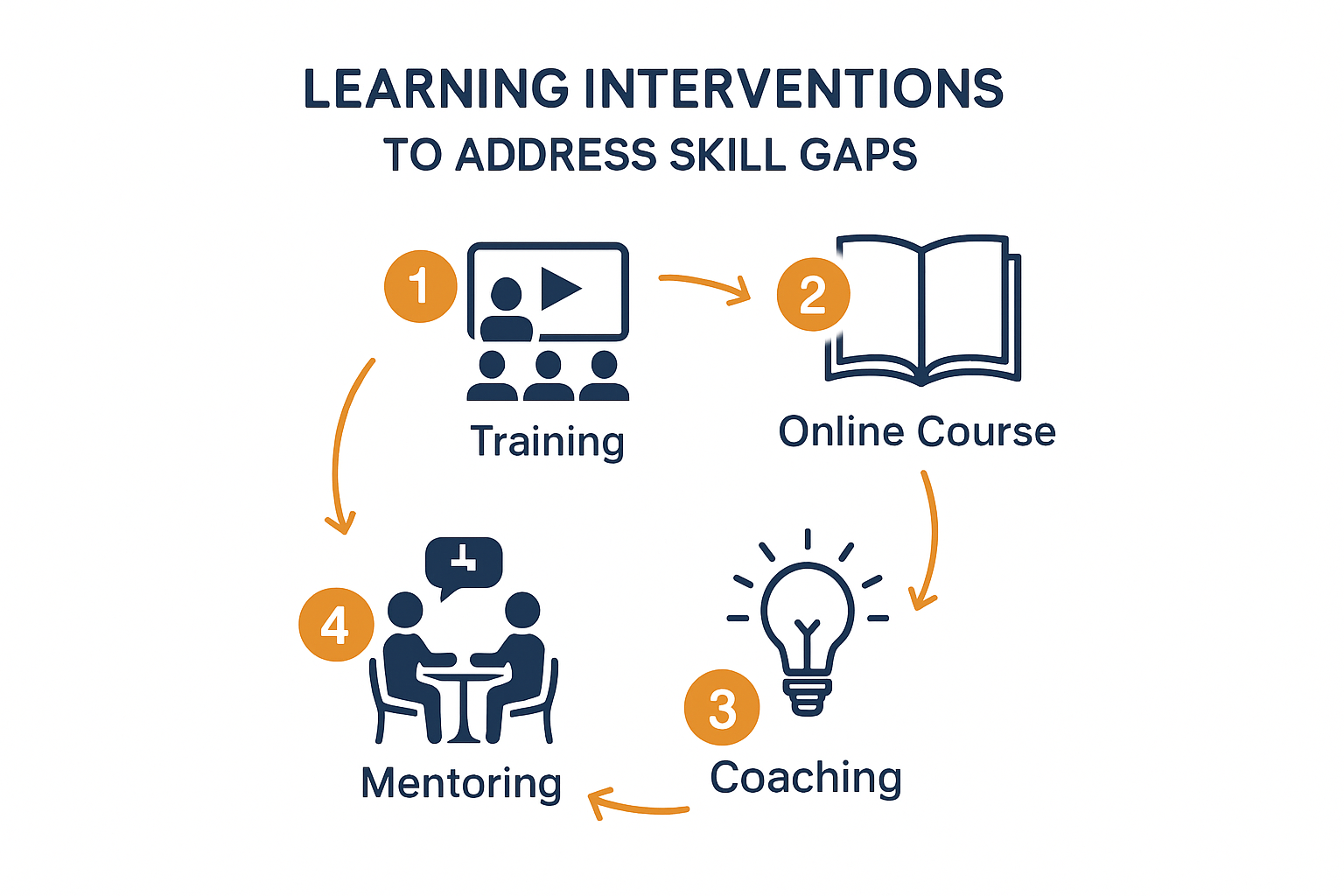
Personalized training programs serve as the cornerstone of effective skill gap remediation. These programs must be precisely tailored to address specific competency deficiencies identified through comprehensive skills assessments. Organizations should develop multi-dimensional learning strategies that combine various educational approaches, ensuring flexibility and comprehensive skill development.
Effective learning interventions typically incorporate:
- Microlearning Modules: Short, focused training segments that address specific skill requirements
- Digital Learning Platforms: Interactive online courses with real-time progress tracking
- Mentorship Programs: Pairing experienced professionals with employees needing skill development
- Experiential Learning Opportunities: Practical projects and assignments that build real-world capabilities
Creating Comprehensive Development Frameworks
Research indicates that successful skill gap strategies require more than traditional training approaches. Organizations must develop holistic development frameworks that integrate continuous learning, performance management, and strategic talent development.
Key components of an effective development framework include:
- Individual skill assessment and baseline measurement
- Personalized development plans
- Regular performance monitoring
- Adaptive learning pathways
- Continuous feedback mechanisms
These frameworks should remain flexible, allowing for rapid adjustments as organizational needs and technological landscapes evolve. The goal is creating a dynamic learning ecosystem that supports ongoing skill enhancement and organizational agility.
Measuring and Sustaining Skill Development
Measuring the effectiveness of skill development initiatives is crucial for long-term success. Organizations must implement robust evaluation mechanisms that track learning outcomes, performance improvements, and return on investment.
Comprehensive measurement strategies should include:
- Pre and post-training skill assessments
- Performance metric tracking
- Employee engagement and satisfaction surveys
- Quantitative productivity measurements
- Long-term capability progression analysis
Successful skill gap remediation is not a one-time event but a continuous organizational commitment. Companies must cultivate a culture of learning that views skill development as an ongoing journey rather than a destination.
By transforming skills gap insights into strategic, data-driven actions, organizations can create resilient, adaptable workforces capable of navigating complex and rapidly changing business environments. The ultimate objective is not merely filling skill gaps but building a proactive, learning-oriented organizational culture that anticipates and responds to emerging skill requirements.
Frequently Asked Questions
What are skills gaps in the workplace?
Skills gaps occur when there is a mismatch between the skills that employees currently possess and the skills needed to meet business objectives. These gaps can be caused by technological advancements, evolving market demands, and lack of ongoing professional development.
How can I identify skills gaps in my team?
To identify skills gaps, observe performance indicators such as missed deadlines and low-quality work. Implement comprehensive skills assessments, conduct performance reviews, and utilize multiple assessment methods to create an accurate profile of your team’s capabilities.
What are the signs of skills gaps within an organization?
Common signs of skills gaps include consistent underperformance, hesitance in taking initiative, and struggles with new technologies. Behavioral indicators such as increased dependency on supervision and knowledge silos can also reveal deeper skill deficiencies.
How can I address skills gaps once identified?
To address skills gaps, design targeted learning interventions like personalized training programs, mentorship, and microlearning modules. Create a comprehensive development framework that includes continuous feedback and regular performance monitoring to ensure sustained growth.
Unlock Your Team’s Potential with Peuneo
Are you struggling to identify and bridge skills gaps within your organization? In today’s fast-paced market, ignoring these gaps can hinder your team’s performance and undermine your company’s growth. As highlighted in our article on identifying skills gaps, recognizing these issues is the first step to transformation. Your workforce may be facing challenges like missed deadlines or a lack of initiative – symptoms that indicate an urgent need for targeted development.

Don’t let skills gaps hold your organization back! At Peuneo, we specialize in providing accredited training and consulting services tailored to meet your unique needs. Our comprehensive online learning portal offers a diverse range of courses designed to equip your employees with the essential skills required in today’s evolving landscape. Act now to empower your workforce and set your business on a path to success! Visit us at https://peuneo.co.za to explore our offerings and take the crucial next step in skill development.