


Training program evaluation is not just another task on your to-do list; it’s essential for staying ahead in today’s fast-paced business environment. Surprisingly, by 2030, over one billion people will need retraining due to rapid advancements in technology. But here’s the kicker: many organizations overlook how vital it is to measure the effectiveness of their training investments. The truth is, without a solid evaluation strategy, companies could be pouring resources into programs that yield little to no real-world benefits. It’s time to rethink how we assess training and ensure that every learning initiative aligns with organizational goals.
Table Of Contents
- Why Training Program Evaluation Matters
- Key Phases Of Program Evaluation
- Foundational Evaluation Frameworks
- [Comprehensive Evaluation Phases](#compreh
 ensive-evaluation-phases)
 - Advanced Evaluation Considerations
- Top Training Evaluation Models To Use
- How To Measure Training Effectiveness
- Steps For An Effective Evaluation Process
- [Establishing Evaluation Objectives](#establishing-evaluation-obj
 ectives)
 - Designing Comprehensive Evaluation Methodology
- Implementing And Analyzing Evaluation Findings
- [Establishing Evaluation Objectives](#establishing-evaluation-obj
Quick Summary
| Takeaway | Explanation |
|---|---|
| Strategic Importance of Training Evaluation | Comprehensive evaluation of training programs is essential for maintaining competitive advantage and understanding the true impact of learning investments on workforce performance and skill acquisition. |
| Holistic Evaluation Frameworks | Employing structured models like the Kirkpatrick Model and the Phillips ROI Methodology helps organizations assess training effectiveness across multiple dimensions, from participant satisfaction to return on investment. |
| Continuous and Adaptive Process | Training program evaluation should not be static; it must evolve continuously to adapt to changing organizational needs while employing advanced analytics and technology for deeper insights. |
| Comprehensive Measurement Strategies | Effective training measurement requires combining quantitative and qualitative approaches to capture full training impact, emphasizing both immediate feedback and long-term business outcomes. |
| Clear Evaluation Objectives | Before initiating evaluations, organizations should establish specific, aligned objectives to ensure assessments are focused and meaningful, incorporating stakeholder engagement throughout the process. |
Why training program evaluation matters
In a rapidly evolving workplace landscape, training program evaluation has become more than just a routine administrative task—it’s a critical strategic imperative for organizations seeking to maintain competitive advantage and workforce effectiveness. The global workforce is experiencing unprecedented transformation, with research indicating that by 2030, over one billion people will require retraining due to advances in AI, robotics, automation, and emerging green technologies.
The Strategic Importance of Comprehensive Evaluation
Training program evaluation serves as a sophisticated diagnostic tool that goes far beyond simple performance measurement. It provides organizations with deep insights into the actual impact of their learning and development investments. By systematically assessing training outcomes, companies can understand whether their educational initiatives are genuinely translating into improved workplace performance, skill acquisition, and organizational capabilities.
Companies investing in structured training recognize its significance. Research shows that 85% of companies with more than 50 employees provide formal training to their workforce, underscoring the widespread recognition of continuous learning’s importance. However, merely providing training is insufficient—understanding its effectiveness is crucial.
Measuring Real-World Learning Outcomes
Effective training program evaluation allows organizations to:
- Validate Learning Investment: Determine the precise return on training expenditures
- Identify Skill Gaps: Pinpoint areas where additional training or different instructional approaches are needed
- Enhance Employee Performance: Create targeted interventions that directly improve workplace competencies
Moreover, comprehensive evaluation provides empirical evidence of training effectiveness. Studies have demonstrated that well-designed training programs can result in remarkable outcomes, with 96% of participants in specialized courses reporting high likelihood of recommending the training—a strong indicator of perceived value and quality.
Adapting to Evolving Organizational Needs
In today’s dynamic business environment, training program evaluation is not a static process but a continuous, adaptive mechanism. Organizations must develop evaluation frameworks that are flexible, data-driven, and aligned with both immediate operational requirements and long-term strategic objectives.
The most sophisticated evaluation approaches integrate multiple assessment levels—from immediate participant reactions to long-term organizational performance metrics. This holistic approach ensures that training programs are not just educational experiences but transformative interventions that drive meaningful organizational change and individual professional growth.
Ultimately, training program evaluation represents a critical investment in human capital. By systematically analyzing, refining, and optimizing learning experiences, organizations can create a culture of continuous improvement, resilience, and strategic capability development.
Key phases of program evaluation
Training program evaluation is a systematic process that requires careful planning, strategic execution, and comprehensive analysis. While numerous evaluation models exist, most share fundamental phases that provide a structured approach to understanding training effectiveness and organizational impact.
Foundational Evaluation Frameworks
Professional organizations and researchers have developed several robust models for training program evaluation. The Kirkpatrick Model remains one of the most widely recognized, offering a comprehensive four-level framework that guides evaluators through progressively sophisticated assessment stages:
- Reaction Level: Measuring participant satisfaction and immediate learning experience
- Learning Level: Assessing knowledge and skill acquisition during the training
- Behavior Level: Evaluating the transfer of learning into workplace performance
- Results Level: Analyzing the broader organizational impact and business outcomes
Building upon this model, the Phillips ROI Methodology introduces a fifth level specifically focused on calculating the financial return on investment, providing executive leadership with quantifiable evidence of training program value.
Comprehensive Evaluation Phases
Effective training program evaluation typically encompasses several interconnected phases that ensure a holistic and rigorous assessment:
-
Pre-Training Assessment
Before implementing any training initiative, organizations must conduct a thorough needs analysis. This phase involves identifying skill gaps, understanding organizational objectives, and establishing clear evaluation metrics. The CIRO Model emphasizes the critical importance of context and input evaluation, recommending comprehensive pre-training research to align learning objectives with strategic business goals. -
During-Training Monitoring
During the training program, evaluators collect real-time data on participant engagement, comprehension, and initial skill development. This phase involves continuous assessment techniques such as:
- Interactive knowledge checks
- Skill demonstration exercises
- Participant feedback mechanisms
- Performance tracking against predefined learning objectives
- Post-Training Evaluation
Following program completion, a multi-dimensional assessment occurs. This phase extends beyond traditional metrics, incorporating both qualitative and quantitative measurements. Key evaluation elements include:
- Skills application in real workplace scenarios
- Behavioral changes observed by managers
- Long-term performance improvements
- Direct and indirect organizational impact
Advanced Evaluation Considerations
Successful training program evaluation requires more than mechanical data collection. It demands a nuanced, contextual approach that considers organizational culture, individual learning styles, and evolving business requirements.
Modern evaluation strategies increasingly leverage technology, utilizing advanced analytics, machine learning algorithms, and integrated performance management systems to provide deeper, more actionable insights. These technological tools enable organizations to move beyond static reporting and develop dynamic, predictive evaluation frameworks.
Ultimately, effective training program evaluation is an ongoing, iterative process. By systematically examining each phase—from initial needs assessment to long-term impact analysis—organizations can continuously refine their learning strategies, optimize resource allocation, and drive meaningful professional development.
Top training evaluation models to use
Training evaluation models provide structured frameworks for organizations to systematically assess and optimize their learning and development initiatives. While numerous models exist, some have emerged as particularly influential in guiding comprehensive training program assessments.
Classic and Comprehensive Evaluation Approaches
Research indicates that several evaluation models stand out for their distinctive methodologies and widespread applicability. The Kirkpatrick Model, developed in 1959, remains the most popular and widely-used framework, offering organizations a straightforward yet powerful approach to training evaluation.
The Kirkpatrick Model comprises four essential levels:
- Reaction Level: Measuring participant satisfaction and immediate engagement
- Learning Level: Assessing knowledge and skill acquisition
- Behavior Level: Evaluating workplace performance changes
- Results Level: Analyzing broader organizational impact
Advanced Evaluation Models
Researchers have identified several sophisticated models that extend beyond traditional assessment techniques:
-
Phillips ROI Model
Building upon the Kirkpatrick framework, the Phillips ROI Model introduces a critical fifth level focused specifically on calculating financial return on investment. This model provides executive leadership with quantifiable metrics demonstrating the direct economic value of training programs. -
Brinkerhoff Success Case Method
This innovative approach emphasizes identifying and studying the most and least successful participants. By deeply analyzing extreme cases, organizations can:
- Understand factors contributing to training success
- Develop targeted improvement strategies
- Create more effective future training interventions
- Kaufman’s Model of Learning Evaluation
Kaufman’s model distinguishes itself by incorporating five interconnected levels of evaluation:
- Input Level: Assessing available resources
- Process Level: Examining training design and delivery
- Micro-Level: Individual learning outcomes
- Macro-Level: Organizational performance
- Mega-Level: Societal and external stakeholder impact
Selecting the Right Evaluation Model
Choosing an appropriate evaluation model depends on multiple factors, including organizational complexity, training objectives, available resources, and specific industry requirements. No single model represents a universal solution, and many organizations successfully blend elements from multiple frameworks.
Effective model selection requires careful consideration of:
- Organizational learning culture
- Complexity of training programs
- Available measurement technologies
- Specific performance improvement goals
- Budget and resource constraints
Modern training evaluation increasingly leverages technological advancements, integrating data analytics, machine learning, and sophisticated performance tracking systems. These technologies enable more nuanced, real-time assessments that go beyond traditional evaluation methodologies.
Ultimately, the most successful training evaluation approach combines robust theoretical frameworks with flexible, context-specific implementation. Organizations must remain adaptable, continuously refining their evaluation strategies to align with evolving workplace learning requirements and technological capabilities.
How to measure training effectiveness
Measuring training effectiveness is a complex, multi-dimensional process that requires a strategic approach encompassing various assessment techniques and performance indicators. Organizations must move beyond simple participant satisfaction surveys to develop comprehensive evaluation frameworks that capture the true impact of learning interventions.
Comprehensive Measurement Strategies
Research demonstrates that effective training effectiveness measurement involves multiple assessment levels. The Kirkpatrick Model provides a structured framework for evaluating training impact across four critical dimensions:
- Reaction Level: Gathering immediate participant feedback and engagement metrics
- Learning Level: Assessing knowledge and skill acquisition through structured assessments
- Behavior Level: Evaluating actual workplace performance changes
- Results Level: Analyzing broader organizational impact and business outcomes
Data Collection Methods
Experts recommend utilizing a diverse range of data collection techniques to ensure comprehensive and accurate measurement:
- Quantitative Assessment Tools
- Pre and post-training knowledge tests
- Skills assessment examinations
- Performance metric tracking
- Key performance indicator (KPI) comparisons
- Financial impact analysis
- Qualitative Evaluation Techniques
- Manager observations
- Participant interviews
- 360-degree feedback mechanisms
- Long-term behavioral change assessments
- Workplace performance narrative reports
Advanced Measurement Considerations
The Phillips ROI Methodology introduces a sophisticated fifth level of evaluation specifically focused on calculating return on investment (ROI). This approach enables organizations to quantify the financial value generated by training programs, providing leadership with concrete evidence of learning and development investments.
Key ROI measurement strategies include:
- Calculating direct cost savings
- Measuring productivity improvements
- Evaluating performance enhancement metrics
- Comparing training expenses against demonstrated business value
Modern organizations increasingly leverage technology to enhance measurement precision. Advanced analytics, machine learning algorithms, and integrated performance management systems enable more nuanced, real-time tracking of training effectiveness.
Successful training effectiveness measurement requires a holistic, adaptive approach that considers:
- Individual learning styles
- Organizational cultural context
- Specific performance improvement objectives
- Technological capabilities
- Long-term strategic goals
By implementing a comprehensive, multi-dimensional measurement strategy, organizations can transform training from a traditional compliance exercise into a strategic tool for continuous improvement, talent development, and competitive advantage.
Ultimately, the most effective training effectiveness measurement goes beyond simple data collection. It demands a sophisticated, contextual approach that connects learning interventions directly to organizational performance, individual growth, and strategic objectives.
Steps for an effective evaluation process
Developing a structured and systematic approach to training program evaluation is crucial for organizations seeking to maximize their learning and development investments. Research from international development organizations highlights a comprehensive five-step process that provides a robust framework for conducting meaningful training assessments.
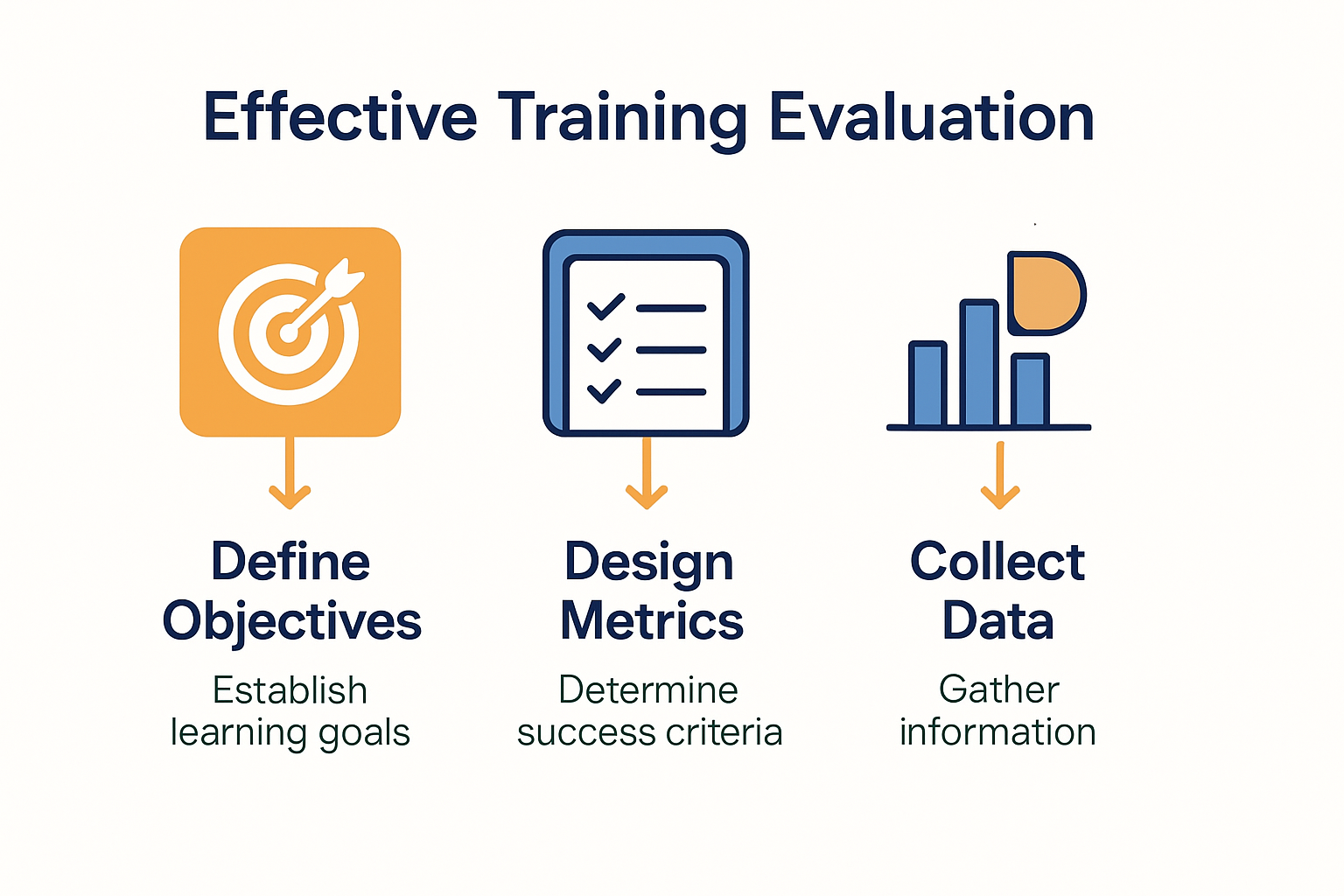
Establishing Evaluation Objectives
Before initiating any evaluation process, organizations must clearly define their specific assessment goals. Experts recommend establishing precise objectives that align with broader organizational strategies. This initial phase involves:
- Identifying specific performance gaps
- Determining desired learning outcomes
- Establishing clear measurement criteria
- Aligning evaluation goals with strategic business objectives
Critical considerations during this phase include understanding the unique context of the training program, the target audience, and the specific skills or knowledge being developed. This foundational step ensures that the entire evaluation process remains focused and meaningful.
Designing Comprehensive Evaluation Methodology
According to training effectiveness research, a multi-level approach provides the most comprehensive insights. The evaluation methodology should incorporate:
- Preparation Phase
- Develop specific evaluation instruments
- Create detailed assessment protocols
- Select appropriate data collection methods
- Establish baseline performance metrics
- Data Collection Strategies
- Implement multiple assessment techniques
- Utilize both quantitative and qualitative measurement tools
- Design surveys and feedback mechanisms
- Develop performance observation protocols
- Stakeholder Engagement
- Involve participants, managers, and organizational leaders
- Create channels for multi-level feedback
- Ensure transparent and inclusive evaluation processes
Implementing And Analyzing Evaluation Findings
The final stage of the evaluation process focuses on comprehensive analysis and actionable insights. Key steps include:
- Systematically collecting and organizing collected data
- Conducting rigorous statistical and qualitative analysis
- Identifying patterns, trends, and significant findings
- Developing detailed reports with clear recommendations
- Creating action plans for continuous improvement
Successful evaluation goes beyond merely collecting information. It requires a nuanced approach that:
- Interprets data within organizational context
- Connects training outcomes to broader performance objectives
- Provides actionable insights for future learning interventions
- Supports strategic decision-decision-making processes
Modern organizations increasingly leverage advanced technologies such as data analytics, machine learning, and integrated performance management systems to enhance evaluation precision. These technological tools enable more sophisticated, real-time tracking and analysis of training effectiveness.
Ultimately, an effective evaluation process is not a one-time event but a continuous, iterative approach to understanding and improving organizational learning. By systematically assessing training programs, organizations can create more targeted, impactful learning experiences that directly contribute to individual and collective performance excellence.
Frequently Asked Questions
What is training program evaluation?
Training program evaluation is the process of assessing the effectiveness of training initiatives to determine their impact on learner performance and organizational outcomes.
Why is it important to evaluate training programs?
Evaluating training programs helps organizations ensure their investments are yielding positive results, identify skill gaps, and enhance employee performance, ultimately maintaining a competitive advantage.
What are the key phases of training program evaluation?
The key phases include pre-training assessment, during-training monitoring, and post-training evaluation, each providing insights at different stages of the training process.
What models are commonly used for training evaluation?
Common models include the Kirkpatrick Model, which evaluates reactions, learning, behavior, and results, and the Phillips ROI Model, which focuses on financial return on training investments.
Unlock Your Training Potential Today!
Are your training programs truly delivering results? As highlighted in our recent article, effective training evaluation is crucial in today’s rapidly evolving business landscape. Many organizations struggle to align their training investments with real-world outcomes, leading to lost potential and uninspired teams. At Peuneo, we understand these challenges and offer robust solutions to ensure your training initiatives not only meet but exceed expectations.

With our accredited training and consulting services, you can confidently assess and enhance your programs. Our online learning portal offers a diverse range of courses tailored to your specific industry needs, ensuring compliance and skill development. Don’t let your training efforts go unmeasured—take the first step toward better outcomes today! Visit us at https://peuneo.co.za and enroll now to start transforming potential into performance!