


Managers are facing a new reality in 2025. Leaders who once relied on charisma or technical know-how are now being asked to master a much wider range of skills. Surprising, right? Emotional intelligence and data literacy are now just as important as traditional management techniques. Here is the twist. Nine out of ten global executives now recognize human skills such as collaboration and creativity as critical for leadership success. The skills that matter most are changing fast and the reasons why might catch you off guard.
Table of Contents
- Core Leadership Skills Every Manager Needs
- Key Communication And Collaboration Abilities
- Problem Solving And Decision Making Strategies
- How To Build And Improve These Essential Skills
Quick Summary
| Takeaway | Explanation |
|---|---|
| Embrace Adaptive Leadership | Modern managers must adopt adaptive leadership strategies, prioritizing continuous learning and flexibility to navigate organizational complexities effectively. |
| Develop Coaching and Emotional Intelligence | Successful leaders focus on enhancing their coaching skills and emotional intelligence, emphasizing self-awareness, empathy, and emotional regulation to foster team development. |
| Utilize Multidimensional Communication | Managers should cultivate proficiency in various communication forms, including verbal, digital, and cross-cultural, to effectively connect with diverse teams. |
| Adopt Data-Driven Decision Making | Implement analytical thinking and data literacy in decision-making processes to derive strategic insights and anticipate potential outcomes. |
| Engage in Continuous Skill Development | A proactive approach to skill enhancement through personalized learning plans, experiential training, and technology is essential for effective leadership in 2025. |
Core Leadership Skills Every Manager Needs
The leadership landscape is rapidly transforming, demanding managers develop a sophisticated set of skills that go beyond traditional management approaches. In 2025, successful leaders must cultivate a dynamic skill set that enables them to navigate complex organizational challenges while empowering their teams.
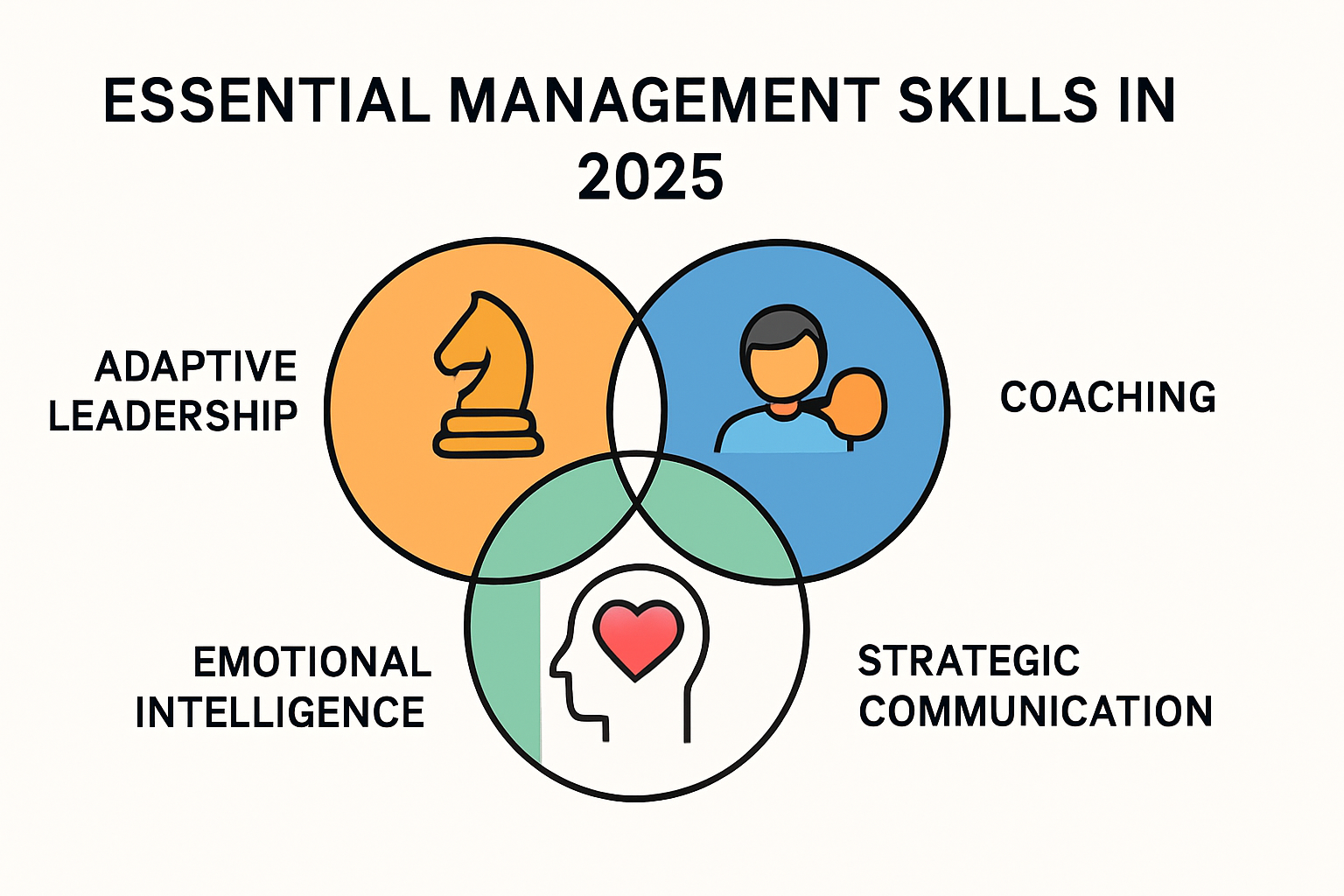
Adaptive Leadership and Continuous Learning
Adaptive leadership has become more than a buzzword – it is a critical survival strategy for managers. Our comprehensive guide on skills development highlights the necessity of continuous learning and flexibility. Modern managers must rapidly assess situations, pivot strategies, and maintain team performance during unprecedented change.
According to research from DDI World, organizations are recognizing that leadership development must evolve. This means creating robust support systems that allow managers to consistently assess their skills, receive meaningful feedback, and develop sustainable career paths. The most successful leaders will be those who view learning as an ongoing journey rather than a destination.
Coaching and Emotional Intelligence
Coaching has emerged as a fundamental leadership competency. Gone are the days of top-down management – today’s leaders must function as mentors and facilitators. Research from ICAgile indicates that powerful coaching skills involve three core elements: presence, transformative questioning, and active listening.
Emotional intelligence sits at the heart of effective coaching. Managers must develop the ability to read team dynamics, understand individual motivations, and create psychologically safe environments. This involves:
- Self-awareness: Recognizing personal emotional triggers and biases
- Empathy: Genuinely understanding team members’ perspectives
- Emotional regulation: Managing personal and collective emotional responses
Strategic Communication and Collaboration
Effective communication has always been crucial, but in 2025, it requires a more nuanced approach. Managers must communicate across diverse teams, potentially spanning multiple generations and working environments. This demands clarity, transparency, and the ability to articulate complex ideas simply.
Collaboration skills have also transformed. With increasing reliance on remote and hybrid work models, managers must create cohesive team experiences using digital tools while maintaining human connection. This requires technical proficiency, interpersonal skills, and an understanding of digital collaboration platforms.
The most successful managers in 2025 will be those who view leadership as a holistic practice of continuous growth, empathy, and strategic thinking. By developing these core skills, leaders can create resilient, innovative teams capable of thriving in an increasingly complex business landscape.
Key Communication and Collaboration Abilities
Communication and collaboration have become more complex and critical than ever before in the evolving workplace of 2025. Managers must now master sophisticated communication strategies that transcend traditional boundaries and leverage advanced technological platforms to connect and inspire teams.
Multidimensional Communication Skills
In an era of diverse and distributed workforces, communication is no longer a simple linear process. Our team building techniques guide emphasizes the importance of nuanced communication approaches. According to research from global workplace studies, 57% of employers consider communication the most desirable skill for potential recruits.

Managerial communication in 2025 requires proficiency across multiple dimensions:
- Verbal Communication: Clear, concise articulation of ideas
- Digital Communication: Effective use of collaboration tools and platforms
- Cross-Cultural Communication: Understanding and navigating diverse communication styles
Successful managers recognize that effective communication is not about transmitting information but creating meaningful understanding. This means developing active listening skills, practicing empathy, and adapting communication styles to individual team member preferences.
Digital Collaboration and Remote Team Management
The rise of remote and hybrid work models has transformed collaboration from a physical to a digital experience. Microsoft research reveals that 96% of business decision-makers believe effective communication is crucial for organizational success.
Digital collaboration requires managers to:
- Master digital communication platforms
- Create virtual team cohesion
- Establish clear digital communication protocols
- Ensure inclusive and transparent information sharing
Conflict Resolution and Emotional Intelligence
As teams become more diverse and complex, managers must develop advanced conflict resolution skills. This involves understanding the underlying emotional dynamics of workplace interactions and creating environments that promote constructive dialogue.
Key strategies include:
- Recognizing and managing emotional triggers
- Facilitating open and respectful discussions
- Developing mediation skills
- Creating psychologically safe spaces for difficult conversations
The most effective managers in 2025 will be those who view communication not as a technical skill but as a nuanced art of human connection. By integrating technological proficiency with deep emotional intelligence, leaders can create collaborative environments that drive innovation, trust, and exceptional team performance.
Problem Solving and Decision Making Strategies
In the complex and rapidly changing business environment of 2025, managers must evolve their problem-solving and decision-making approaches to remain competitive and effective. Traditional linear methods are no longer sufficient in an era of unprecedented complexity and uncertainty.
Data-Driven Decision Making
Modern managers must develop sophisticated analytical skills that transform raw data into strategic insights. Our skills development guide emphasizes the critical role of data literacy in contemporary leadership. According to research from IMD, effective problem-solving now requires translating complex information across multiple domains and creating early feedback loops.
Key components of data-driven decision making include:
- Analytical Thinking: Systematically breaking down complex problems
- Data Interpretation: Understanding statistical significance and context
- Predictive Analysis: Anticipating potential outcomes and risks
Successful managers recognize that data is not just about numbers but about understanding underlying patterns and human behaviors. This approach requires a blend of technological proficiency and intuitive understanding.
Adaptive Problem-Solving Frameworks
Traditional problem-solving models are giving way to more flexible, iterative approaches. Experts recommend spending 70% of problem-solving time understanding the problem and only 30% on generating solutions. This counterintuitive approach ensures more comprehensive and nuanced problem resolution.
Effective adaptive problem-solving strategies involve:
- Embracing uncertainty
- Developing multiple solution scenarios
- Creating rapid prototyping and testing mechanisms
- Maintaining flexibility in approach
Collaborative Decision Making
Decision making in 2025 is fundamentally collaborative. Managers must create environments that encourage diverse perspectives and collective intelligence. This means moving beyond hierarchical decision-making models to more inclusive, transparent processes.
Key collaborative decision-making techniques include:
- Cross-functional team engagement
- Transparent deliberation processes
- Consensus-building mechanisms
- Psychological safety in discussion environments
The most successful managers will be those who view problem-solving as a dynamic, collaborative process rather than a linear task. By integrating data-driven insights, adaptive frameworks, and collaborative approaches, leaders can develop more robust, innovative solutions that address complex organizational challenges.
Ultimately, problem-solving in 2025 is about cultivating a mindset of continuous learning, adaptability, and collective intelligence. Managers who master these skills will not just solve problems but transform challenges into opportunities for growth and innovation.
How to Build and Improve These Essential Skills
Building and improving essential leadership skills requires a strategic, multifaceted approach that goes beyond traditional training methods. Managers must adopt proactive, continuous learning strategies that integrate personal development, technological tools, and intentional practice.
Targeted Skill Development Frameworks
Our comprehensive guide to soft skills development emphasizes the importance of structured, personalized skill enhancement. According to global workforce research, nine out of ten global executives now recognize the critical importance of human skills like collaboration, creativity, and leadership.
Effective skill development strategies include:
- Self-Assessment: Regular evaluation of current skill levels
- Personalized Learning Plans: Targeted approaches addressing specific skill gaps
- Continuous Feedback: Ongoing performance and skill progression monitoring
The World Economic Forum highlights that by 2025, top skills will include analytical thinking, innovation, and complex problem-solving. This demands a proactive approach to personal and professional development.
Practical Learning and Experiential Training
Traditional classroom training is no longer sufficient. Managers must embrace immersive, experiential learning methods that provide real-world context and immediate application. This involves:
- Simulation-based training scenarios
- Cross-functional project assignments
- Mentorship and coaching programs
- Active participation in challenging workplace situations
McKinsey research indicates a significant rise in the need for social, emotional, and higher cognitive skills, emphasizing the importance of learning through direct experience and reflection.
Technology-Enabled Skill Enhancement
Technology plays a crucial role in modern skill development. Managers can leverage digital platforms to create personalized, adaptive learning experiences. Key technological approaches include:
- Micro-learning modules
- Artificial intelligence-driven skill assessment tools
- Virtual reality training simulations
- Online collaborative learning platforms
Successful skill development in 2025 requires a holistic approach that combines self-awareness, practical experience, technological tools, and a commitment to continuous learning. Managers who view skill development as an ongoing journey rather than a destination will be best positioned to lead effectively in an increasingly complex business environment.
Ultimately, building essential skills is about cultivating a growth mindset. It requires curiosity, vulnerability, and a willingness to step outside comfort zones. By embracing these principles, managers can transform their professional capabilities and drive meaningful organizational success.
Frequently Asked Questions
What are the essential skills managers need in 2025?
In 2025, essential skills for managers include adaptive leadership, emotional intelligence, strategic communication, data literacy, and effective problem-solving capabilities.
How can managers improve their emotional intelligence?
Managers can improve emotional intelligence by practicing self-awareness, developing empathy, and learning to regulate their emotional responses in various situations.
Why is data-driven decision making important for managers?
Data-driven decision making is crucial as it allows managers to make informed choices based on analytical insights, helping them identify trends and anticipate outcomes more effectively.
What strategies can managers use for effective digital collaboration?
Managers can enhance digital collaboration by mastering communication platforms, setting clear communication protocols, and cultivating team cohesion through regular virtual interactions.
Ready to Transform Your Leadership Team for 2025?
The article highlights real challenges every modern manager faces: navigating adaptive leadership, boosting emotional intelligence, mastering digital collaboration, and turning data into action. These pain points can block true progress. If you want to future-proof your leadership and empower your teams with the most critical skills for the next era, you do not have to struggle alone. Peuneo specializes in accredited, practical training designed around exactly these evolving management needs. From flexible online courses to personalized consulting, we deliver proven ways to unlock your team’s full potential and drive results.

Do not wait until skill gaps slow your growth. Discover how our tailored programs can help your managers lead with confidence and creativity. Visit Peuneo’s official platform and see which skills development opportunities are right for you. Your next step toward future-ready leadership starts today.