


Employee development is now a cornerstone of success in today’s fast-paced work environment. Research indicates that 44% of workers’ skills could be disrupted by 2028, underscoring the critical need for proactive employee growth strategies. But here’s the eye-opener: many organizations still approach development as a one-size-fits-all solution. The surprising twist is that personalized learning strategies can significantly enhance both employee satisfaction and organizational productivity, creating a thriving workforce ready for the challenges ahead.
Table of Contents
- Key Areas For Employee Growth
- Effective Employee Development Strategies
- Measuring Strategy Success
- Implementing Your Development Plan
Quick Summary
| Takeaway | Explanation |
|---|---|
| Focus on Continuous Skill Development | Organizations must enhance both technical and soft skills to ensure employees remain adaptable and valuable in a rapidly changing work environment. |
| Create Clear Career Progression Pathways | Implement mentorship programs, encourage internal mobility, and tailor development plans to enhance employee motivation and retention. |
| Embrace Personalized Learning Approaches | Adopt customized learning strategies that accommodate diverse preferences and career goals, fostering a culture of continuous learning. |
| Integrate Technology-Enabled Learning | Utilize digital platforms and AI to provide flexible, engaging, and personalized learning opportunities that cater to diverse employee needs. |
| Measure Strategy Success with Comprehensive Metrics | Develop a holistic framework for evaluating learning outcomes, combining quantitative and qualitative assessments to track employee development effectively. |
Key Areas for Employee Growth
Employee development is no longer a luxury but a critical strategy for organizational success. As the business landscape continues to evolve rapidly, identifying and nurturing key areas of employee growth becomes paramount for maintaining competitive advantage and workforce resilience.
Professional Skill Enhancement
In today’s dynamic work environment, continuous skill development is essential. Research indicates that 44% of workers’ skills could be disrupted by 2028, underscoring the urgent need for strategic employee development strategies. Organizations must focus on both technical and soft skills to ensure employees remain adaptable and valuable.
Technical skill development involves updating digital competencies, industry-specific knowledge, and emerging technological capabilities. This might include training in data analytics, artificial intelligence, cybersecurity, or specialized software relevant to your industry. Soft skill enhancement equally matters, encompassing communication, leadership, emotional intelligence, critical thinking, and problem-solving abilities.
Career Progression Pathways
Creating clear and meaningful career progression pathways is crucial for employee motivation and retention. Employees want to understand how they can grow within an organization, not just acquire new skills. Strategic development strategies should include:
- Mentorship Programs: Connecting junior employees with experienced professionals for guidance and knowledge transfer
- Internal Mobility: Encouraging lateral and vertical movement within the organization
- Performance-Based Development Plans: Tailoring individual growth trajectories based on specific strengths and organizational needs
Strategic training programs can increase employee productivity and engagement, potentially boosting organizational income by up to 218% when implemented effectively. This highlights the direct correlation between intentional employee development and business performance.
Personalized Learning Approaches
One size does not fit all in employee development. Modern organizations must embrace personalized learning strategies that accommodate diverse learning preferences and individual career goals. Research shows that 58% of employees prefer self-paced learning, indicating a significant shift towards customized development approaches.
Personalization can involve multiple strategies, such as:
- Offering micro-learning modules
- Providing digital learning platforms
- Supporting online and offline learning opportunities
- Creating individualized development plans
- Leveraging technology for adaptive learning experiences
By recognizing and investing in these key areas of employee growth, organizations can create a robust, dynamic workforce capable of navigating complex business challenges. The goal is not just skill acquisition, but fostering a culture of continuous learning, adaptability, and professional evolution.
Successful employee development is a collaborative journey between employers and employees—one that requires commitment, strategic planning, and a genuine investment in human potential.
Effective Employee Development Strategies
Developing robust employee development strategies requires a comprehensive, forward-thinking approach that aligns organizational goals with individual growth potential. Modern businesses must move beyond traditional training models to create dynamic, adaptive development frameworks that address rapidly changing workforce needs.
Strategic Learning and Skill Alignment
Deloitte’s 2025 Human Capital Trends research emphasizes the critical importance of integrating personalized, skills-based learning pathways that leverage advanced technologies and digital platforms. This approach ensures that employee development strategies are not just reactive, but proactively designed to anticipate future skill requirements.
Effective strategies involve:
- Conducting comprehensive skills gap analyses
- Developing targeted learning interventions
- Creating flexible, adaptable training frameworks
- Utilizing data-driven insights to inform development approaches
Organizations must think strategically about skill development, focusing on both current job requirements and potential future roles. This means creating learning ecosystems that support continuous professional growth and organizational adaptability.
Technology-Enabled Learning Platforms

Digital transformation has revolutionized employee development approaches. Research indicates that 58% of employees worldwide prefer to learn at their own pace, highlighting the importance of flexible, technology-enabled learning solutions.
Key technological strategies include:
- Implementing adaptive learning management systems
- Developing microlearning modules
- Creating personalized learning paths
- Integrating artificial intelligence for customized skill recommendations
- Utilizing virtual and augmented reality for immersive training experiences
These technology-driven approaches allow organizations to provide more engaging, accessible, and personalized development opportunities that cater to diverse learning preferences and organizational needs.
Holistic Development and Performance Integration
True employee development goes beyond traditional training programs. It requires a holistic approach that integrates learning with performance management, career progression, and organizational strategy. Companies with strategic development programs have reported up to a 218% increase in organizational income, demonstrating the profound impact of comprehensive development strategies.
Holistic development strategies should:
- Align individual growth with organizational objectives
- Provide continuous feedback and coaching
- Create mentorship and cross-functional learning opportunities
- Support both professional and personal skill development
- Recognize and reward continuous learning efforts
By embracing a comprehensive approach to employee development, organizations can create a culture of continuous learning, innovation, and adaptability. The most successful strategies view employee development not as a standalone initiative, but as an integral part of organizational growth and success.
Ultimately, effective employee development is about creating an environment where learning is valued, supported, and seamlessly integrated into daily work experiences. It requires commitment, investment, and a forward-thinking approach that sees employees as the most valuable asset in driving organizational innovation and success.
Measuring Strategy Success
Measuring the success of employee development strategies is crucial for understanding their true impact and ensuring continuous improvement. Organizations must move beyond simplistic evaluation methods to develop comprehensive, nuanced approaches that capture the multifaceted nature of employee growth and organizational learning.
Key Performance Indicators for Learning and Development
Analysis from industry experts reveals that effective measurement requires a holistic approach to tracking learning outcomes. Critical metrics include training completion rates, knowledge retention scores, skills improvement, and the rate at which learned skills are applied on the job.
Comprehensive performance indicators should encompass:
- Quantitative Metrics: Completion rates, assessment scores, time-to-competency
- Qualitative Assessments: Manager feedback, peer evaluations, self-reflection reports
- Performance Impact: Productivity improvements, quality of work, innovation contributions
The goal is to create a robust framework that provides a 360-degree view of employee development effectiveness, moving beyond surface-level measurements to understand deeper learning transformations.
Multi-Dimensional Evaluation Approaches
Research indicates that over one in two companies faces a skills gap, driving the need for sophisticated evaluation strategies. Organizations are increasingly adopting multi-dimensional approaches to measure development success, including:
- Performance reviews (46% of companies)
- Manager feedback (36%)
- Skills gap analysis (34%)
- 360-degree feedback mechanisms
- Direct correlation with business outcomes
This nuanced approach allows organizations to understand not just whether training occurred, but how effectively knowledge is translated into tangible workplace improvements. It recognizes that true learning goes beyond simple knowledge acquisition to meaningful skill application and behavioral change.
Strategic Alignment and Continuous Improvement
Measuring employee development strategy success requires a dynamic, forward-looking approach that aligns learning initiatives with broader organizational objectives. This means creating feedback loops that continuously refine and improve development programs based on real-world performance data.
Key strategic considerations include:
- Tracking long-term skill development trajectories
- Analyzing the return on investment for training programs
- Identifying emerging skill gaps and future learning needs
- Creating personalized development pathways
- Maintaining flexibility in measurement approaches
Successful organizations view measurement not as a one-time assessment, but as an ongoing process of understanding, adapting, and optimizing employee potential. The most effective strategies create a continuous learning ecosystem that evolves with changing business needs and individual employee growth.
Ultimately, measuring employee development strategy success is about creating a comprehensive understanding of how learning translates into organizational value. It requires a sophisticated approach that balances quantitative metrics with qualitative insights, recognizing that true development is a complex, multifaceted journey of individual and collective growth.
Implementing Your Development Plan
Implementing an employee development plan is a critical process that requires strategic planning, organizational commitment, and a nuanced understanding of individual and collective learning needs. The transition from conceptual strategy to practical execution demands a comprehensive, adaptable approach that addresses both organizational objectives and individual employee potential.
Designing a Flexible Implementation Framework
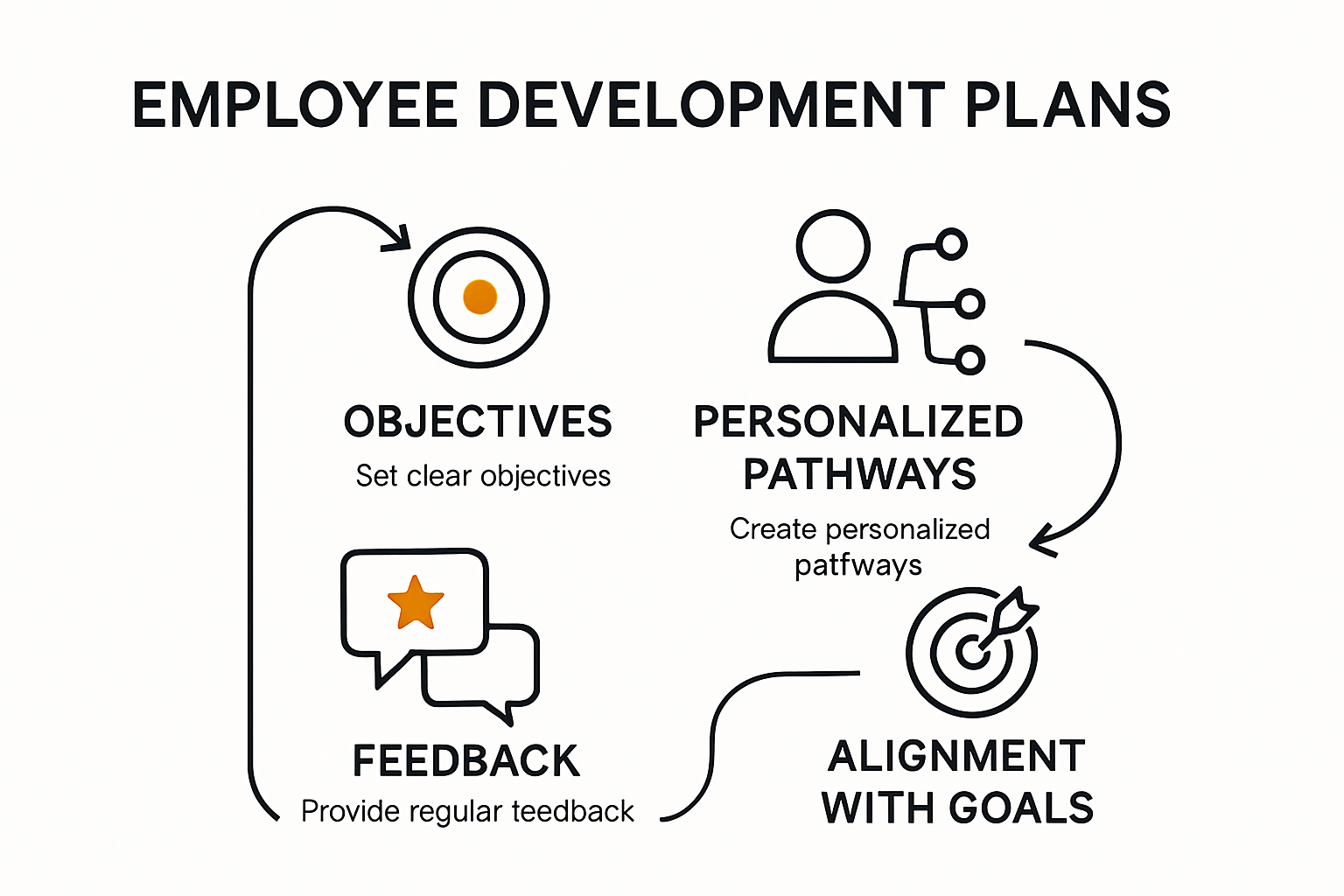
Research from Deloitte’s 2025 Human Capital Trends highlights the importance of navigating complex worker-organization relationships during development strategy implementation. This means creating implementation frameworks that are both structured and inherently flexible.
Key considerations for design include:
- Establishing clear, measurable development objectives
- Creating personalized learning pathways
- Developing adaptive implementation mechanisms
- Ensuring continuous feedback and adjustment capabilities
- Aligning individual growth with organizational strategic goals
Successful implementation requires moving beyond one-size-fits-all approaches, recognizing that each employee’s development journey is unique and requires tailored strategies.
Technology-Enabled Learning Integration
Emerging data indicates that 44% of workers’ skills could be disrupted by 2028, underscoring the critical need for technology-enhanced implementation strategies. Modern development plans must leverage digital platforms that support diverse learning preferences and provide accessible, engaging learning experiences.
Effective technology integration involves:
- Implementing robust learning management systems
- Utilizing artificial intelligence for personalized learning recommendations
- Creating mobile and cloud-based learning platforms
- Developing interactive, multimedia training content
- Enabling real-time skill tracking and progress monitoring
Technology serves as an enabler, transforming traditional learning approaches into dynamic, responsive development ecosystems that can quickly adapt to changing skill requirements.
Cultivating a Supportive Learning Culture
Research shows that 58% of employees prefer self-directed learning, highlighting the importance of creating an organizational culture that genuinely supports continuous professional development.
Culture-building strategies include:
- Leadership demonstrating commitment to continuous learning
- Recognizing and rewarding learning achievements
- Creating psychological safety for skill exploration
- Providing dedicated time and resources for learning
- Establishing mentorship and peer learning networks
Implementation success depends not just on structured programs, but on fostering an environment where learning is valued, encouraged, and seen as a critical component of professional growth.
Effective implementation of development plans is an ongoing, dynamic process. It requires continuous communication, flexibility, and a genuine commitment to employee potential. Organizations must view development not as a destination, but as a continuous journey of growth, adaptation, and mutual value creation.
Ultimately, successful implementation transforms development plans from theoretical documents into living, breathing strategies that drive individual excellence and organizational innovation. It demands patience, strategic thinking, and an unwavering belief in the transformative power of continuous learning.
Frequently Asked Questions
What are effective employee development strategies for 2025?
Effective employee development strategies for 2025 include focusing on continuous skill development, creating clear career progression pathways, embracing personalized learning approaches, leveraging technology-enabled learning platforms, and measuring success with comprehensive metrics.
How can organizations personalize employee development plans?
Organizations can personalize employee development plans by offering micro-learning modules, supporting self-paced learning options, creating individualized development paths, and utilizing technology for adaptive learning experiences that cater to diverse preferences and goals.
Why is measuring employee development success important?
Measuring employee development success is essential to evaluate the impact of training programs, understand skill application on the job, and identify areas for continuous improvement, ensuring that organizations maximize their investment in employee growth.
What role does technology play in employee development?
Technology plays a crucial role in employee development by providing flexible learning management systems, enabling personalized learning experiences through AI, and offering interactive training content that enhances engagement and supports diverse learning preferences.
Transform Your Workforce for 2025 and Beyond!
Investing in employee development is essential to navigate the complexities of today’s business landscape. As highlighted in our recent article on Employee Development Strategies for 2025 Growth, organizations face significant challenges in keeping up with rapid skill disruptions and aligning their workforce’s growth with changing market demands. Personalizing development paths not only enhances employee satisfaction but also drives organizational productivity and innovation. How are you preparing for this future?

At Peuneo, we offer tailored solutions designed specifically for organizations looking to stay ahead in their sectors. Our accredited training programs cater to both governmental and corporate needs, ensuring compliance with industry standards while focusing on the crucial areas of skill enhancement and career progression pathways. Our online learning portal features multiple courses that allow your employees to learn at their own pace—strengthening their skills to meet future challenges head-on. Don’t let your organization fall behind; unlock your team’s potential today with Peuneo’s expert guidance!
Visit https://peuneo.co.za now and take the first step towards a more skilled, engaged, and resilient workforce!