


Everyone talks about coaching and mentoring at work as if they’re the same thing. Here’s where it gets interesting. Mentored employees are twice as likely to be engaged and nine out of ten say they’re happier in their roles. Yet coaching and mentoring actually serve totally different purposes and functions. The real edge comes from knowing which to use, how to use them together and why so many top companies are investing big in these strategies for the future.
Table of Contents
- Key Differences Between Coaching And Mentoring Employees
- Benefits Of Coaching And Mentoring In Modern Workplaces
- Practical Steps To Launch Effective Coaching And Mentoring Programs
- Measuring The Impact On Organizational Performance
Quick Summary
| Takeaway | Explanation |
|---|---|
| Understand the Differences Between Coaching and Mentoring | Recognizing that coaching is a structured, short-term process focused on specific skills, while mentoring is a long-term relationship aimed at broader career and personal development can help tailor developmental strategies. |
| Prioritize Employee Engagement through Mentoring | Implementing mentoring programs can significantly enhance employee satisfaction and retention, with studies indicating that mentored employees are more engaged and committed to their organizations. |
| Establish Clear Objectives for Programs | Effective coaching and mentoring initiatives need defined goals that align with business strategies, such as leadership development and employee retention, to maximize their impact. |
| Leverage Data in Participant Matching | Utilizing technology and data-driven methods to match mentors and mentees based on skills and aspirations can enhance the effectiveness of coaching and mentoring relationships. |
| Adopt a Holistic Evaluation Approach | Organizations should measure the impact of these programs with both quantitative performance indicators and qualitative feedback to ensure continuous improvement and responsiveness to workforce needs. |
Key Differences Between Coaching and Mentoring Employees
Successful organizations recognize that employee development is not a one-size-fits-all approach. Understanding the nuanced differences between coaching and mentoring is crucial for creating effective talent development strategies in 2025 and beyond.
Structural and Relational Dynamics
Coaching and mentoring might seem similar at first glance, but they represent distinctly different approaches to employee growth. Explore our guide on professional development to understand these methodologies more deeply.
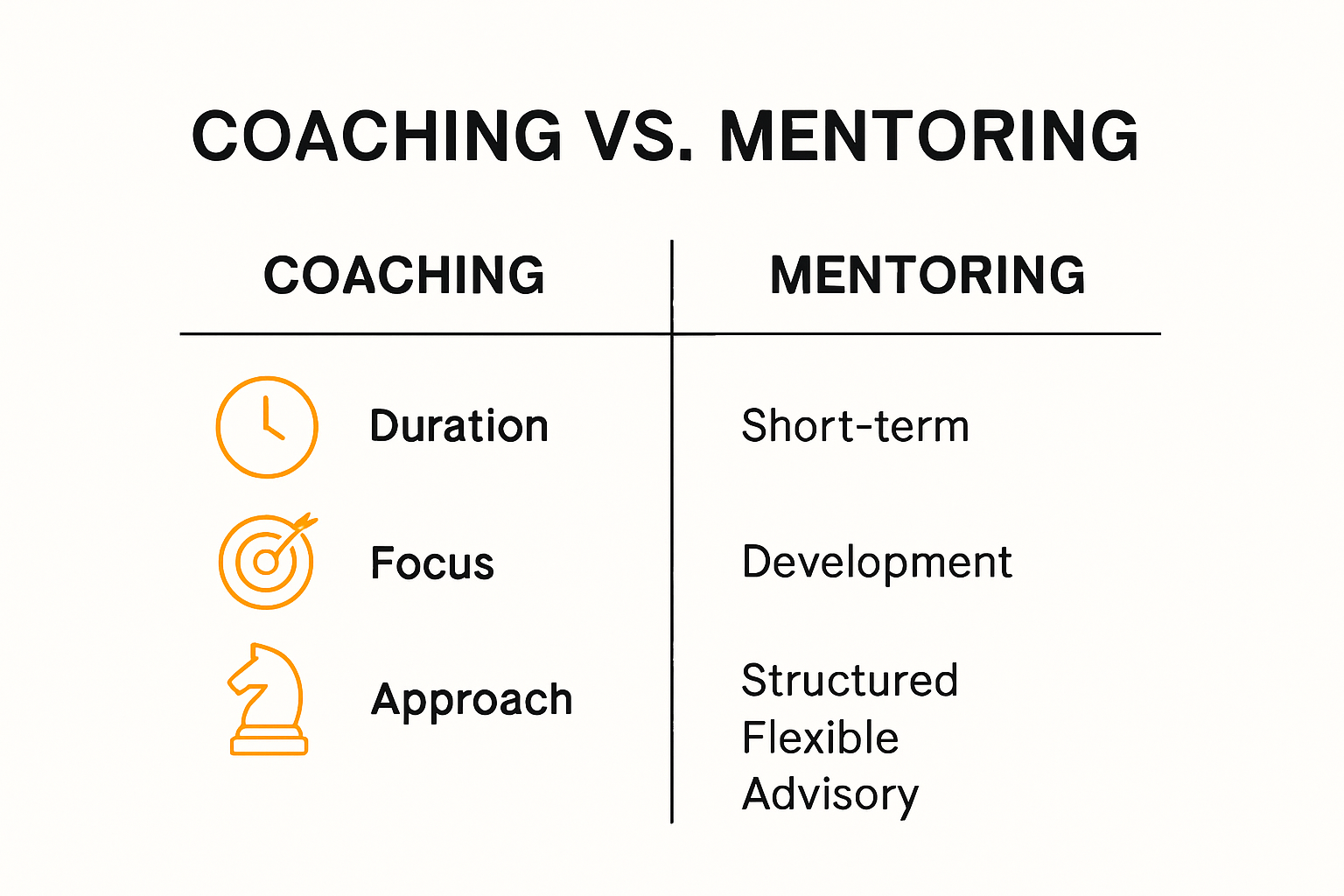
According to research from Chronus, coaching is typically a short-term, structured process with clear objectives. The coach acts as a professional guide focused on improving specific skills or achieving well-defined performance goals. In contrast, mentoring represents a more holistic, long-term relationship where guidance extends beyond immediate skill acquisition to broader career and personal development.
Goal Orientation and Accountability
The accountability framework differs significantly between these two approaches. In a coaching relationship, the coach takes primary responsibility for guiding the employee toward specific outcomes. Coaches often use targeted interventions, structured assessments, and performance metrics to track progress.
Mentoring, by comparison, places greater emphasis on the mentee’s self-directed growth. The mentor provides wisdom, shares experiences, and offers support, but the ultimate accountability for personal and professional development rests with the mentee. Goodlife research highlights that mentoring relationships are more about long-term relationship building and holistic career progression.
Formality and Interaction Style
Another critical distinction lies in the interaction style and formality. Coaching relationships are typically more formal, with predefined structures, scheduled sessions, and clear performance benchmarks. These interactions are often time-limited and focused on specific skill enhancement or performance improvement.
Mentoring interactions tend to be more organic and flexible. They involve deeper personal connections, with mentors drawing from their own professional experiences to provide nuanced guidance. The relationship is less about rigid structures and more about creating a supportive environment for continuous learning and professional growth.
While both coaching and mentoring are valuable employee development strategies, understanding their unique characteristics allows organizations to design more targeted and effective talent development programs. The key is recognizing when to apply each approach based on individual employee needs, organizational goals, and specific developmental objectives.
Benefits of Coaching and Mentoring in Modern Workplaces
In the rapidly evolving professional landscape of 2025, organizations must prioritize employee development strategies that go beyond traditional training approaches. Coaching and mentoring have emerged as powerful tools for organizational growth, employee satisfaction, and sustainable workforce development.

Enhanced Employee Engagement and Retention
Employee engagement remains a critical challenge for modern businesses. Learn more about strategic employee development to understand its comprehensive impact. According to research from Chronus, nine out of ten workers with a mentor report being happier in their current role. Moreover, employees with mentors are twice as likely to be engaged at work compared to those without mentoring relationships.
This engagement directly translates to improved retention rates. When employees feel supported, valued, and see clear pathways for personal and professional growth, they are more likely to commit long-term to an organization. Mentoring and coaching create a sense of investment in employee potential, reducing turnover and building a more stable workforce.
Performance and Productivity Optimization
The impact of coaching and mentoring extends far beyond employee satisfaction. Productivity research reveals remarkable performance improvements. For instance, sales employees with mentors generated 19% more daily revenue than those without mentors. This statistic underscores the tangible business value of structured developmental relationships.
Coaching provides targeted skill enhancement, allowing employees to address specific performance gaps quickly. Mentoring offers broader professional guidance, helping individuals navigate complex career challenges and develop a more holistic approach to their professional growth. Together, these approaches create a comprehensive development ecosystem that drives individual and organizational performance.
Organizational Culture and Knowledge Transfer
In an era of rapid technological and market changes, preserving institutional knowledge becomes crucial. Coaching and mentoring serve as powerful mechanisms for knowledge transfer between experienced professionals and emerging talent. Senior employees can share nuanced insights, strategic thinking, and contextual understanding that formal training programs often cannot capture.
Moreover, these developmental approaches contribute to building a learning-oriented organizational culture. When mentoring and coaching are integrated into standard practice, they signal an organizational commitment to continuous improvement. Employees feel empowered to seek growth, ask questions, and approach challenges with a collaborative mindset.
The symbiotic relationship between individual development and organizational success becomes evident. By investing in coaching and mentoring, companies create resilient, adaptable workforces capable of navigating complex professional landscapes. These strategies are not just employee benefits but strategic investments in long-term organizational capabilities.
Practical Steps to Launch Effective Coaching and Mentoring Programs
Launching successful coaching and mentoring programs requires strategic planning and deliberate implementation. With insights into comprehensive employee development, organizations can create transformative talent development initiatives that drive meaningful professional growth.
Strategic Program Design and Objective Setting
Effective programs begin with clear, measurable objectives. According to research from Qooper, organizations must define specific goals that align with broader business strategies. Consider objectives such as leadership pipeline development, skill transfer, employee retention, or cross-departmental knowledge sharing.
Statistics reveal the potential impact of such programs. MentorCliq research highlights that 98% of Fortune 500 companies have implemented mentoring programs, with companies experiencing median profits over twice as high as those without such initiatives. This underscores the importance of thoughtful program design.
Participant Selection and Matching Strategies
The success of coaching and mentoring programs hinges on effective participant selection and matching. Organizations should develop comprehensive screening processes that consider not just professional credentials, but also interpersonal skills, communication abilities, and genuine commitment to professional development.
Modern matching approaches go beyond traditional hierarchical models. Research from Together Platform suggests leveraging technology and AI to create more sophisticated, data-driven matching processes. This approach allows for more nuanced connections based on skills, career aspirations, and potential complementary professional attributes.
Program Infrastructure and Continuous Improvement
Establishing robust program infrastructure is crucial for long-term success. This involves creating clear guidelines, providing necessary training for mentors and mentees, establishing communication protocols, and implementing systematic feedback mechanisms.
Organizations should view these programs as dynamic systems requiring continuous evaluation and adaptation. Regular assessment of program effectiveness, participant satisfaction, and measurable outcomes allows for ongoing refinement. Consider implementing quarterly reviews, collecting qualitative and quantitative feedback, and remaining adaptable to emerging workforce development trends.
Successful coaching and mentoring programs are not one-size-fits-all solutions. They require thoughtful design, continuous investment, and a genuine commitment to creating meaningful professional development opportunities. By approaching these initiatives strategically, organizations can unlock significant potential in their workforce, driving individual growth and collective organizational success.
Measuring the Impact on Organizational Performance
Measuring the effectiveness of coaching and mentoring programs goes beyond traditional performance metrics. Organizations must develop comprehensive evaluation frameworks that capture both tangible and intangible benefits. Explore our comprehensive guide to performance measurement to understand the nuanced approach required in 2025.
Quantitative Performance Indicators
Financial and operational metrics provide concrete evidence of program effectiveness. Research from Chronus reveals that organizations implementing mentoring programs have seen an impressive 600% return on investment (ROI). This substantial financial impact demonstrates the tangible value of structured developmental relationships.
Key quantitative metrics to track include employee productivity rates, revenue per employee, skill acquisition speed, and performance improvement trajectories. Organizations should establish baseline measurements before program implementation and conduct regular comparative assessments. These metrics help validate the direct correlation between coaching and mentoring initiatives and overall organizational performance.
Retention and Employee Engagement Metrics
Mentoring statistics from Mentorloop highlight a compelling retention narrative. Employees participating in mentoring programs showed significantly higher retention rates, with mentees and mentors experiencing 72% and 69% retention respectively, compared to just 49% for non-participants.
Engagement metrics provide additional insights into program effectiveness. These include measuring changes in employee satisfaction scores, internal promotion rates, cross-departmental collaboration frequency, and professional development progression. By tracking these indicators, organizations can understand how coaching and mentoring programs contribute to creating a more dynamic, motivated workforce.
Qualitative Impact Assessment
Beyond numerical data, qualitative assessments offer critical insights into program effectiveness. This involves collecting detailed feedback through structured interviews, comprehensive surveys, and narrative assessments from participants. Organizations should focus on understanding the deeper cultural and professional transformation triggered by these developmental initiatives.
Qualitative measurements might explore aspects like leadership skill development, strategic thinking enhancement, interpersonal communication improvements, and individual career trajectory changes. These nuanced insights help organizations refine their coaching and mentoring approaches, ensuring they remain adaptive and responsive to emerging workforce development needs.
Successful performance measurement requires a holistic approach that balances quantitative precision with qualitative depth. By developing sophisticated evaluation frameworks, organizations can transform coaching and mentoring from optional developmental activities into strategic performance optimization tools. The goal is not just measuring impact, but continuously evolving these programs to drive sustainable organizational excellence.
Frequently Asked Questions
What is the difference between coaching and mentoring?
Coaching is a structured, short-term process aimed at improving specific skills or achieving well-defined performance goals, while mentoring is a long-term relationship focused on broader personal and professional development.
How can coaching and mentoring improve employee engagement?
Studies show that mentored employees are twice as likely to be engaged at work and report higher job satisfaction, leading to improved retention rates and overall organizational commitment.
What are some best practices for launching coaching and mentoring programs?
Effective programs should begin with clear objectives, implement strategic participant matching, and establish a system for continuous feedback and improvement to ensure they meet organizational goals.
How do you measure the success of coaching and mentoring programs?
Success can be measured through quantitative metrics like productivity rates and retention figures, as well as qualitative assessments such as participant feedback and career progression narratives.
Unlock Real Growth With Peuneo’s Custom Coaching & Mentoring Solutions
Are you ready to move beyond generic development programs and address the real challenges your teams face? If your employees struggle to stay engaged or you’re seeking measurable improvements in performance and retention, the strategies in this article highlight the critical difference between coaching and mentoring. The next step is putting these best practices into action with an expert partner who knows the South African landscape.

Peuneo is dedicated to helping organizations build impactful coaching and mentoring initiatives that drive both engagement and long-term growth. When you choose Peuneo’s tailored training, accredited coaching, and consulting, you gain access to hands-on expertise, accredited programs, and powerful online tools designed for future-ready workplaces. Create an environment where every employee can thrive—explore your options on our online learning portal and make 2025 your most successful year yet.
Don’t wait—start building your culture of growth and knowledge transfer today with Peuneo.