


Training is often viewed simply as an employee perk. Yet aligning training with business objectives can actually revolutionize how organizations operate. Companies that tightly align their training programs with business goals report nearly 9 times greater effectiveness, skyrocketing from just 6% to 53%. But here’s the twist. It’s not just about filling skill gaps. It’s about driving organizational transformation and cultivating a culture of continuous improvement. Get ready to explore how aligning training effectively can become your competitive edge.
Table of Contents
- Why Linking Training To Business Matters
- Steps To Align Training Effectively
- Measuring Your Trainings Business Impact
- Common Challenges And Solutions
- Future-proof Training Alignment Strategies
Quick Summary
| Takeaway | Explanation |
|---|---|
| Align Training with Business Objectives | Training programs should be directly linked to organizational objectives for maximum effectiveness, enhancing growth and competitive edge. |
| Set Measurable Learning Objectives | Use SMART criteria to establish clear and quantifiable training goals that are tied to business performance metrics. |
| Implement Continuous Evaluation | Training alignment is an ongoing process; regularly assess and adapt training initiatives to meet evolving business needs and skill requirements. |
| Employ Data-Driven Metrics | Utilize specific performance indicators such as productivity, retention, and customer satisfaction to measure the real impact of training programs. |
| Foster a Continuous Learning Culture | Encourage ongoing skill development and adaptive learning practices to ensure workforce readiness in a rapidly changing business environment. |
Why linking training to business matters
Most organizations invest significant resources in training programs, yet many fail to connect these initiatives directly to their core business objectives. Aligning training with business goals isn’t just a strategic nicety—it’s a critical determinant of organizational success and performance.
The Strategic Imperative of Training Alignment
Businesses that strategically link their training programs to organizational objectives experience dramatically different outcomes compared to those with disconnected learning initiatives. Research shows that L&D programs are nearly 9 times more effective when tightly aligned with business objectives, jumping from a mere 6% effectiveness to an impressive 53%.
This alignment transforms training from a routine compliance exercise to a powerful strategic tool. When training directly addresses specific business challenges, it becomes a catalyst for organizational growth, innovation, and competitive advantage. Companies aren’t just teaching skills—they’re developing targeted capabilities that drive tangible business results.
Measuring the Real Value of Training Investments
Traditionally, training was viewed as a cost center—an expense to be minimized. Today’s forward-thinking organizations recognize training as a strategic investment with measurable returns. Research indicates that setting clear, measurable training objectives tied directly to business outcomes ensures that learning initiatives deliver concrete value.
The financial implications are significant. Organizations that strategically align their training programs can expect substantial benefits:
- Operational Efficiency: Targeted training reduces errors and improves workflow processes
- Performance Enhancement: Employees develop precisely the skills needed to drive business objectives
- Competitive Advantage: Continuous, goal-aligned learning keeps organizations agile and responsive
Beyond Compliance: Creating Organizational Capability
Experts suggest that strategically aligned training can deliver 3-4 times higher ROI compared to unfocused learning initiatives. This isn’t just about individual skill development—it’s about building organizational capability.
Successful alignment requires a holistic approach. It demands close collaboration between HR, learning and development teams, and senior leadership. The goal is to create a learning ecosystem that doesn’t just teach skills, but actively supports and accelerates business strategy.
By treating training as a strategic lever rather than a standalone activity, organizations can transform learning from a periodic event into a continuous journey of capability building and performance improvement. The message is clear: in today’s competitive landscape, training isn’t something you do to employees—it’s something you do for and with them to drive collective organizational success.
Steps to align training effectively
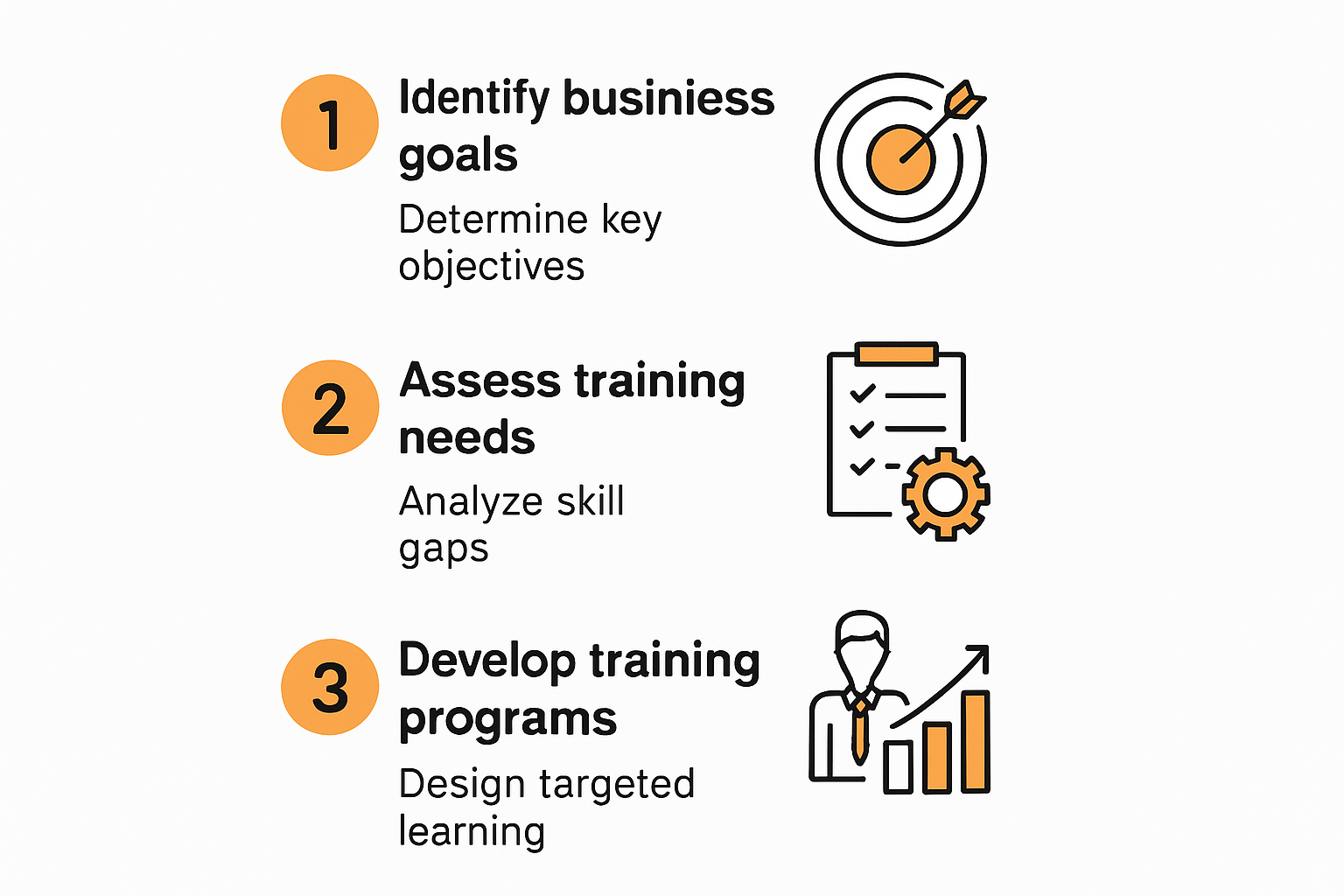
Transforming training from a generic exercise to a strategic organizational tool requires a systematic and intentional approach. Successful alignment isn’t about implementing random training programs, but creating a deliberate pathway that connects learning directly to business objectives.
Establishing Clear Strategic Alignment
LinkedIn Learning research indicates that aligning learning programs with business goals is the top priority for Learning and Development (L&D) professionals heading into 2025. This means training can no longer exist in isolation but must be deeply integrated with organizational strategy.
The first critical step involves comprehensive communication between business leaders and training professionals. This dialogue helps identify specific skill gaps, performance challenges, and strategic objectives that training can directly address. By understanding the precise business context, learning programs can be meticulously designed to deliver targeted outcomes.
Developing Measurable Learning Objectives
Experts recommend creating SMART (Specific, Measurable, Achievable, Relevant, Time-bound) goals as a foundational approach to effective training alignment. These objectives serve as clear benchmarks for measuring training effectiveness and ensuring direct connection to business performance.
Key components of developing robust learning objectives include:
- Performance Metrics: Identifying specific performance indicators that training will impact
- Skill Mapping: Precisely defining the skills required to achieve business objectives
- Outcome Tracking: Establishing clear mechanisms to measure training’s direct influence on organizational performance
Implementing Continuous Evaluation And Adaptation
Research from corporate training specialists emphasizes that alignment is not a one-time event but an ongoing process. Organizations must develop robust feedback mechanisms and regular assessment protocols to ensure training remains synchronized with evolving business needs.
This continuous evaluation involves multiple strategies:
- Regular performance reviews connecting training outcomes to business results
- Periodic skill gap analyses to identify emerging organizational needs
- Flexible learning platforms that can quickly adapt to changing business requirements
Successful training alignment transforms learning from a peripheral activity into a core strategic driver. By treating training as a dynamic, responsive tool closely integrated with business objectives, organizations can create a powerful mechanism for continuous improvement, employee development, and competitive advantage.
The future of corporate learning lies not in standardized programs, but in tailored, strategic approaches that view training as an integral component of organizational growth and success.
Measuring your training’s business impact

Measuring the true business impact of training programs goes far beyond simple participant satisfaction scores. It requires a comprehensive, strategic approach that connects learning initiatives directly to tangible organizational outcomes and performance metrics.
Calculating Training Return on Investment
Experts in human resources analytics recommend using a precise formula to calculate Training Return on Investment (ROI):
ROI = (Return of Benefit – Investment Cost) / Investment Cost × 100
This mathematical approach transforms training from a perceived expense into a measurable business investment. By quantifying the financial returns generated by training programs, organizations can demonstrate their strategic value. For instance, a training program costing $50,000 that generates $150,000 in productivity improvements would represent a 200% ROI.
Tracking Tangible Performance Metrics
Research from corporate training specialists highlights several key performance indicators that directly connect training to business outcomes:
- Productivity Increases: Measuring output and efficiency before and after training
- Employee Retention: Tracking changes in turnover rates post-training
- Customer Satisfaction: Evaluating improvements in service quality and customer interactions
- Error Reduction: Quantifying decreases in workplace mistakes and operational inefficiencies
These metrics provide concrete evidence of training’s impact, moving beyond subjective assessments to demonstrate real organizational value. By establishing baseline measurements before training and comparing them with post-training results, companies can create a clear narrative of their learning investments’ effectiveness.
Advanced Evaluation Strategies
Performance measurement experts recommend implementing comprehensive evaluation strategies that go beyond traditional metrics. This includes utilizing tools like Net Promoter Score (NPS) to gauge learner satisfaction and potential program impact.
Advanced measurement approaches might include:
- Longitudinal tracking of individual and team performance
- Comparative analysis between trained and untrained employee groups
- Detailed competency assessments before and after training interventions
Successful impact measurement requires a holistic view that considers both immediate training outcomes and long-term organizational performance. It’s not just about proving training works—it’s about continuously improving learning strategies to drive meaningful business results.
By adopting a data-driven approach to training evaluation, organizations can transform learning and development from a cost center into a strategic asset that directly contributes to competitive advantage and organizational growth.
Common challenges and solutions
Despite the clear benefits of aligning training with business goals, organizations frequently encounter significant obstacles that can derail their strategic learning initiatives. Understanding these challenges and implementing targeted solutions is crucial for creating effective, impactful training programs.
Strategic Misalignment and Communication Barriers
Research indicates that only 18% of HR departments successfully coordinate business strategy development, C-suite collaboration, and talent strategy alignment. This systemic disconnect represents a fundamental challenge in creating meaningful training programs.
Key communication barriers include:
- Lack of cross-departmental dialogue
- Unclear organizational objectives
- Insufficient understanding of business strategy among learning professionals
To address these challenges, organizations must establish robust communication channels. This involves creating dedicated forums for strategic discussions, implementing regular cross-functional meetings, and developing clear translation mechanisms that convert business objectives into precise learning outcomes.
Resource Allocation and Technological Integration
Experts from corporate learning platforms emphasize that effective training alignment requires strategic resource allocation and sophisticated technological integration. Many organizations struggle with outdated learning management systems that cannot adapt quickly to changing business needs.
Solutions for effective resource management include:
- Flexible Learning Platforms: Implementing agile learning technologies
- Data-Driven Decision Making: Using analytics to guide training investments
- Modular Training Design: Creating adaptable learning modules
Emerging Skills and Future-Proofing Training
Training industry projections highlight a critical challenge: preparing employees for rapidly evolving technological landscapes, particularly around artificial intelligence. Companies must proactively develop training strategies that anticipate future skill requirements.
Strategic approaches to future-proofing training include:
- Continuous skills assessment
- Developing AI-friendly learning cultures
- Creating adaptive upskilling programs
- Encouraging continuous learning and experimentation
Successful organizations view these challenges not as insurmountable obstacles, but as opportunities for strategic transformation. By adopting a proactive, flexible approach to training alignment, companies can turn potential barriers into competitive advantages.
The most effective training strategies recognize that alignment is an ongoing process of communication, adaptation, and strategic thinking. Organizations that embrace this dynamic approach will be best positioned to develop workforce capabilities that directly drive business success.
Future-proof training alignment strategies
In an era of rapid technological transformation and shifting workforce dynamics, organizations must develop forward-thinking strategies that ensure training remains adaptive, relevant, and strategically aligned with evolving business needs.
Embracing Technological Integration and Skills Intelligence
Research from training industry experts highlights the critical importance of leveraging artificial intelligence, sustainability considerations, and multigenerational workforce strategies as central pillars of future-proof learning approaches.
Key technological integration strategies include:
- Implementing AI-driven learning platforms
- Developing adaptive skills assessment tools
- Creating personalized learning pathways
- Integrating real-time skill tracking mechanisms
These technologies enable organizations to create dynamic learning environments that can rapidly respond to emerging skill requirements and technological shifts.
Strategic Workforce Planning and Internal Mobility
Harvard Business Review research emphasizes the significance of enterprise-wide skills intelligence in matching employee capabilities with organizational needs. By developing a data-driven approach to internal mobility, companies can strategically align talent development with long-term business objectives.
Effective strategies for workforce planning include:
- Comprehensive Skills Mapping: Creating detailed skills inventories
- Predictive Capability Modeling: Anticipating future skill requirements
- Agile Talent Development: Designing flexible upskilling programs
- Cross-Functional Learning Opportunities: Encouraging interdepartmental skill exchange
Continuous Learning and Adaptive Culture
Training industry analysis suggests that remaining competitive requires embedding continuous learning as a core organizational strategy. This involves transforming training from an episodic activity into an ongoing, integrated process of skill development and organizational adaptation.
Critical components of a continuous learning culture include:
- Encouraging experimentation and learning from failure
- Providing accessible, on-demand learning resources
- Creating psychological safety for skill development
- Recognizing and rewarding learning achievements
Future-proof training alignment transcends traditional training models. It represents a holistic approach that views learning as a strategic capability—a dynamic, evolving system that enables organizations to anticipate, adapt, and thrive in an increasingly complex business landscape.
Successful organizations will recognize that their most valuable asset is not just their current workforce, but their collective capacity to learn, unlearn, and continuously reinvent themselves in response to emerging challenges and opportunities.
Frequently Asked Questions
What is the importance of aligning training with business goals?
Aligning training with business goals enhances organizational effectiveness and creates a competitive edge. It transforms training into a strategic tool, directly addressing business challenges and driving measurable results.
How can organizations measure the ROI of their training programs?
Organizations can calculate ROI by using the formula: ROI = (Return of Benefit – Investment Cost) / Investment Cost × 100. This allows businesses to quantify the financial returns generated by their training initiatives.
What are the key steps to effectively align training with business objectives?
Key steps include establishing clear strategic alignment, developing measurable learning objectives using SMART criteria, and implementing continuous evaluation and adaptation to ensure training meets evolving business needs.
What challenges do organizations face when aligning training with business goals?
Common challenges include strategic misalignment, communication barriers, and resource allocation issues. Additionally, organizations must future-proof their training by adapting to emerging skills and technological demands.
Transform Your Training into a Strategic Advantage
Are you ready to elevate your organization’s training initiatives and fully align them with business goals? As highlighted in our insightful guide, aligning training with business strategy isn’t just a best practice; it’s a game changer. Improve your effectiveness by tapping into accredited training that resonates with your specific needs—an area where Peuneo (Pty) Ltd excels.

Don’t just train—transform! Leverage Peuneo’s tailored training and consulting solutions, designed to enhance your team’s performance while ensuring compliance with industry standards. With our comprehensive online learning portal, you can start today with programs that not only meet governmental and corporate needs but also drive measurable impact. Visit Peuneo now to discover how our expertise can help you turn your training into an essential component of your organizational success. Act fast—your future-ready workforce starts here!